Saturday, November 25, 2006

Post-Talk Reflection: Blogging for Senior Citizens

Prior to the talk this afternoon, I wrote here, about what Chun See asked regarding the expected audience turnout:
There's no benchmark for what is a "good" or "poor" audience turnout, other than average attendances. So I'd consider a good crowd to be 25 people and up.

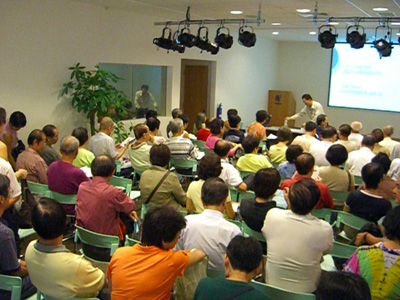
I'm happy to report that about 100 people turned up this afternoon! About 15 minutes before the talk was about to start, about 60% of the 80 seats were filled. Five minutes before we began, all but two seats were unoccupied.
Blogging for Seniors Talk (2) Blogging for Seniors Talk (1)
After that, more people came and were bunched up at the back (more than what I captured in the photo), with some standing outside the glass partition. I was sure the good turnout was due to the event being listed in the Events for Seniors Citizen Week in one of the newspapers.

Chun See, at 54 years old, kept saying he felt very young during the talk, because there seems to be participants in their 60s in the audience. I think the average age of the participant was 55 or thereabouts (darn, I forgot to ask them before they dispersed).

He shared why he named his blog "Good Morning Yesterday" (it was from a song, and one lady even sportingly tried to sing it when requested by Chun See), his motivation for blogging (mental exercise, share a bit of Singapore's history, and connection with the young), and excerpts of comments from younger readers of his blog (Chun See said the best compliment he received was "Uncle, you ROCK!")

I came in for the last part with a "live" demo on signing-up and creating a blog with Blogger.com. I told the audience I had to assume they knew what a "URL" was, and the basics of accessing the Internet. Then proceeded to show how to publish a post, edit a previously published post, how to access the blog, and a brief mention on copyright and personal privacy issues. All within 15 minutes.

I emphasised a few times the session was not about the "How To" in creating or maintaining a blog. I was mindful not to give too much information but some were clearly hungry for more. We referred them to RSVP.org.sg, where they run a course on Blogging conducted in English and Mandarin. I wonder if RSVP would have a surge in enquiries for their blogging course after today :)

Before I ended my part, I advised that even if they didn't start their own blog, what they might want to do is to leave comments in other people's blogs (followed this with a quick demo).

Prior to the talk, we asked how many of them had email accounts and half of them raised their hands. From the way the audience paid attention, the questions asked, and the way they responded verbally or other non-verbal cues, I sensed that a good number of them already have basic knowledge about accessing the Internet. It was very gratifying to have a few of them come up to us and personally thanked us for the talk.

Chun See was able to engage the audience. He was throwing names of places in Singapore (long gone now) that the audience was able to identify with his sharing. I think more important, being around the same age, they were able to identify with him. I'm sure hearing a 54 year-old blogger tell about the joys of blogging (yeah, Chun See used the word "joy" quite a bit) made the message sink in much more than what a younger person could have done.

Oh, and thanks to our FOYer friends, Victor, Walter and Dr. Tan Wee Kiat for turning up for the session!

Technorati Tags: , ,

Do you have more examples of Accessible Designs?

[UPDATE 31 Dec 06: I've since learned that "Hearing Impaired" is not a preferred term. I should use "Deaf" or "Hard of Hearing". Thanks.]

I've re-produced a post from Preetam about Accessible Design, over at sgLEAD:
Braille marking on Japanese beer cans
Japanese alcoholic drinks also carry an “alcohol” braille character on top to prevent visually disabled people from accidentally consuming it.

Incidentally, a friend recently asked me about sgLEAD and why it was setup. He asked if it was to raise funds for the disabled. I explained that the initial aim was simply to start something that would interest like-minded friends and colleagues. I suppose raising awareness and sharing of information is the primary objective of the group.

It's hard to quantify the value of such groups. Take this for example -- a librarian colleague (who had joined the group) had a personal contact, and that contact was a non-librarian who's hearing-impaired Deaf. Where appropriate, I'd seek his inputs about deafness and hearing impairment being hard of hearing. [That being said, I know Kevin's research for his PhD. has something to do with measuring the value of social networks.]

Anyway, wrt to this post, do you have examples & photos of accesible designs? I'd love to learn what you've come across.

Technorati Tags: , , ,

Blogging Talk for Senior Citizens dutch translation mystery solved!

I was about to log-off for the night, to get ready for the Blogging Talk for Seniors tomorrow in about 12 hours' time, when I received this email. It definitely solved the Dutch-translation question I asked earlier (email published here with permission):
Hello Ivan

I just noticed you referred to my blogpost in Librarylingo on the Blogging for Senior Citizens event. And you were curious to know what I wrote about.

Well first of all it was meant to draw attention to the Blogging for Seniors event. I thought that was a nice initiative and I posted it as a suggestion for Dutch libraries to organise similar events.

Secondly I was intrigued by the fact that Mr. Lam Chun See at 54 was presented as the "oldest blogger". Living in a country with a surplus of older people it struck me that Singapore must have a predominantly young population and would consider people of 54 already 'senior'.

This is what I wrote about it:
"This announcement is from Singapore. The Mr. Lam Chun See from the announcement is considered at age 54 to be the oldest blogger in the country. I suppose that's how it works in countries without the problem of dejuvenation. You are considered a senior citizen much sooner. He writes a weblog with stories of his childhood years in the kampong. Maybe I'll do something like that some day. Start writing about public libraries when there were no search engines and things to do on the internet and all you had was a card catalogue and an encyclopedia to answer queries.Wait and see..

I use my blog to comment on the Dutch public library scene and to provide my colleagues with news I think is interesting or fascinating. A few months ago I also wrote about the Deafinitely Boleh event as well.

International fame! And you didn't even know!

Keep on blogging. I love reading your blog(s) and I thought Mr Lam Chun See does keep a nice blog as well.

If you're interested in Dutch libaries. I try to keep an English language log going at www.dutchlibraries.web-log.nl

And if you really want to know I'm 57.

Greetings

Ria Smith | trends & advies
ProBiblio
E rsmith [at] probiblio. nl
I www.probiblio.nl

Thanks so much for the email, Ria. I intend mention your writing to me during the talk, as an example of the connections and conversations that can take place in the Blogosphere.

And Chun See will be happy to know that at least one (Dutch) librarian does not consider him to be old! LOL


Technorati Tags: , ,

Wednesday, November 22, 2006

Science Fiction Book Club Meme

Discovered this book-related meme from Hamikka, which I learnt from this post by Larry Hosken that it's called a Science Fiction Book Club meme (not sure if it's the same as this Science Fiction Book Club).

Instructions:
"Below is a Science Fiction Book Club list most significant SF novels between 1953-2006. The meme part of this works like so: Bold the ones you have read, strike through the ones you read and hated, italicize those you started but never finished and put a star* next to the ones you love."

OK, mine as follows:
1. The Lord of the Rings, J.R.R. Tolkien*
2. The Foundation Trilogy, Isaac Asimov
3. Dune, Frank Herbert*
4. Stranger in a Strange Land, Robert A. Heinlein
5. A Wizard of Earthsea, Ursula K. Le Guin
6. Neuromancer, William Gibson
7. Childhood’s End, Arthur C. Clarke
8. Do Androids Dream of Electric Sheep?, Philip K. Dick*
9. The Mists of Avalon, Marion Zimmer Bradley
10. Fahrenheit 451, Ray Bradbury
11. The Book of the New Sun, Gene Wolfe
12. A Canticle for Leibowitz, Walter M. Miller, Jr.
13. The Caves of Steel, Isaac Asimov
14. Children of the Atom, Wilmar Shiras
15. Cities in Flight, James Blish
16. The Colour of Magic, Terry Pratchett
17. Dangerous Visions, edited by Harlan Ellison
18. Deathbird Stories, Harlan Ellison
19. The Demolished Man, Alfred Bester
20. Dhalgren, Samuel R. Delany
21. Dragonflight, Anne McCaffrey*
22. Ender’s Game, Orson Scott Card
23. The First Chronicles of Thomas Covenant the Unbeliever, Stephen R. Donaldson
24. The Forever War, Joe Haldeman*
25. Gateway, Frederik Pohl
26. Harry Potter and the Philosopher’s Stone, J.K. Rowling
27. The Hitchhiker’s Guide to the Galaxy, Douglas Adams
28. I Am Legend, Richard Matheson
29. Interview with the Vampire, Anne Rice
30. The Left Hand of Darkness, Ursula K. Le Guin
31. Little, Big, John Crowley
32. Lord of Light, Roger Zelazny
33. The Man in the High Castle, Philip K. Dick
34. Mission of Gravity, Hal Clement
35. More Than Human, Theodore Sturgeon
36. The Rediscovery of Man, Cordwainer Smith
37. On the Beach, Nevil Shute
38. Rendezvous with Rama, Arthur C. Clarke
39. Ringworld, Larry Niven
40. Rogue Moon, Algis Budrys
41. The Silmarillion, J.R.R. Tolkien
42. Slaughterhouse-5, Kurt Vonnegut
43. Snow Crash, Neal Stephenson
44. Stand on Zanzibar, John Brunner
45. The Stars My Destination, Alfred Bester
46. Starship Troopers, Robert A. Heinlein*
47. Stormbringer, Michael Moorcock
48. The Sword of Shannara, Terry Brooks
49. Timescape, Gregory Benford
50. To Your Scattered Bodies Go, Philip Jose Farmer

And the tally:
  • I've read 19 out of 50 (38%) of the Science Fiction Book Club selection
  • There are 6 which I really love
  • None which I've read and hated (I find it hard to hate books -- I may not get them, but hardly "hate")
  • There's 1 that I started but never finished (the Harry Potter story)

Although not specified in the meme, there are two books which I would want to read but never did (for various reasons): "Slaughterhouse-5" by Kurt Vonnegut, and "Snow Crash" by Neal Stephenson.

All the books I've read, I've borrowed from the public library. Didn't have to spend a single cent on them. How cool is that. Even cooler -- I can probably find some of them from the public library again.

Who shall I tag for this meme? [Scrolling through my blog feeds to see who tends to read]. I'm tagging the following: Siva, Brennan, Kevin, his sister Lynda, Preetam, Kenneth, Vanessa, Chun See, Billy, Lucian, Tinker Tailor, Walter, Sharon (who has a book-dependency problem)... ... CW, Von, QQ, Damien, Diane, Addie (librarians all). Might as well try Cowboy Caleb (who used to visit the NLB libraries a lot before his new job), and mrbrown too (he said he likes the library).

Those whom I've missed out, please feel free to tag to this post/ add a comment with your link/ email me. I'd love to see what we've in common re: Sci Fi readings.

Technorati Tags: , ,

Monday, November 20, 2006

Life in the New Jazz Age: But some people prefer to be in an Orchestra

[This post started as a comment, then grew into an essay. The good news is that I managed to contain it before it grew to a thesis. The bad news is that the essay might not be very coherent. Comments and critiques are welcome, whatever your musical tastes!]

I don't play Jazz nor am I trained in classical music. But I know just enough about the musical styles to understand what Vanessa wrote, in what I thought was an excellent post, titled "The conceptual/ jazz age".

We should all play jazz
Jazz is not chaos; it's not "free-for-all". My understanding of Jazz is that it has a framework (i.e. rules) but within that framework it allows a significant degree of improvisations.

I read Vanessa's post as a commentary on workplace culture and mindsets in the context of a globalised world -- on the need for a balance to be struck between Structure and Flexibilty; Centralised Control Vs Decentralised Creativity.

Excerpts from her post:
When I learnt classical piano, everything was fixed and pre-determined with little room for variation, if any at all. When I learnt my exam pieces, there were specific notes or bars where I had to play louder, softer, staccato and legato... Translated to the old-world working style, as long as you got your job done, you could clock in your hours, collect your pay and go home.

When you play a jazz piece, you aren’t expected to stick to the main tune, note for note. You play the main melody and chorus (variations are fine but the tune should be recognisable to the audience). Then you improvise. Ideally, you should work out with band members who gets to improvise and at which stage. Finally, someone gives a signal - drummers are usually good at doing this - then we know we’re going back to the main theme and completing the song.

So in a jazz band, there is flexibility without absolute chaos. We’re given a basic framework (the “company mission statement”) and are familiar with our main roles (the “organisational chart”). Everything else requires creativity, which is something you cannot memorise.

Jazz musicians are better prepared for the unexpected. A change in key, tempo or rhythm doesn’t upset the pro. He adapts to it and comes up with something new and mind-blowing. That is the whole point of improvising in music. Today’s workers cannot expect to have an iron rice bowl (ie, permanent employment). Times and tunes are changing fast. We have to sing for our supper.

Perhaps we should all be trained in Jazz :)

Two main ideas
I was chatting with Vanessa about her post. I asked what the main ideas were. She explained there were two, and in her own words:
  1. All organisations should realise they have to adapt to this new age;
  2. Organisations should give employees leeway to be more like jazz musicians rather than stuffy violinists
Regarding point #1, I'm sure that in today's context, no organisation can afford to operate like a traditional orchestra (i.e. playing set pieces all the time) -- and they know it. Those that don't recognise this or refuse to change would have closed down by now. As for point #2, I think the issue is not whether organisations give leeway to employees to improvise, but rather "how much leeway".

Does everyone want to be in a Jazz Band?
But implied in those two main points seem to be this -- "Employees want to play Jazz". From my conversations with friends and also my observations, such a statement is not necessarily true.

I have come across people who prefer to play set-pieces more than they'd like to improvise. These employees are not necessarily from the "old economy". They could be fresh out of school -- those relatively new to the New Economy.

Thing is, these employees probably see themselves as Jazz Players too. They want the latitude to improvisation. The problem is the degrees in which they are expected to. In short, they may only be prepared (actual or perceived) to improvise that much.

For instance:
  • Employee: "Excuse me boss, may I have a decision on this matter?"
  • Boss: "What would you do?"
  • Employee: (Silently thinks, "You're the boss, aren't you supposed to make a decision instead of asking for one?")
There are always two sides, or more, to an issue. The above example may over-simplify things. I'm just illustrating some employees who might think or react.

Admittedly, there have been times where I've reacted like that employee. But in truth, I've come to relish the chance to make decisions on behalf of "the boss". Even in situations where I've been given instructions, I'd try to test where I'm allowed to be creative. Not that I can be creative all the time (some things I should and will not, like financial policies).

How Jazzy should I play it as an employee?
That being said, it'll be a mismanagement on the part of any boss if -- knowing that the employee likes to improvise -- the boss deliberately assigns a lot of routine tasks to that employee.

That's not to say we shouldn't assign routine tasks at all. I have routine tasks all the time, like monthly reports. I think they are a pain, albeit necessary ones. Generally it's the assignments outside normal routine that keeps me happy. I make that fact known to my boss. I let it be known that I like to play Jazz.

How Jazzy should I let employees play?
As a manager, I have colleagues reporting to me. I tend to give them the chance to make decisions too. However, I've learnt that doing so might be misconstrued as not playing my part as "the boss".

Is there a way to resolve this?

I think it's about (1) the boss not making any assumptions that the employee is comfortable with making decisions; (2) setting expectations right between boss and employee, and (3) keeping communication open, i.e. really say what each other feel in a tactful manner.

As a manager, I'd assume that the onus on me to initiate the discussion -- although in truth, I'd prefer colleagues to raise them first. For one, it alerts me to the issue in a more direct manner. Two, it signals that the employee takes ownership of their work and personal development.

What if I want to play more than Jazz?
There are of course cases where certain employees wish to improvise more than what the organisation is prepared to accept. Continuing with the Music/ Jazz analogy, it's a case of the employee preferring to play rock tunes in a Jazz Band. That's a job-mismatch issue.

Either the player follows the jazz band, or find a rock band instead. Or you can stay in the Jazz Band and slowly introduce them to Rock. If you survive the process and the band still retains you : )

Whatever way, I believe we all have a choice.


Achieving Musical Equilibrium in an Age of Globalisation
Taking an academic perspective, the ideal situation is when we achieve Equilibrium between the Employee's Propensity for Improvisation and the Expectations of the Organisation.

In plain speak, there's a disequilibrium when:
  • The employee wants more leeway to improvise but the work environment/ culture tends to veer towards more central control, or
  • The employee wants more structure whereas the work environment is way too dynamic and exceeds the ability of the employee to improvise.
  • And combinations that basically create an imbalance.
(Sheesh, my plain-speak isn't that plain afterall...)

Understanding the Language of Jazz
Traditional orchestral pieces will still have their place in this world but definitely fewer than they used to be. Even they will employ variation in playing their pieces. I believe that as effective employees or bosses, it's a given that we need to understand the Language of Jazz. We need individual competencies. Then we need a framework to exercise those competencies.

But in life, that "framework" isn't as clear cut as Jazz. Playing a piece of music is a lot more defined than, say, "Promoting Reading" or "Promoting Libraries".

I suppose it comes down to this -- in all things there needs a balance (I realise that sounds like a cop-out statement; nevertheless, that's my final analysis). That balance will come from engineered effort but also forces more subtle. Things will evolve. In the final analysis, I believe we either play Jazz or learn to create a new form of jazz.

The alternative is perhaps not play at all.


Technorati Tags: , , , , , ,

Sunday, November 19, 2006

Blogging Talk for Senior Citizens goes International

Wow, I had a kick when I discovered our talk -- the one Chun See and I would be conducting in a week's time -- had been mentioned at this Dutch language blog hosted in the Netherlands called LibraryLingo.

Try this translated page to read the page in English (note: the word "web-unwieldly" means "blog"; that's the best the translation software can do). The translation is far from perfect. I have no clue what the paragraph on Chun See's blog meant. Can anyone translate this passage from Dutch to English?
Hij schrijft een weblog, 'GoodmorningYesterday' vol met verhalen van vroeger toen hij een klein jongetje in de kampong was. Misschien ga ik dat ook maar doen. Lekker mutsen over echte catalogi met kaartjes, toen je nog geen zoekmachines en webgedoe had en je gewoon in een kaartenbak en een encyclopedie een antwoord moest zoeken. Wait and see...

Preetam very kindly shared these two 'senior citizen blogs'/ blog posts he's come across in this region (explanations are from Preetam):
Chun See and I had a quick phone discussion over preparations for the talk. He wondered how many people would turn up. I shared that it's usually hard to tell, especially when such a talk has never been conducted before (i.e. less chance of word-of-mouth publicity). Also, being conducted in the English language would also mean a narrower pool of participants.

Publicity posters have been put up at other library branches. My colleague from Programmes & Events Management would have alerted the usual print media (if they find the event interesting, they'd list in their activity section). I'll also ask if the folks from Yesterday.SG would help give a plug for this event in their blogs (if they find it relevant). Apart from that, we'll have to see who turns up.

There's no benchmark for what is a "good" or "poor" audience turnout, other than average attendances. So I'd consider a good crowd to be 25 people and up.

But whether it's an audience of two or 20, I'm not too concerned. Personally, I think having such a talk for seniors being organised at the library is, by itself, a step in the right direction. If the turnout is poor, we'll review the reasons why (like how we tend to review all new programmes conducted). Sometimes, the audience just isn't ready or there's no demand. We'll know only after we try.

I don't expect the participants to start their own blogs after attending this talk. It's really about sharing personal experiences and perspectives of using blogs, so that the participants can make their own informed decisions.

Blogging for Senior Citizens
Date/Time : 25 November 2006 , 3.00 pm to 4.30 pm
Venue : Queenstown Community Library - Programme Zone
Subject : Education & Learning (English)
Presenter : Mr Lam Chun See and Mr Ivan Chew
Admission :
Free admission

Blogging has become tremendously popular among young people in Singapore in recent years. Unfortunately there is a misconception among the older folks that blogging is technically very difficult is thus is only suited for the young and internet-savvy. The main aim of this talk is to explain what is blogging and to share with you the fun of blogging. You will also see a demonstration of how easy it is to start and create a blog.


Technorati Tags: , ,

Friday, November 17, 2006

No such thing as "No Talent"

It's hard not to be impressed after watching this:

We’re all talented in some ways. It’s a matter of how we make the best of our limited abilities and maximise what we’re good at.

Technorati Tag:

Blogging and Big Business: A reflection

When I read Lucian's Dell Troubles, these thoughts went through my mind:
  • I know Lucian personally. I trust his opinions. If he gives a thumbs-down for Dell, I'll take his word for it;
  • I remember similar "Dell Hell" posts, like this one, from Shel. As with Lucian, I also know Shel and I trust his opinions;
  • Increasingly, when Dell products are mentioned in blogs, it's usually highlighted for some defects.
  • I have this strong impression of how Dell is going downhill. I don't recall people praising about Dell products anymore.

Good thing about blogging is that I can access the archives of ideas and opinions (mine and others), and review them in the present context.

Here's one on my troubles with an Ariston Fridge (3 Jan 2006). Question: "Among those who read that post, would they buy an Ariston Fridge or even consider one?"

I can tell you this -- even if I've forgotten about the earlier pain, I still remember that I'd blogged about it and having re-read my own post, I'm really never going to buy Ariston. Not when there are other brands to try.

Via this earlier post of mine (23 Apr 2005), I re-read the BusinessWeek article that posits how "Blogs Will Change Your Business" (2 May 2005) and "Why You Can't Ignore Blogs Anymore" (22 Apr 2005). Back in 2005 when the articles were published, it was not well understood (if at all) how blogs could affect Big Business. More than a year has passed. If it's not well understood then, I bet it is now.

So...
  1. It's not necessarily true that Businesses will Die if they don't blog. But I think they MUST read blogs and know how to search out blog posts about their products and services. Imagine Dell happily thinking all's well when consumers are seething with rage;
  2. Blogging does matter to Businesses, especially when there are alternatives for consumers (i.e. when competition is fierce)
  3. In the absence of viable competitors, customer opinions expressed via blogs may not matter so much to your business. Your customers may rant and rave but if they have to use your product, they will.
  4. Libraries are Businesses.
  5. In a globalised world, so are Governments.

OK, you make the inferences and draw your conclusions : )

[Technorati Tags: , , ]

Thursday, November 16, 2006

Observations on how NLB's Book Blog (High Browse Online) has evolved

I cannot claim that High Browse Online (HBonline), the NLB's book blog, was my original idea. Looking back at my blog archives, I found this comment from Preetam, who suggested that the NLB could start a "common book-blog". That comment was made back in September 2004 (btw, I started blogging in June 2004). Eventually, High Browse Online was born, sometime in Oct/ Nov 2005.


Parenting and Guerrilla Warfare
What I can say without embarrassment is that I was one of its "parents". Not a single-parent though. There were others, like colleagues in the editorial team and the tech-guys/ gals who worked silently behind the scenes. Also not forgetting those who simply supported the idea. Having people who believed in what was being pushed for (when there were uncertainties behind the project) was crucial. It might be overly dramatic but let's just say there were skirmishes that had to be fought (by myself and others), which sometimes involved guerrilla tactics, LOL.


Art of Administration Vs Art of Blogging
I was very hands-on with HBonline when it first started. Few of my colleagues in the HBonline editorial team had blogging experience (or maybe they didn't dare admit they were bloggers, heh). Being fast learners, they quickly got the hang of formating and handling the blog software and were able to take over the administration of the blog within weeks. I was content to watch how the team handled the posts.

However, what took longer was to establish an appropriate tone and writing style for the blog -- the HBonline "Voice", if you will. We lacked one at the start. The writing style was still very impersonalised. This fact was quickly picked up by TinkerTailor and Kevin (see their comments here and here).


Training Vs Innate Qualities of staff
The editorial team members recognised that on their own as well. Beginning of this year, some of them opted to attend courses like "Writing for the Web" so that they can brush up on their skills. As I compare the newer posts with earlier ones, I think the training has helped somewhat in improving the writing styles but a more objective assessment would be by others (so I'd appreciate if you let me know).

Also, my observation is that training can only help to some extent. It seems the better posts are by those (librarians) who already have a flair for what I call "Blog Banter". Take a look at the comments here as an example. So maybe for libraries considering a book blog, you might want to pick librarians who are already chatty, and with an "Extroverted Online Personality" (i.e. you can be an introvert in real-life but an extrovert online).


Page Views, Hits and Comments
At the onset, Page Views and Page Hits were not the primary objective for HBonline and we knew it wouldn't be easy to get readers to post comments. For one, HBonline was considered a niche blog -- limited to books and impossible to cater to all reading preferences. Two, we knew that having a love of reading does not automatically mean you'd be inclined to share your thoughts. But having said that, I still harboured hopes that HBonline would be a runaway success in the Singapore Blogosphere, where more bloggers would be talking about it, if not posting comments or contributing alerts or posts. That didn't really happen.


Incentives & Community Contributions
Things improved a little when HBonline offered a Monthly Voucher Giveaway for book review submissions. From that low-key promotion, we received unsolicited contributions to HBonline.

Looking at the published submissions, the number of contributors numbered less than five a month, but I'm not complaining. That's five more than when we first started. And from what I observe, some of them are beginning to be regular contributors -- like "L Goh" (contributions here, here and here), Thomas Salim (who has his own blog) and someone called "Little Blue Herring" (see HBonline search results).

Aside: I'm really curious who's Little Blue Herring (LBH). Hmm... "Herring", and "Blue"... someone from NLB? heh heh. Not that it matters. It's the submission that counts. Like this one titled "On Writing In English" (which was a longer response to comments in this post).

Where comments and discussions in HBonline are concerned, efforts by my colleague who manages the Heartlands Bookclub have also paid off, as seen by posts like this, this and this one.


Community Partners
HBonline doesn't have an apparent blog-roll, but it's really hidden under the Book Blog Partners category. HBonline's first book blog partner was from overseas. Another partnership to highlight would be the one with Singapore Entrepreneurs. I was delighted when Bernard (who maintains SG Entrepreneurs blog) helped with this author interview. The story was that when the interview came up, there wasn't a librarian who was familiar with the topic of marketing and available to do the interview. Good thing Bernard stepped forward to help.

In my opinion, that was an excellent example of community partnership. The library will always have limited capabilities and resources so we shouldn't be afraid of seeking help from the community.

But I think more can be done to create more regular linkages/ cross-postings to the partners. I'll have to discuss this with the HBonline colleagues. Maybe we should start a section for blog-roll even, just to link to individual bloggers we like, nevermind if they don't always blog about books.


It's only the beginning...
Finally, I discovered this post where I asked "Are librarians ready for blogs". Of particular interest was this comment from Shel, where he asked "What if (librarians) blogged for their library passions and got into conversations, debates, arguments with readers over the books themselves. What would that do for reading, and using libraries?"

My response mentioned some possible outcomes like librarians being "more visible & accessible to readers", creating a "better user experience for existing library users", and that the librarian and the books stood a good chance of "being Googled" by non-library users, who subsequently might be persuaded to use the library after reading the blog.

So far, the part about librarians "being Googled" (i.e. appearing in search engine results) is apparent. For instance, search for "Lee Ping Librarian" or any of the HBonline editors' names. That's one part of being "visible".

As to whether HBonline has created a better user experience for current library users or encourage non-users to become library users, that might be too early to tell. Perhaps it requires us defining what is a "better user experience" or even what is "usage".

HBonline is about a year old. This may sound sappy but like any parent, I'm hopeful and anxious and this "baby" would continue to grow and mature and "do well" in future. Not so much for its own sake though. It's for the library customer's benefit and I feel that ultimately impacts on the continued presence of libraries and librarians.


Technorati Tags: , , ,

Wednesday, November 15, 2006

My sister's blog

I sometimes "meet" my sister on MSN. The other night, I asked her if she would like to start a blog. She said she wanted something to upload her music (gospel songs that she sang and recorded as practice or something). Having tried out Vox, I suggested that to her. It seemed perfect for what she intends to do.

Tonight I "met" her again and asked if she's created the blog. She said yes but she couldn't remember her URL. We managed to figure that one out eventually. I learnt how it felt to be the Family Online Tech Support, heh heh. Anyway, it was useful for me to know her newbie point of view. What a "seasoned" blogger might take for granted, the newbies might find it confusing. Each new thing I learn helps for that next sharing session.

Minutes after we resolved that minor issue, she'd already uploaded several of her audio recordings. I like this one. No, she doesn't use Mac :)

Initially she didn't publish any post. I suggested she publish at least one "Hello World" post, which she did. And as I refresh the browser now, she's blogged a second post, this time with a picture of her and my brother.

I asked if she was comfortable with me telling the Whole Wide World about her blog. She said OK but hopes the world doesn't mind her blog posts are a little "childish".

"Well, if that's you and you're comfortable with it, then so be it," I replied.

I quickly shared two simple guidelines with my sister: (1) Don't post anything that you are not comfortable with the world reading; (2) Don't post things that you will regret. OK, maybe the guidelines aren't that simple. It's a matter of judgment.

ASIDE: Some points of discussion about privacy issues & blogging:
  • In that two posts, my sister has already alluded to how we're related and that she has a twin brother. Revealing those facts aren't a problem by themselves. It's just that the paranoid me can't help but think that potentially someone might use that information to do a con job on, say, my parents or on them.
  • But in the final analysis, I'm convinced I already have no control over a lot of personal and private information. Who's to say what people already know about me or my family, even without me blogging about it. How many times have our personal and private information changed hands through the course of our lives -- friends, school, transactions?
  • I think the biggest mistake we can make is to think that we have absolute privacy over our lives. Hence, it might be better to work on the basis that some data is already known.
  • Also, it might be better to let our family members know what we use our blog(s) for. It's OK if they discover pleasant things about you from others. I'm talking about avoiding unpleasant surprises, whatever they may be.

My sister's blog is at queenzogwog.vox.com and my brother's at keepwatch.wordpress.com.

Don't ask me what's a "Zog Wog". :)

My brother's blog hasn't been updated for a while due to work and personal commitments. I'm not sure if my sister's blog will be maintained. I certainly don't expect her to be as prolific as Kevin's sister. My brother and sister are probably not "bloggers" in the conventional sense. But come to think of it, who's to say who's a blogger and who isn't?

I'd say they have a personal website to call their own, and that's all there is to it. Up to them to use it as it meets their need at that particular point in time.