Hello World.
Today's my last official day as a librarian. Today, 15 March 2014, is exactly 17 years and 5 months since I started work at the National Library Board.
Slightly more than a year back, I reviewed where I was and where/ what I could be going/ doing. The conclusion was that the conditions (personal, external and so on) were right for me to pursue the creative side of things. Fulfilling a childhood ambition, perhaps.
In August last year, I started a modest little media studio with a friend (email me and ask me about it). I've moved from being a librarian to being an entrepreneur. Behind the initial sense of excitement of starting something new, there's a quiet anxiousness of not knowing how things will turn out. I take heart in the support of friends, colleagues and family. I've considered possible success and failure, and concluded that the only real failure is to not try at all.
You could say my Project 365 Sketches was a pre-cursor to my career change, though I've been making music and art for a long time now. The difference is that I hope to do it as paid work.
I started as a Assistant Librarian and left as an Assistant Director. It's quite fitting, the "Assistant" designation. It's an oversimplification, but I'd sum up librarianship as a role that ultimately assists people in their search for connections -- connections to information, ideas and to some extent, people (authors, like-minded readers etc).
In truth, I'm not particularly knowledgeable about library work, library technologies or library management. If anything, I was merely the first Singaporean librarian, who used my real name, and blogged a little about what went on in the library (but even that was largely public programming).
For the folks who have left comments at this blog, or exchanged emails with me as as a librarian, I sincerely thank you all. Blogging has opened new vistas for me. We've largely forgotten why blogging was such a big deal then (leaving "comments" on a website was not the norm). Almost 10 years ago, Blogging had a bad name in Singapore (go search the newspaper archives). Later, people attended talks to understand what was a Blog. I remember a participant asking me (at the very first public talk I gave), after she said she understood what a Blog was, how one "crossed the line" to become a blogger. Those were pretty interesting times.
Will I start another blog? Probably not. Or not yet anyway. I remember telling the journalist, in a 2006 interview, that I'll blog only if I have something meaningful to say.
(Edit: I'll be posting at artistivanchew.tumblr.com until I do start a new blog).
So.
All stories must come to an end, eventually.
I'm still contactable via ramblinglibrarian [ at ] gmail.
Keep Reading. Keep Learning.
Showing posts with label life. Show all posts
Showing posts with label life. Show all posts
Saturday, March 15, 2014


Sunday, April 01, 2012
iremember my childhood: Being caned by my father
For the Singapore Memory Project. I guess it's really for myself:
(Original Twitter sequence has been edited slightly)
Full story:
I suppose it was this tweet that made me remember a particular childhood episode, when I was around 10 years old. Remembering about my father and a period where he seemed to viciously cane me for the slightest reason.
My father used the thin rattan cane (the defacto tool of corporal discipline Asian parents used at that generation). It wasn't just "tough parental love", for the frequency of me being caned was almost daily. My younger brother and sister were spared mostly, I recalled.
I can't remember how long that caning went. I'm not sure when it stopped. I still recall pretending to be asleep when I heard my father come home. So that he won't find an excuse to cane me.
The caning was serious enough to break skin, result in bleeding and noticeable welts. Bad enough that my mum had to apply some ointment to cover up the broken skin. I would go to school with visible cane marks.
When I was 10, my father was in his 40s (he was considered to have married late, for his generation). My father was a strong man. And it didn't help that I was an emotionally sensitive child. At 10 years old, I once even thought of ending my life just to spite him.
My father seemed to have focused his anger on me. I was not naughty as a child at all. I attended school, came straight home, did my homework, never talked back to my elders (kids my generation were spoken of, but not spoken to). OK I cant say I was a perfect child, but I was far from being a bad one.
In truth, my father was not a cruel man. He was generous to his friends, our neighbours, and our relatives. Maybe that was why it hurt me, in more than the physical sense. The 10 year old me never understood why he couldn't be generous and forgiving to his own firstborn.
There were negative consequences, in that I deliberately became a very morose and serious child. I remember "experimenting" with not saying anything to my father for days. Days became weeks. And then it became natural.
In my teenage years, that refusal to talk to my father (other than functional statements) became little rebellious acts. Part of it was the teen angst and the onset of hormonal changes. One time, it occured to me why young lions were chased out of the pride. They would otherwise kill the top male lion, their sire, because there was no room to maneuvour.
My father and I didn't have a destructive relationship but we were never close. I knew he tried to be better towards me, and there was an episode where I was very gateful to him for supporting my contiuning education. But even so, my feelings towards him never quite swung completely towards the good. There was always that shadow of resentment.
It took decades before those childhood scars could truly start healing. One poignant point was when my father said something close to an apology for that childhood caning episode. A self-admission.
I was with my wife and my parents, at a hawker centre eating desserts. My parents were in their 60s by then. I had moved out of my parent's apartment after getting married. It was a home visit with my wife.
We talked about how some things had changed, or remained the same, in the neighbourhood. My father started sharing, with my wife, how I was as a child: that I liked to draw and read. He remembered that I was a good boy, even as a toddler.
Out of the blue, he said how at one point he would come home and cane me for any reason. He was not sure why he was that angry. A part of him knew he had been too harsh. And yet he could not stop himself and he continued to take his anger out on me. He recalled not caning me only when he saw me asleep (when I heard that, I had goosebumps -- and I also secretly congratulated myself for displaying some smarts as a 10 year old).
With his relevation, or confession even, there came an awkward pause.
There was my father, sounding apologetic. All my life, I've not seen that side of him. I looked at my wife. I looked anywhere except at my father. I said nothing then, or after.
I guess this is my way of saying it now.
P.S. Perhaps to you reading this, I'm making a mountain out of a molehill. Strange that I cannot speak of this with my father now. All I can say is that the resentment has been real for much of my life.
It's not so traumatic that I can't talk about it. I just can't talk to my father of it. Or won't. In truth, there is cowardice and irrational fear at work. I fear that I would cry, and he would cry. Or maybe it all doesn't matter now, and I'm merely post this to share a (good) story.
Whatever it is, it's been enough that I know my father knows. And vice versa. That's as good as I wish for things to be.
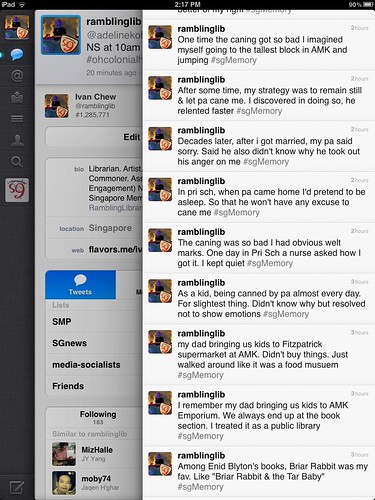
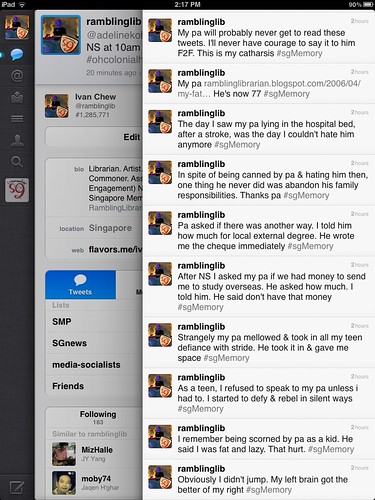
(Original Twitter sequence has been edited slightly)
"@ramblinglib: As a kid, being canned by pa almost every day. For slightest thing. Didn't know why but resolved not to show emotions #sgMemory”
“@ramblinglib: The caning was so bad I had obvious welt marks. One day in Pri Sch a nurse asked how I got it. I kept quiet #sgMemory”
“@ramblinglib: In pri sch, when pa came home I'd pretend to be asleep. So that he won't have any excuse to cane me #sgMemory”
“@ramblinglib: After some time, my strategy was to remain still & let pa cane me. I discovered in doing so, he relented faster #sgMemory”
“@ramblinglib: One time the caning got so bad I imagined myself going to the tallest block in AMK and jumping #sgMemory”
“@ramblinglib: Obviously I didn't jump. My left brain got the better of my right #sgMemory”
“@ramblinglib: I remember being scorned by pa as a kid. He said I was fat and lazy. That hurt. #sgMemory”
“@ramblinglib: As a teen, I refused to speak to my pa unless i had to. I started to defy & rebel in silent ways #sgMemory”
“@ramblinglib: Strangely my pa mellowed & took in all my teen defiance with stride. He took it in & gave me space #sgMemory”
“@ramblinglib: After NS I asked my pa if we had money to send me to study overseas. He asked how much. I told him. He said don't have that money #sgMemory”
“@ramblinglib: Pa asked if there was another way. I told him how much for local external degree. He wrote me the cheque immediately #sgMemory”
“@ramblinglib: In spite of being canned by pa & hating him then, one thing he never did was abandon his family responsibilities. Thanks pa #sgMemory”
“@ramblinglib: Decades later, after i got married, my pa said sorry. Said he also didn't know why he took out his anger on me #sgMemory”
“@ramblinglib: The day I saw my pa lying in the hospital bed, after a stroke, was the day I couldn't hate him anymore #sgMemory”
“@ramblinglib: My pa http://t.co/LB9WVUNa He's now 77 #sgMemory”
“@ramblinglib: My pa will probably never get to read these tweets. I'll never have courage to say it to him F2F. This is my catharsis #sgMemory”
Full story:
I suppose it was this tweet that made me remember a particular childhood episode, when I was around 10 years old. Remembering about my father and a period where he seemed to viciously cane me for the slightest reason.
My father used the thin rattan cane (the defacto tool of corporal discipline Asian parents used at that generation). It wasn't just "tough parental love", for the frequency of me being caned was almost daily. My younger brother and sister were spared mostly, I recalled.
I can't remember how long that caning went. I'm not sure when it stopped. I still recall pretending to be asleep when I heard my father come home. So that he won't find an excuse to cane me.
The caning was serious enough to break skin, result in bleeding and noticeable welts. Bad enough that my mum had to apply some ointment to cover up the broken skin. I would go to school with visible cane marks.
When I was 10, my father was in his 40s (he was considered to have married late, for his generation). My father was a strong man. And it didn't help that I was an emotionally sensitive child. At 10 years old, I once even thought of ending my life just to spite him.
My father seemed to have focused his anger on me. I was not naughty as a child at all. I attended school, came straight home, did my homework, never talked back to my elders (kids my generation were spoken of, but not spoken to). OK I cant say I was a perfect child, but I was far from being a bad one.
In truth, my father was not a cruel man. He was generous to his friends, our neighbours, and our relatives. Maybe that was why it hurt me, in more than the physical sense. The 10 year old me never understood why he couldn't be generous and forgiving to his own firstborn.
There were negative consequences, in that I deliberately became a very morose and serious child. I remember "experimenting" with not saying anything to my father for days. Days became weeks. And then it became natural.
In my teenage years, that refusal to talk to my father (other than functional statements) became little rebellious acts. Part of it was the teen angst and the onset of hormonal changes. One time, it occured to me why young lions were chased out of the pride. They would otherwise kill the top male lion, their sire, because there was no room to maneuvour.
My father and I didn't have a destructive relationship but we were never close. I knew he tried to be better towards me, and there was an episode where I was very gateful to him for supporting my contiuning education. But even so, my feelings towards him never quite swung completely towards the good. There was always that shadow of resentment.
It took decades before those childhood scars could truly start healing. One poignant point was when my father said something close to an apology for that childhood caning episode. A self-admission.
I was with my wife and my parents, at a hawker centre eating desserts. My parents were in their 60s by then. I had moved out of my parent's apartment after getting married. It was a home visit with my wife.
We talked about how some things had changed, or remained the same, in the neighbourhood. My father started sharing, with my wife, how I was as a child: that I liked to draw and read. He remembered that I was a good boy, even as a toddler.
Out of the blue, he said how at one point he would come home and cane me for any reason. He was not sure why he was that angry. A part of him knew he had been too harsh. And yet he could not stop himself and he continued to take his anger out on me. He recalled not caning me only when he saw me asleep (when I heard that, I had goosebumps -- and I also secretly congratulated myself for displaying some smarts as a 10 year old).
With his relevation, or confession even, there came an awkward pause.
There was my father, sounding apologetic. All my life, I've not seen that side of him. I looked at my wife. I looked anywhere except at my father. I said nothing then, or after.
I guess this is my way of saying it now.
P.S. Perhaps to you reading this, I'm making a mountain out of a molehill. Strange that I cannot speak of this with my father now. All I can say is that the resentment has been real for much of my life.
It's not so traumatic that I can't talk about it. I just can't talk to my father of it. Or won't. In truth, there is cowardice and irrational fear at work. I fear that I would cry, and he would cry. Or maybe it all doesn't matter now, and I'm merely post this to share a (good) story.
Whatever it is, it's been enough that I know my father knows. And vice versa. That's as good as I wish for things to be.
Sunday, April 05, 2009
Reflections on Gandhi's experiments with Truth
[My rambly attempt at an essay on Gandhi, from reading his book. I'm sure it can be further edited for brevity. And there are errors and inconsistency in tense. E.g. Should I say "Gandhi writes..." or "Gandhi wrote..."? Anyway, critiques are welcome.]
What makes a person do great things? And how are great things achieved?
Particularly, what motivated Gandhi? What did he think or do, that made him the respected figure that he is today?
I first learned about Gandhi from watching the 1982 movie starring Ben Kingsley. That was it. In the movie, Gandhi appeared Saint-like. An intellect. I thought his achievements were due to some special quality inherent in a genius.
But reading this book changed my perspective.

(Translated from the original in Gujarati)
Other title: Satyanā prayogo athavā ātmakathā
NLB Call No.: 954.035 GAN
I read the unabridged edition of a 1948 publication, translated from Gujarati.
Having read Gandhi's own words (albeit translated), it became clear Gandhi was an ordinary man. Who was painfully aware of his limitations and was socially inept for a long time. Who took a long time to find his self-confidence (in a seemingly serendipitous manner).
This book will show that Gandhi was just a man. A meek, naive and painfully shy young boy. Who learned and survived from his mistakes. Who in spite of his achievements still writes of his fear of being hero-worshipped.
What seems to have put him on the road to "greatness" was the cumulative effect of a series of unintended circumstances, where each time he merely tried to do his best. And not always successfully.
AN ORDINARY PATH TO EXTRAORDINARY ACHIEVEMENTS
I'd sum up Gandhi's path to success like this:
CREDIBILITY AND TRUST
Gandhi fought injustice with ideas. So much could have failed. He could've been just another person/ a crank, who went to jail. Reading the way he handled things - writing to station conductor for first class tickets - it was all so undramatic.
It was Gandhi's ability to make others trust and follow him that made the difference.
That trust was established and continued because of his steadfast principles and morals, and transparency in his conduct of life. He does what he preaches, and he remains humble in light of his achievements.
His work against the negative treatment of Indians in South Africa, and against the Apartheid regime, did not come about because he was smarter or had power. Or though his resolve alone.
I think the other key ingredient was the willingness of the powers-that-were to hear him out. That willingness was grounded in the momentum that gathered from the Gandhi's collective acts and responses.
Even before he took on Apartheid, he was already practicing the universal principle of Tolerance and openness towards other religions and beliefs (p. 295, he suggests a school for students regardless of religious beliefs and backgrounds).
NON-VIOLENT NON-COOPERATION
The other thing that struck me was how little he wrote about the idea of Non-violent Non-cooperation in the book.
[One criticism of the book was that Gandhi assumed he was writing for readers of his day, rather than a text that long survives him. Then again, it could also be an example of his unassuming nature.]
Gandhi knew that individuals are for justice but may be forced to operate within unjust rules. And he submits himself to those rules.
He acted out of the box when violence was probably what people were used to.
Civil disobedience: a simple yet powerful idea. And a brave one, when you decide to disobey the authority in non-violence means, yet knowing that the other party may not show such restraint.
As I understand it, it's about consciously disobeying an unjust law without resorting to violence. And willingly submitting to the consequences of breaking that law (e.g. Fine or jail ).
HUMILITY
In the Introduction, Gandhi explains why he agreed to write the book.
Gandhi writes that the title Mahatma (Great Soul) "has deeply pained" him.
TRUTH and SELF-REALISATION
Gandhi clarifies that it is a book documenting his observations of his seeking various Truths (i.e. his Life's experiments).
Much of what he wrote were on his reflections on matters like health, diet, and personal conduct.
I kept thinking about what Gandhi meant by his "experiments with Truth". About halfway through the book, it dawned on me that "Truth" is not just about facts. Truth is about thoughts and actions that lead to good, for oneself and others.
I thought the book is really about Gandhi's pursuit towards self- realisation. Oft times at the expense of his health, and also at times impacting on others (especially his wife and his children).
His philosophy about the conduct of life reminds me of Buddhist precepts like Compassion, Tolerance, Self-restraint (even Celibacy, as explained in the later chapters).
What is clear was how he never imposes his truth on others.
To the last, he was able to reflect how some of his experiments with Truths were inconclusive. Or that they turned out to be mistakes (e.g. his treatment of his wife, some aspects of bringing up his children).
In the concluding chapter, he wrote his pursuit of the truth is still on-going and he was not yet free of feelings of love, hatred, attachment and repulsion.
POSSIBLE FORMULA FOR GREATNESS
One reason for reading this book was to answer my own question of what makes a person do great things, and how great things were accomplished.
Gandhi epitomised three qualities:
And introspection ensures truth, at least it may lead to it. For without genuine introspection, being blindly resolute in one's belief is merely ignorance.
A MAN WORTH UNDERSTANDING
The book is not a typical autobiography, as Gandhi clarified in the book. He downplayed much of his involvement. His sense of humility may even frustrate the researcher in search of the historical context of his life and times.
[There are certain aspects that he assumes the reader already knows. E.g. The callousness of apartheid, and the British rule --some would say "exploitation"-- of India, why the Satyagraha, i.e. non-violence movement].
It's arguable whether his is a life worth emulating.
Many aspects are, but I feel circumstances have changed. Some of ideas seem strange and contrary to our time (p. 230, his distrust of the concept of Insurance).
Gandhi's life and achievements is worth studying. But not to worship him as a hero. It's easy to do so (especially when one relies only on movies!) I think it's a human tendency to elevate people who have done seemingly great deeds to the Pantheon.
But his is definitely a life worth understanding.
The clear conclusion for me is that Gandhi was an ordinary human being. That it is humanly possible to achieve some semblance of what he has accomplished.
Extraordinary things are often achieved by consistently doing undramatic things.
That only increased my respect for Gandhi.
p.s. I've to thank my band-budddy, Adrian, for introducing me to this book. My RoughNotes, here.
What makes a person do great things? And how are great things achieved?
Particularly, what motivated Gandhi? What did he think or do, that made him the respected figure that he is today?
I first learned about Gandhi from watching the 1982 movie starring Ben Kingsley. That was it. In the movie, Gandhi appeared Saint-like. An intellect. I thought his achievements were due to some special quality inherent in a genius.
But reading this book changed my perspective.
(Translated from the original in Gujarati)
Other title: Satyanā prayogo athavā ātmakathā
NLB Call No.: 954.035 GAN
I read the unabridged edition of a 1948 publication, translated from Gujarati.
Having read Gandhi's own words (albeit translated), it became clear Gandhi was an ordinary man. Who was painfully aware of his limitations and was socially inept for a long time. Who took a long time to find his self-confidence (in a seemingly serendipitous manner).
This book will show that Gandhi was just a man. A meek, naive and painfully shy young boy. Who learned and survived from his mistakes. Who in spite of his achievements still writes of his fear of being hero-worshipped.
What seems to have put him on the road to "greatness" was the cumulative effect of a series of unintended circumstances, where each time he merely tried to do his best. And not always successfully.
AN ORDINARY PATH TO EXTRAORDINARY ACHIEVEMENTS
I'd sum up Gandhi's path to success like this:
- He was painfully and utterly human in his wants and needs. Very much naive as a child and as a young man.
- He learned his ways through trial and error, rather than though any innate talent or skill (in Gandhi's words, he didn't have any).
- Main thing was he didn't give up. He had support from some friends and his family. But ultimately it was his own reflections on what was "truth" that he found and grew small measures of success and self-confidence.
- These "successes" were ordinary and unspectacular by themselves, e.g. not freezing up in front of the judge when presenting his case; not having a court case thrown out.
- Over time, though his consistent actions, he slowly build up a reputation and to a point where people trusted him and sought out his legal services.
- That's when he gradually stumbled onto social causes and taking up cases for the ordinary man. And then finding himself in extraordinary situations.
- When faced with those situations, he simply lead by example and achieved--again through the trust others had in him--to achieve extraordinary things.
CREDIBILITY AND TRUST
Gandhi fought injustice with ideas. So much could have failed. He could've been just another person/ a crank, who went to jail. Reading the way he handled things - writing to station conductor for first class tickets - it was all so undramatic.
It was Gandhi's ability to make others trust and follow him that made the difference.
That trust was established and continued because of his steadfast principles and morals, and transparency in his conduct of life. He does what he preaches, and he remains humble in light of his achievements.
His work against the negative treatment of Indians in South Africa, and against the Apartheid regime, did not come about because he was smarter or had power. Or though his resolve alone.
I think the other key ingredient was the willingness of the powers-that-were to hear him out. That willingness was grounded in the momentum that gathered from the Gandhi's collective acts and responses.
Even before he took on Apartheid, he was already practicing the universal principle of Tolerance and openness towards other religions and beliefs (p. 295, he suggests a school for students regardless of religious beliefs and backgrounds).
NON-VIOLENT NON-COOPERATION
The other thing that struck me was how little he wrote about the idea of Non-violent Non-cooperation in the book.
[One criticism of the book was that Gandhi assumed he was writing for readers of his day, rather than a text that long survives him. Then again, it could also be an example of his unassuming nature.]
Gandhi knew that individuals are for justice but may be forced to operate within unjust rules. And he submits himself to those rules.
He acted out of the box when violence was probably what people were used to.
Civil disobedience: a simple yet powerful idea. And a brave one, when you decide to disobey the authority in non-violence means, yet knowing that the other party may not show such restraint.
As I understand it, it's about consciously disobeying an unjust law without resorting to violence. And willingly submitting to the consequences of breaking that law (e.g. Fine or jail ).
HUMILITY
In the Introduction, Gandhi explains why he agreed to write the book.
p X. "If anything that I write in these pages should touch the reader as touched with pride, then he must take it that there is something wrong with my quest, and that my glimpse are nothing more than mirage. Let hundreds like me perish, but let the truth prevail. Let us not reduce the standard of truth for even by a hair's breath from judging erring mere mortals like myself."
"I hope and pray that no one will regard the advice interspersed in the following chapters as authoritative. The experiments narrated should be regarded as illustrations, in the light of which everyone must carry on his own experiments in accordance to his own inclinations and capacity."
Gandhi writes that the title Mahatma (Great Soul) "has deeply pained" him.
TRUTH and SELF-REALISATION
Gandhi clarifies that it is a book documenting his observations of his seeking various Truths (i.e. his Life's experiments).
Much of what he wrote were on his reflections on matters like health, diet, and personal conduct.
I kept thinking about what Gandhi meant by his "experiments with Truth". About halfway through the book, it dawned on me that "Truth" is not just about facts. Truth is about thoughts and actions that lead to good, for oneself and others.
I thought the book is really about Gandhi's pursuit towards self- realisation. Oft times at the expense of his health, and also at times impacting on others (especially his wife and his children).
His philosophy about the conduct of life reminds me of Buddhist precepts like Compassion, Tolerance, Self-restraint (even Celibacy, as explained in the later chapters).
What is clear was how he never imposes his truth on others.
To the last, he was able to reflect how some of his experiments with Truths were inconclusive. Or that they turned out to be mistakes (e.g. his treatment of his wife, some aspects of bringing up his children).
In the concluding chapter, he wrote his pursuit of the truth is still on-going and he was not yet free of feelings of love, hatred, attachment and repulsion.
POSSIBLE FORMULA FOR GREATNESS
One reason for reading this book was to answer my own question of what makes a person do great things, and how great things were accomplished.
Gandhi epitomised three qualities:
- Courage in pursuing one's personal beliefs
- Non-violence
- Constant review and questioning of own beliefs (also things like reflection on his duties as husband, his treatment of his wife, handling of gifts)
And introspection ensures truth, at least it may lead to it. For without genuine introspection, being blindly resolute in one's belief is merely ignorance.
A MAN WORTH UNDERSTANDING
The book is not a typical autobiography, as Gandhi clarified in the book. He downplayed much of his involvement. His sense of humility may even frustrate the researcher in search of the historical context of his life and times.
[There are certain aspects that he assumes the reader already knows. E.g. The callousness of apartheid, and the British rule --some would say "exploitation"-- of India, why the Satyagraha, i.e. non-violence movement].
It's arguable whether his is a life worth emulating.
Many aspects are, but I feel circumstances have changed. Some of ideas seem strange and contrary to our time (p. 230, his distrust of the concept of Insurance).
Gandhi's life and achievements is worth studying. But not to worship him as a hero. It's easy to do so (especially when one relies only on movies!) I think it's a human tendency to elevate people who have done seemingly great deeds to the Pantheon.
But his is definitely a life worth understanding.
The clear conclusion for me is that Gandhi was an ordinary human being. That it is humanly possible to achieve some semblance of what he has accomplished.
Extraordinary things are often achieved by consistently doing undramatic things.
That only increased my respect for Gandhi.
p.s. I've to thank my band-budddy, Adrian, for introducing me to this book. My RoughNotes, here.
Saturday, January 31, 2009
Growing beautiful with time
[First posted at MyRightBrain]
Two passengers on the bus.
Both women.
One was clearly younger than the other. I could tell from their skin.
The younger one appeared in her twenties. Smooth, clear skin with just a light touch of make-up. She'd easily be considered pretty, if not beautiful.
The other woman was much, much older. Hair dyed brown, not quite covering all that silver-grey. Skin tanned and wrinkled. Was she considered pretty or beautiful when younger?
And it occurred to me:
Some people might be born beautiful or handsome. If not, then some measure of beauty could be achieved through cosmetics and science. Still, the passing of time ultimately robs skin and muscle of the potential to appear beautiful.
Our minds are a different matter though.
The possibility always exists that minds will become more beautiful with age.
Two passengers on the bus.
Both women.
One was clearly younger than the other. I could tell from their skin.
The younger one appeared in her twenties. Smooth, clear skin with just a light touch of make-up. She'd easily be considered pretty, if not beautiful.
The other woman was much, much older. Hair dyed brown, not quite covering all that silver-grey. Skin tanned and wrinkled. Was she considered pretty or beautiful when younger?
And it occurred to me:
Some people might be born beautiful or handsome. If not, then some measure of beauty could be achieved through cosmetics and science. Still, the passing of time ultimately robs skin and muscle of the potential to appear beautiful.
Our minds are a different matter though.
The possibility always exists that minds will become more beautiful with age.
Thursday, January 01, 2009
"Enough"
On the last day of 2008, my friend (this guy) told me this story that he'd read from this book:
Profound stuff, eh?
The full story, here.
In light of the global economic downturn, I thought this would be a nice first-post for 2009.
Cheers, everyone.
At a party hosted by a successful hedge fund manager, (the late) author Kurt Vonnegut remarked to fellow (late) author Joseph Heller that their host made more money in a single day than what Heller earned from his successful novel, Catch-22, over its entire history.
Heller replied, "Yes that's true. But I have something that he will never have."
"Enough".
Profound stuff, eh?
The full story, here.
In light of the global economic downturn, I thought this would be a nice first-post for 2009.
Cheers, everyone.
Monday, September 29, 2008
Gratitude
I had to work a few hours overtime this evening.
The sky was pitch black by the time I left the office.
On my way home, I went past a school. Its canteen was lit. Students sitting on benches, peering down on textbooks.
Must be exam mugging session, I thought.
Instantly I was brought back to my O-level year. My school also opened up our canteen for students who chose to revise their work in school.
I remembered those nights, some 20 years ago.
My school opened up its school canteen to a group of us, mostly boys, so that we could revise for the exams. Our homes were too noisy and cramped.
Age and time changes one's perspective.
Until tonight, it never entered my consciousness that teachers too had to work overtime for us back then. They could have been home watching TV. Being with their family.
As a student, I didn't hear or consider any of that. We'd taken for granted that teachers had to be there.
It finally dawned on me about 20 years later.
So.
To my teachers who did their share of overtime for us then. And for teachers who continue to do so for students today.
Thank you.
It might take a long time.
A decade or two.
But eventually some of us kids will learn what is gratitude.
The sky was pitch black by the time I left the office.
On my way home, I went past a school. Its canteen was lit. Students sitting on benches, peering down on textbooks.
Must be exam mugging session, I thought.
Instantly I was brought back to my O-level year. My school also opened up our canteen for students who chose to revise their work in school.
I remembered those nights, some 20 years ago.
My school opened up its school canteen to a group of us, mostly boys, so that we could revise for the exams. Our homes were too noisy and cramped.
Age and time changes one's perspective.
Until tonight, it never entered my consciousness that teachers too had to work overtime for us back then. They could have been home watching TV. Being with their family.
As a student, I didn't hear or consider any of that. We'd taken for granted that teachers had to be there.
It finally dawned on me about 20 years later.
So.
To my teachers who did their share of overtime for us then. And for teachers who continue to do so for students today.
Thank you.
It might take a long time.
A decade or two.
But eventually some of us kids will learn what is gratitude.
Thursday, December 20, 2007
Like riding a bicycle
They say you never forget how ride a bicycle once you learn how to do it.
The last time I rode a bicycle was almost 10 years ago. So when Siva invited me to join them at Changi Village for a two-hour cycling trip, I hesitated.
But he assured me it would be, in his words, a "lame duck ride".
No jostling with traffic on the main roads; a leisurely pace on the park connector between Changi Village and East Coast Park. Nothing strenuous.
The only thing I'd have to be prepared was for a stiff bum.
He was right.
About the pace and the stiffness.
But nothing prepared me for the downpour at 9am. The weather forecast predicted showers in the late afternoon but I guess the winds shifted since the last time I checked the NEA website.
It wasn't a bad thing though.
There's something to be said about riding a bicycle in the rain, near the coast.
Wind in my face. Rain, tasting faintly of salt, tapping out a staccato song on my helmet. Getting soaked from helmet to socks.
Soggy feet.
The one thing I dreaded most. But turned out I didn't mind it that much.
I guess the anticipation of soggy feet was worse than the sogginess itself.
Finally, that hot drink at the end of the ride. Feeling the warmth permeated the chill in your bones, your spirits buoyed by the company of nice people.
There's also something to be said about riding a bike after a long hiatus.
I was surprised, and delighted, that my mind and body remembered how to balance on one. Even down to the coordination in the shifting of gears.
Oliver Wendel Holmes, Jr. said, "Men's minds, once stretched by new ideas, never regain its original dimensions."
Perhaps there's something similar about riding a bike too.
The last time I rode a bicycle was almost 10 years ago. So when Siva invited me to join them at Changi Village for a two-hour cycling trip, I hesitated.
But he assured me it would be, in his words, a "lame duck ride".
No jostling with traffic on the main roads; a leisurely pace on the park connector between Changi Village and East Coast Park. Nothing strenuous.
The only thing I'd have to be prepared was for a stiff bum.
He was right.
About the pace and the stiffness.
But nothing prepared me for the downpour at 9am. The weather forecast predicted showers in the late afternoon but I guess the winds shifted since the last time I checked the NEA website.
It wasn't a bad thing though.
There's something to be said about riding a bicycle in the rain, near the coast.
Wind in my face. Rain, tasting faintly of salt, tapping out a staccato song on my helmet. Getting soaked from helmet to socks.
Soggy feet.
The one thing I dreaded most. But turned out I didn't mind it that much.
I guess the anticipation of soggy feet was worse than the sogginess itself.
Finally, that hot drink at the end of the ride. Feeling the warmth permeated the chill in your bones, your spirits buoyed by the company of nice people.
There's also something to be said about riding a bike after a long hiatus.
I was surprised, and delighted, that my mind and body remembered how to balance on one. Even down to the coordination in the shifting of gears.
Oliver Wendel Holmes, Jr. said, "Men's minds, once stretched by new ideas, never regain its original dimensions."
Perhaps there's something similar about riding a bike too.
Sunday, April 15, 2007
Thinking about life, on the MacRitchie Trail
"It's mental more than physical... you just have to push yourself", decried Siva, after the group rendezvoused for Prata at the end of this morning's brisk walk.
I thought that walking the nature trail was like how one approached life.
The group was negotiating an uneven part of the trail in the MacRitchie nature reserve. Flat ground gave way to gravel and sand turned into slushy mud. As my shoes hit the sand and decayed forest debris, my mind was quite clear. I wasn't thinking about where we were going, how far we were to the end point, or how many more steps to take.
My choices were limited in that sense.
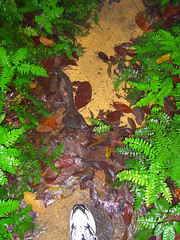 My eyes focused only on the one-metre zone directly down and ahead, my brain firing off a few million instructions to keep my body upright and moving and avoiding the holes that would give you a twisted ankle and bruised pride, and mindful of keeping up with the blistering pace by the group.
"...Left foot out step lightly on the loose rock watch the puddle press down move the right foot twist slightly left muddy spot in front turn the body to compensate Oops stepped into puddle of water never mind shoes are dirty anyway oh i can feel water seeping into my right shoe ah forget it focus on the next step watch that low hanging branch bend down keep moving..."
It would have been more tiring if I'd stopped to think of what I was doing.
After a few minutes, my mind overcame the uncertainty of the terrain. That's when I started to think of the trail ahead -- how much more to go? Would my legs give out before the end? But I stopped myself from thinking so much about the journey. I knew where I was. I decided to just enjoy the moment. My legs were aching. It was a good ache. The kind that let you know you're alive.
So I figured life was a lot like negotiating the nature trail. For most people, we know where we are headed. The specifics might be different, but we'd know in a larger sense.
When the going gets tough, sometimes the only way to cope is to contract our field of vision to what's immediately ahead. That's not to say we don't have an end in mind, or that we take the next step blindly. Just that we deal with the immediate problem first. No point making elaborate plans on how to celebrate at the summit at the end of the walk when you're down on your bum with a sprained ankle, having tripped on a loose rock.
When our senses are overwhelmed, we just have to focus on the present.
I should explain what Siva meant by "pushing himself". He clarified that the brisk walk wasn't a competition. It was just his way of motivating himself to complete the walk -- how he would strategise on when to catch up with the group, at what point he needed to maintain his pace and when to speed up. Which led him to say that mental strength was what determined if one completed the walk, rather than physical.
I've done part of the nature trail sometime ago but this was my first with the group. We walked at what I thought was a blistering pace. I was told we covered approximately 10 kilometres, in about 1.5 hours.
Like life, when we derive enjoyment in what we do -- where there's enough of a challenge within your physical limits; where you find warmth in the company of friendly strangers who put you at ease -- we'd want to do it again.
And like quite a few things in my life so far, I was glad to have made myself do something that I ordinarily wouldn't do. Like this walk.
When I woke at 5.30am, I was tempted to go back to sleep. But the thought of giving more ammunition to Siva for his verbal taunts (all in jest of course) was one of the deciding factor in getting my butt off the bed. :)
I thought that walking the nature trail was like how one approached life.
The group was negotiating an uneven part of the trail in the MacRitchie nature reserve. Flat ground gave way to gravel and sand turned into slushy mud. As my shoes hit the sand and decayed forest debris, my mind was quite clear. I wasn't thinking about where we were going, how far we were to the end point, or how many more steps to take.
My choices were limited in that sense.
My eyes focused only on the one-metre zone directly down and ahead, my brain firing off a few million instructions to keep my body upright and moving and avoiding the holes that would give you a twisted ankle and bruised pride, and mindful of keeping up with the blistering pace by the group."...Left foot out step lightly on the loose rock watch the puddle press down move the right foot twist slightly left muddy spot in front turn the body to compensate Oops stepped into puddle of water never mind shoes are dirty anyway oh i can feel water seeping into my right shoe ah forget it focus on the next step watch that low hanging branch bend down keep moving..."
It would have been more tiring if I'd stopped to think of what I was doing.
After a few minutes, my mind overcame the uncertainty of the terrain. That's when I started to think of the trail ahead -- how much more to go? Would my legs give out before the end? But I stopped myself from thinking so much about the journey. I knew where I was. I decided to just enjoy the moment. My legs were aching. It was a good ache. The kind that let you know you're alive.
So I figured life was a lot like negotiating the nature trail. For most people, we know where we are headed. The specifics might be different, but we'd know in a larger sense.
When the going gets tough, sometimes the only way to cope is to contract our field of vision to what's immediately ahead. That's not to say we don't have an end in mind, or that we take the next step blindly. Just that we deal with the immediate problem first. No point making elaborate plans on how to celebrate at the summit at the end of the walk when you're down on your bum with a sprained ankle, having tripped on a loose rock.
When our senses are overwhelmed, we just have to focus on the present.
I should explain what Siva meant by "pushing himself". He clarified that the brisk walk wasn't a competition. It was just his way of motivating himself to complete the walk -- how he would strategise on when to catch up with the group, at what point he needed to maintain his pace and when to speed up. Which led him to say that mental strength was what determined if one completed the walk, rather than physical.
I've done part of the nature trail sometime ago but this was my first with the group. We walked at what I thought was a blistering pace. I was told we covered approximately 10 kilometres, in about 1.5 hours.
Like life, when we derive enjoyment in what we do -- where there's enough of a challenge within your physical limits; where you find warmth in the company of friendly strangers who put you at ease -- we'd want to do it again.
And like quite a few things in my life so far, I was glad to have made myself do something that I ordinarily wouldn't do. Like this walk.
When I woke at 5.30am, I was tempted to go back to sleep. But the thought of giving more ammunition to Siva for his verbal taunts (all in jest of course) was one of the deciding factor in getting my butt off the bed. :)
Sunday, March 18, 2007
You'll suck at what you do, for a long time, but...
Who's Ira Glass? Nevermind. Watch this video first (hat-tip to David Silver). David wrote that it's "five minutes and nineteen seconds of smart advice". I've transcribed the parts which I felt was the essence of the video.
Starting from 0:39 min:
At 2:30min, Ira plays a radio news report that was aired eight years ago, when he had been in the radio broadcasting business for a long time. He criticises his own performance:
Now that I know who's Ira Glass, the message is even more convincing. My personal take-away: We'll suck at what we do, probably for a long time. But that's no excuse to not try, and try again. There's no short-cut getting from here to good.
Winston Churchill was perhaps more succinct (the context was different but the philosophy applies): "Never give up. Never surrender."
Starting from 0:39 min:
"... For the first couple of years that you're making stuff, what you're making isn't so good... ... it has an ambition to be good but it's not quite that good.
But your taste... ... is good enough that you can tell that what you're making is kind of a disappointment to you. You can tell that it's still sort of crappy. A lot of people never get past that phase... ... they quit.
The thing I would just like to say to you with all my heart is that... everybody I know, who does interesting creative work, they went though a phase of years where... ... they knew that it fell short... ... it didn't have that special thing that we wanted it to have. ...Everybody goes through that.
... You gotta know that it's totally normal.... ... the most important, possible thing, that you could do is do a lot of work. Do a huge volume of work.
Put yourself on a deadline, so that every week or every month, you know that you have to finish one story... whatever it's going to be... ...even if it's not somebody who pays you, but you're in a situation where you have to have to turn out the work.
It's only by going through a huge volume of work that you're actually going to catch up and close that gap. And the work that you're making will be as good as your ambitions.
At 2:30min, Ira plays a radio news report that was aired eight years ago, when he had been in the radio broadcasting business for a long time. He criticises his own performance:
"What am I talking about? Every part of this was ill-conceived... the writing is horrible. You can't even follow what I'm talking about... ... here's a tip -- You don't underline [stress] every third word for emphasis, because it sounds really unnatural. What you want is to talk like how you normally talk.
This is year eight. I'm not a beginner. I'm like deep, deep into it.
...It takes a while. It's going to take you a while. It's normal. You just have to fight your way through that.
You will make things that aren't as good that you know in your heart that you want them to be, and you just make one effort after another."
Now that I know who's Ira Glass, the message is even more convincing. My personal take-away: We'll suck at what we do, probably for a long time. But that's no excuse to not try, and try again. There's no short-cut getting from here to good.
Winston Churchill was perhaps more succinct (the context was different but the philosophy applies): "Never give up. Never surrender."
Wednesday, September 15, 2004
Lifelong Learning Awards 2004
While speaking to a mediacorp executive recently, for a collaborative programme between Mediacorp Newsradio and NLB, I was encouraged to nominate someone for the Lifelong Learning Award 2004. I replied that I could only think of a retired person who might fit the bill, but not sure if that person was qualified. She said to submit the nomination, which I did. This was what I wrote:
Tag: life long learning
My father retired maybe 8 years ago. He has had heart surgery before but he's still quite active for his age. For past 3 years or so, he's been volunteering at the Ang Mo Kio Community Centre, taking care of the CC garden daily, arranging the layout, repotting etc. He also interacts with the residents, who donate plants or ask for cuttings. Apart from the CC garden, he also helped the neighbours on the floor of his HDB unit set up plant stands.The nomination exercise started on 30 August 2004. Closing date is 24 September 2004, 6pm Singapore time. Nominations can be made online.
To me, it was a total surprise that he did all that, since he's never been trained in horticulture and before his retirement and he’d never shown any interest in plants before. But now, he's learnt how to create his own fertilizer mix, transplant new plants, repotting etc.
He does it by experimentation, by asking people, and a few weeks back, he asked if there were relevant books from the library. Hearing him talk about the garden, you’d think he’s been doing it for a living.
My father would he’d be surprised if someone says he’s a Lifelong Learner. He took up gardening perhaps as a way to pass time, and didn’t consciously set out to be a ‘Lifelong Learner’.
But that’s what I think lifelong learning is about – he didn't do it because he had to, but because he wants to – and not even ‘consciously’ in that sense. It's quite mundane and just a way of life.
Tag: life long learning
Subscribe to:
Posts (Atom)

