Showing posts with label author. Show all posts

Sunday, September 22, 2013

Pre-release book review: Age of Context: Mobile, Sensors, Data and the Future of Privacy/ Robert Scoble & Shel Israel

It was a privilege to be able to review a pre-release copy of Scoble's and Israel's latest book, Age of Context (AoC).


Age of Context: Mobile, Sensors, Data and the Future of Privacy

This was what I posted at Amazon.com, leaving in an extra part that I edited out from the Amazon.com post:

Reading this book was like reading about technological possibilities in Scifi stories. Except, the technologies are already here and in use. By millions of people like us.

I reviewed a pre-release copy of the book, at a time where my mind was distacted by other stuff. Tackling over 270 pages of text wasn't at the top of my list. I was worried I wouldn't be able to read this carefully and give this a fair review. But I need not have worried.

Scoble and Israel did not just write a book. They told stories. That's what I liked about this one. The opening chapter has a title "Storm's Coming". It sets the tone that this book unabashedly seeks to entertain and inform.

A quote from their opening chapter: "Our perfect storm is composed not of three forces, but five, and they are technological rather than meteorological: mobile devices, social media, big data, sensors and location-based services."

Smart homes and apartments, smart appliances; contextual, wearable systems that know our location, our current activities, our up-to-date preferences. Personal Contextual Assistants (PCAs) that, less than a decade ago, we would call it them the stuff of Scifi and Fantasy magazines.

Google Glass - how it works (but it stopped short of describing why some people feel that it works).

How one NFL football team/ stadium is progressively implementing tech & data to anticipate customer purchase behavior. Save time for customer, faster sales, superior customer experience.

These tech combos work, because we are creatures of habit.

How a company like VinTank harnesses and analyses data from social media conversations to identify high value consumers. Using data for its own target marketing.

Data from not just buying or consuming but merely showing an interest it, like touching/ viewing something.

The automobile as a AoC device.

How some branches of government are utilizing data, computer simulations, visualization technologies/ 3D models to increase the level of engagement with citizens.

A sand grain-sized sensor the works with a skin patch to monitor the patient's condition.

That quote from the opening chapter made me wonder, at first, if I would learn anything new. None of those terms were new to me, since I read a fair bit of Science fact and fiction. Besides, we already have our Apples and Samsungs. We are no strangers to wearing computing devices on us. So what would be new to me?

Quite a bit.

For example, I now see Map apps with greater insights now. Specifically, the motivations behind companies like Google and Apple in developing map services. And what is needed to make such services and apps work.

One chapter discussed what the convergence will mean in terms of business and marketing. It suggests that the real business application would be in information arbitrage; micro-commissions for making real-time, context-specific business referrals to customers.

Like the Scifi stories that I enjoy, Scoble and Israel are able to make me relate to how individuals and society reacts to, or are being affected by technology, consciously or otherwise.

For example, most people will choose to drive the car themselves, even when they know the machine can execute instructions with greater precision and efficiency. Or the discomfort some individuals feel after discovering how third-party services have decided, without their permissions, to share personal information -- even if that sharing appears to be benign.

The book comes across as a result of "pragmatic field research", presenting information and facts not in empirical terms but as stories. There are real names of companies and individuals. Some chapters go deep into the subject, while some chapters profiled an overview of the technologies and companies. I liked that alternating treatment, between depth and breadth.

While the authors do not hide their bias towards the benefits that this convergence offers, they are not blind to potential pitfalls. The final chapter talks about how the companies, covered in the book, deal with personal data they collect. The authors talk about what they call "the sneaky stuff".

Overall, the authors seek to assure readers that 'the storm is coming' but we're not entirely helpless.

"We hope you can use this book as a framework to understand the contextual developments that will take place over the next few years. We hope you take it in context and that it will help you adjust to the changes in your work and your life."

I think this book would enable readers to have a greater awareness of what is happening the next time we receive alerts or recommendations from companies, or from our social networks, or when we use apps. Not that the companies are trying to be insidious (though one would have a greater awareness of how they could be). It is always useful to know how things work. When things break, we might be better prepared for it or at least understand why.

I enjoyed the overview and insights to technologies being developed in the USA, which will inevitably spill over to the rest of the world. A few were obvious to me while a large number were not.

The writing is crisp and the pages flow. The writing style reminded me of magazine articles like Nature, and Popular Mechanics: informative, entertaining, and accessible without dumbing down.

Thursday, July 25, 2013

Book review: Love! Live Dangerously! And Have Fun!: a mother's lessons on love, hope, loss and the gifts of life

This one came in the mail for me to review. The book, targeted at young female readers, was easy to read. The tone and style was very personable.

Book review: Love! Live Dangerously! And Have Fun!: a mother's lessons on love, hope, loss and the gifts of life
Cover from: catherinekhoo.wordpress.com. All Rights Reserved.

My take-away from the book:
Crap will happen to anyone and everyone, at some point. No one is immune. The difference is how we choose to carry on.

Taking risks doesn't always mean we will come up tops. But it also doesn't mean we will always fail.

Exercise compassion. Life is not just about 'me'.

Not entirely the way the author described, but I think not too far from it.

The author shared selective episodes from her life, explaining how she realised that one should love and take risks in life.

Right off the start, I sensed this was a woman who did not conform to conventional thinking, even as a teenager. Her mother had forbidden her to go on dates, and that the young Catherine should only focus on her studies. But she dated the boy anyway, even initiating the courtship rather than wait for him to act. The consequence was that her studies were affected, and so did the boy's.

Before you wonder what sort of message the author is imposing on young impressionable minds, the truth is that many of our friends (perhaps you and I) went through the same, in different degrees. There may be more 'teen rebels' among us than we care to acknowledge.

The key difference, I thought, was that a person like Catherine Khoo consistently applied her optimistic outlook towards life.

She wrote in another of her blog:
... I’ve lived this maxim since I was a teenager … and strange enough, it applies so much more as I grow older. Sure, sometimes I jump in without thinking of the consequences, and I fail, but how many times have I brushed off the blood and dust and moved on? Think of it this way, at least I figured out another way not to do it! Truth be told, though...I love this journey

Can we truly have a happy life just by living our dreams?

Cynics may say that there are those who have tried to do just that, and they end up being decrepit and miserable.

Perhaps in anticipation of that, the author peppers her anecdotes about seeing life optimistically.

Part of her credibility arose from her managing and growing her own business. I think it takes a feisty no-nonsense approach to do that, in addition to being a mother, a wife, and a daughter-in-law. If that's not enough, try starting a writing scheme for teens.

I did not think the author suggests that one should one up-end our lives and gallivant halfway around the world. You get a sense that risk-taking has to be tempered with an underlying sense of responsibility first.

Still, I would not have done some of the things she did, no matter what you tell me. For example, her episode with the illegal taxi ride in a foreign country, where she almost became a victim of a robbery. If I learnt my wife/ mother/ sister did just that (accept rides from strangers), I would be very, very angry. It seemed reckless.

For the most part, I empathised with her stories. Like how she walked out on her husband one time, feeling that she was being unfairly put down by her spouse. As a husband myself, it made me reflect on my words and deeds towards my wife.

One thing I felt the book fell short was that flow of the chapters can appear to be disjointed at times -- though this could be said to be the online-diary writing style. Also, I was left with the impression that there could have been a lot more interesting stuff to be told, but weren't.

I would have wanted to read more was her trials and tribulations in starting and sustaining the Young Authors Club, for one. What went through her mind when she was asked to set up the club? Did she see a business opportunity first, or the social cause?

So, here are a few things that I would be interested in reading, perhaps in her next book:
  • Stories, as told by other woman, whom she met along the way.
  • Interesting stories of the children and teens whom she have met, through the club she set up.
  • The challenges in running a business, never mind being a businesswoman.
  • What was it really like when she "shattered the traditional Japanese male enclave when she became the only woman editor-in-chief of two Japan-based magazines published in Singapore, a position she held for seven years" (see this).

Overall, this would make a good book discussion for teens. Or among teens and parents (I guess the teens would have to be forced to attend such a session, lol).

In a practical and pragmatic society like Singapore, some parents will not agree with the premise behind her book's title. The call to "love and live dangerously" was something that goes against conventional thinking when I was growing up, and in a way it's still very much the covert values most of us go by.

This was Catherine Khoo's fourth book. It is currently available at major bookstores here, like MPH, Kinokuniya, and Times Bookshop.

Her books are also available at the NLB libraries.

Catherine also blogs at www.catherinekhoo.sg/the-meaning-of-education.

Sunday, July 14, 2013

Interview with the artist/ writer: "Jack Doe: Anonymous"

[Earlier post: Graphic novel review - Jack Doe: Anonymous]

This post is two years late.

In 2011, after I blogged about the graphic novel, the author/ artist, Shawn Yap, found my post and left this comment:
Hi Ivan! Shawn Yap here! Thanks for the review and feedback! My team and I appreciate it alot! I do have a second book out though – “Closets” (unrelated to Jack Doe though), if you happen to read that, let me know what you think.

That led to an email correspondence, where Shawn agreed to an email interview. The interview took a while because Shawn was busy at that time. And then I got busy and procrastination took over. I never published the interview.

I kept his emails in my inbox as a reminder. This week I finally got off my procrastinating behind, went to Shawn's website to find out what he's been up to (he's got a Facebook page now), then got in touch with him again to ask if he had any updates.

He did. And here's the interview with 2013 updates:

Shawn Yap - www.shawnyap.net

[In 2011]
Q: How did 'Jack Doe' get started? I'm aware that it was part of the MDA First Time Publisher initiative. And that you had other collaborators like Gabriel Chua, Nathan Peng, Daniel Barrett Lee, Xander Lee, Regina Lee, Amanda Yap, Beryl Kwok.

It's quite a funny story actually. I had absolutely no idea of the First Time Publisher Initiative until my mother told me about it, after reading about it on the newspapers.

I was still serving my NS in the Navy at the time, and the deadline were about less than a week away, if I remember.

It was quite a rush to come up with a story for the pitch, so there was many stories I penned down and came up with while in camp. I ran the ideas through Daniel, who was my close friend from my BMT, and there was a lot of back and forth and eventually it led to "Jack Doe". I sent the draft out and we got the pitch.

From there I got a team to work on the project together with me: Daniel, of course; Gabe - who wrote most of the great script in the book; Nathan - who was a major blessing, script-wise, in the later chapters; Xander - who came up with the amazing cover concept; Regina, Beryl and my younger sister, Amanda, who provided help in the coloring/toning department for the covers and the main story.

2) Could you share some insights into the process of making "Jack Doe"? As a reader looking at the final product, I'm curious as to some of the thought processes and physical work involved.
Oh, it was a really long process!

But thankfully I wrote out most of the story before approaching Gabe, Nathan and Daniel with it, from there we had quite a lot of ideas and stuff thrown around to really spice up the story. The story evolved a little here and there while we were releasing it in issues, and that, while scary, was actually quite exciting because it still had room to grow and breathe.

The team hardly had time to meet altogether though, so it was always only 1 or 2 of us at a time.

The work itself, art-wise, was really one of the more taxing aspects of the book, due to deadlines and schedules. I was really thankful for the help I got from the colorists! I was really thankful for the prompt work on the script from the writers. Really helped to speed stuff up! :) I was also really grateful for the additional time given to improve on the trade paperback, there were quite a few improvements made from the story published in M.U.G.E.N.


3) I read from the blurb that Jack Doe contains six chapters published in M.U.G.E.N. I've to profess my ignorance about M.U.G.E.N. Isn't M.U.G.E.N a game? http://en.wikipedia.org/wiki/M.U.G.E.N

Ah...It is! Well...I mean it is both the name of a game and a comic anthology (and a car modification company as well if i'm not wrong). I think the publishers didnt realise that when they came up with the name, but I guess the association helped us a little (well it worked both ways, haha).


4) What was the easiest part in producing Jack Doe?

Revisiting and revising the story for its paperback launch. That was much easier because the bulk of the story was done, it was also the most fun part, for me at least.


5) What's the hardest?

Definitely the deadlines. Towards chapter 5 and 6 the deadlines were getting tighter and tighter and it was really, really crazy.


6) What are your collaborators doing now? i.e. Gabriel Chua, Nathan Peng, Daniel Barrett Lee, Xander Lee, Regina Lee, Amanda Yap, Beryl Kwok.
[Interviewer's note: this was in 2011] Most of them are working at the moment. We've hardly had time to meet up, sadly. They're all working different jobs at the moment - teaching, advertising etc, with the exception of Beryl and I, who are in the process of finishing up our University education.


You can view some of their works online as well! - Xander has a site full of great works at http://www.xanderlee.com/

7) What are you up to lately, work wise? (or your creative pursuits)
[Interviewer's note: this was in 2011] I published a 2nd book - Closets, about a year or 2 back. Apart from that I have been working on a few games. I had a card game "Crisis!" tested at Sporecon early in 2011, and perhaps 2012 too. I am currently working on a 3rd book, titled "Letters", which would probably see a release this year or the next, if all goes well, haha.

Apart from that I have been freelancing and updating my site - http://www.shawnyap.net - constantly with new works and old. So watch out for that! :)

I've also been working on some redesigns for comic book characters for leisure, which has been really fun as well.

8) Any other comments to add?

For those who have read the books - Thank you so much for your support! Feel free to let me know your thoughts and stuff, I'm always open to comments! Huge thank you to you, Ivan, as well for this interview! :)


[2013 July update]

9) Shawn, it's about two years later. How did those things you mentioned in the 2011 interview turn out?

"Closets" my 2nd book, had a limited print run and the reaction to it was really positive! It was my first time self-publishing so it was really scary. I had no idea how people were going to react to it, but I was so thankful that people liked it!

With my card game - "Crisis!" - the response to it at conventions thus far has been amazing and we are still looking to get it published. You know you've got something good when people are having fun playing it, so I'm really happy about that.

As for "Letters.", I am humbled and honored whenever I hear that the story has touched someone's life or that it was something they could relate to. It is really a story very close to my heart, and so to see people, no matter how many, get something out of it makes me really happy I shared it!


10) What keeps you busy these days?

Mainly my full-time job - i'm currently working as a game artist. Apart from that though, I've been doing commissions, fan art and attending the occasional event/convention - meeting fellow artists and art appreciators has been particularly mindblowing.

I published a new graphic novel - "Letters" (my 3rd and hopefully not the last book) digitally under ilovebooks.com, which unfortunately [the site] closed down recently. I am very close to finding a new home for the book, so watch out for it! This 3rd book really one of my proudest achievements to date and I really hope everyone will like it!

Apart from "Letters.", I am also looking to port my other 2 books - "Jack Doe" and "Closets" over digitally as well - to make it available worldwide.

Apart from that, I've been taking commissions and doing fan art whenever i can (it's great therapy!)

You can check out what i've been doing on my website - www.shawnyap.net or my facebook page - https://www.facebook.com/13Wishes


11) Do you have something to tell students/ young adults who are keen to pursue your line of work?

If you believe in what you want to do, then soldier on, no matter how difficult it may get, and never ever let someone else dictate your dreams, it is YOUR dream, you decide how far it goes.

Ramble: From his first comment in 2011 and our recent exchange, I have the impression that Shawn is a bright, passionate and steadfast kind of guy. He came across as being humble and open to critique of his work, and that impression has been consistent. I've never met Shawn. He's perhaps 20 years younger than me. I'm impressed with his attitude and work. I'm learning a few things from him.

Go visit Shawn's website or Facebook page.

Sunday, October 10, 2010

How Singapore authors can get NLB to consider their books for acquisition

NOTE: This post is intended to share information as a matter of general interest, to the few readers of this blog. Plus, it's an easy reference for an increasingly FAQ directed to me. It is NOT an official response from the NLB. Please contact the NLB for confirmation/ clarifications for related enquiries. But for the record, I've verified the information with my colleagues (accurate as of this post) and it's the same information as what I reply back to my friends.

Here's a fairly typical question that some friends and contacts have asked of me:
... I have just published my book... how do I approach the NLB or NLB supplier to have my book made available through the National or Public Libraries?
My reply is that they should email NLB (helpdesk@nlb.gov.sg) directly, and include some or all of the following information:
  • Title
  • Author
  • ISBN
  • Synopsis
  • Sample pages
  • Scanned covers
  • Website, blogs, Facebook entries etc. 
  • Where the work is available (distributor, bookstore, website)
The information will help the relevant department review and make the initial assessment. If found suitable as collections for the National or Public Libraries, then they would arrange with their vendors to buy the titles.

Recently, I had a conversation with my colleague, and I posed these two questions:
  • What if Singapore authors wished to send, at their own cost, physical copies to NLB?
  • What are the general considerations when NLB assesses the suitability of works in general?

I learned that the initial email information would suffice. Sending unsolicited physical items/ books for review was not desired and could pose problems for staff (I could appreciate why, e.g. what to do with the physical copies? Can't sell them or give them away outright).

My colleague gave the assurance that NLB does try to comprehensively collect Singapore authors' works, including self-published ones. In most cases, copies would be purchased and made available for reference or lending.

As for the criteria and considerations in assessing the suitability of works, like any library in the world, there is a mix of policies, guidelines, professional judgment and operational practicalities.

Foremost tends to be the needs and interests of the end customers. Other considerations include the availability of other existing titles in the collections, the available budget at that point in time, as well as space considerations.

In general, the following criteria are considered:
  • Authority and reputation of the author, publisher, producer or illustrator
  • The literary, creative, scholarly or technical merit of the work
  • Accuracy of information
  • Value of work, relative to its purchase cost
  • Whether the work or author has received literary prizes or recognitions
  • Reviews in other professional journals and popular media
  • Timeliness/ currency of the content
  • Current public interest; the relevance of the work to contemporary issues
  • Is the work likely to appeal to the general public or a very niche audience?
  • The quality of the illustrations
  • The durability of the binding and quality of the paper

BTW, all Singapore-published works -- print and non-print -- are required, by the NLB Act, need to be deposited in the Legal Deposit (see deposit.nl.sg). Except for works that are private or confidential in nature.

The Legal Deposit FAQ page has more details.

Sunday, March 22, 2009

Stephen Hawking’s bedtime stories

[Also cited at SGlead.wordpress.com]

Spotted a New Scientist interview (18 Mar 09) with Stephen Hawking and his daughter, Lucy Hawking, about their writing of Children’s books (and more).

Here's a quote from Stephen Hawking:
It is extremely important to me to write for children. Children ask how things do what they do, and why. Too often they are told that these are stupid questions to ask, but this is said by grown-ups who don’t know the answers and don’t want to look silly by admitting they don’t know.

It is important that young people keep their sense of wonder and keep asking why. I’m a child myself, in the sense that I’m still looking.

Children are fascinated by black holes and ask me questions. I find they soon get the idea if it is explained in simple language. And yes, it is nice to think a few of them might grow up and read A Brief History from cover to cover.
Link

In the interview, they also shared more about their father-daughter relationship, and how they decided to go into books for children (it was Lucy's idea).

Here's an interesting question to Lucy Hawking, and her response:
Have you ever heard your father's real voice rather than his computer-generated one?

LH: I was born in 1970 and Dad got his voice synthesiser in 1985, so I grew up with him and his speaking voice, although even I now think of his voice entirely in terms of his familiar computerised one. I saw a BBC documentary about him a couple of years ago, which featured him speaking in his actual voice. It was a shock to hear it again because I hadn't heard it for so long - it really took me back.

Their latest book, George's Cosmic Treasure Hunt, isn't in the NLB public libraries yet (you may wish to check the online catalogue at a later date).
cover


Other earlier works by Lucy Hawking are available in the NLB libraries:

George's Secret Key to the Universe
cover
Summary (from Catalogue.nlb.gov.sg): Follows the adventures of a young boy and his neighbour friend as they travel through a computer portal into outer space, where they explore such mysteries as black holes and the origins of the universe, while trying to evade an evil scientist.
  • NLB Call No. (book): J HAW (i.e. "J" = Children's Section)
  • NLB Call No. (AV item): J AV HAW (i.e. "J AV" = Children's Section, Audio-Visual item)

Run for your life
cover
NLB Call No.: HAW (Adult Fiction section)

The accidental marathon
cover
NLB Call No.: HAW (Adult Fiction section)

Jaded
cover
NLB Call No.: HAW (Adult Fiction section)

Wouldn't it be cool to have Lucy Hawking do a book talk/ storytelling session to kids at the Public Library?

It's a rhetorical question :)

More about Lucy Hawking's writings, at www.fantasticfiction.co.uk/h/lucy-hawking

Wednesday, November 26, 2008

The Laughing Buddha Cab Company/ Chris Mooney-Singh

[First published at RoughNotes]

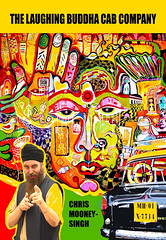
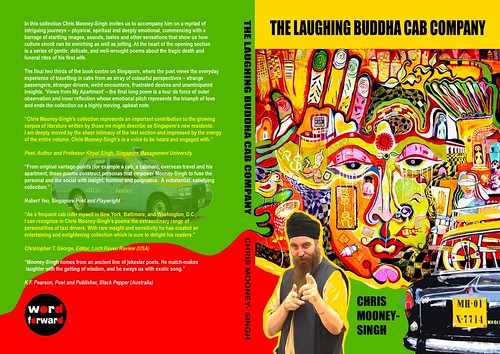
The title shouted from its cover: The Laughing Buddha Cab Company.

A Buddha's face, an open palm, an old-style taxi cab at the bottom-right.

And the poet himself -- a Caucasian face under a Sikh's turban.

Laughing Buddha Cab Company

Scanning through the pages quickly, some words and phrases caught my attention: "Monkey men", "Metallica dreams"...

Didn't mean anything to me (as yet) but certainly very intriguing.

And so I read the poems on the way home.

This was one poetry book that connected with me, for some reason.

Maybe because it revealed more layers to the poet, as a person.

Chris Mooney-Singh gives his readers a peek into his life and experiences, through the poems drawn from jaunts in taxi cabs, in Singapore and India.

The piece titled "Taxi Pantun" (page 57) was quite poignant. About a cabbie relating his woes of his wife (the cabbie's) battle with cancer to his passenger. Not knowing that his passenger emphatised more than one might think.

Speaking of empathy, lines like these made me ponder:
"I watch the bats
outside the MRT
where taxis stop
as we return
with troubled looks
from anxious jobs.
Their circling wings
match out heartbeats,
a comforting flutter
above our heads."

From p. 65 - "Urban Dwellers"

I thought these were beautiful words:
"Light scaled your hair last night.
A moon rising between apartments
sent down its white ladder through
the window while you were sleeping."

From p. 68 - "Views from My Apartment"

In this collection, Chris' poems gives me the sense that there's an air of acceptance; a coming-to-terms with whatever life has thrown at him.

"Children, Darling, are no longer an option.
Children cannot pour like jellybeans


from old jars. Sweets may not be good
for us, after our half century. Better they


stay away. We can go to other homes
as uncle and aunt and give out Toblerone...
"
From p. 72 - "Views from My Apartment".

I know I shouldn't draw the conclusion that this collection is about Chris and his life.

But I can't help but think that he's giving the reader hints of his life, a peek into his mind.

Overall, I'd say this collection is "Quietly Colourful".

The poems are contemplative and reflective.

Come to think of it, this collection could be said to be like Chris the poetry-man himself.

The words burst with a performer's flair at times.

Colourful, like Chris the performer of poetry.

And quiet.

When the stage lights dim and the performer steps off.

Perhaps into a taxi cab.

Chris Mooney-Singh. Laughing Buddha Cab Company

See also:

Thursday, August 21, 2008

Author Anita Desai at the National Library

Just saw this at High Browse Online:
Meet novelist, short-story writer and children’s author Anita Desai in person! Don’t miss this once in a lifetime opportunity to speak to one of the world’s most eminent writers!

Details as follows:

Monday, 25 August 2008
7.00 pm
The Pod, Level 16, National Library
Admission is Free. All are Welcome
.

More about Anita Desai:

Now a Professor of Humanities at MIT, Anita Desai was born in India in 1937 to an Indian father and a German mother. She was three-times nominated for the Booker Prize, but ironically, in a twist of fate, her daughter, Kiran Desai, won the prize in 2006 for her book The Inheritance of Loss. In 1993 Merchant Ivory released a film based on one of her books, In Custody. In 1990, she was awarded the Padma Shri, India’s highest artistic honour.

Cry, the Peacock
Call No.: DES
Anita’s first novel in 1963 sets out
the major themes that would
occupy her writing – the tensions
between modernity and tradition,
especially on Anglicized middle-class
Indian women.


Link

Sunday, December 09, 2007

Singapore Writers Festival: "World Wide Web of Words" post-event reflections

[From this earlier post]

Arrived at The Arts House 30 minutes early.

Went upstairs and saw this scene.
CIMG0731.JPG

Alas, they weren't queuing up for our panel discussion though, LOL (they were waiting to listen to a poetry reading session by Chinese poet Bei Dao, i.e. Zhao Zhenkai).

In contrast, this was how it looked at the other side where the "World Wide Web of Words" panel discussion would be held:
SWF: Corridor outside the Living Room, Arts House

Heh. : )

I made sure I was at the right room (the one complaint I have of The Arts House is its lack of signages. Even the toilets were hard to find).
SWF Programme Listing (Living Room) - 8 Dec 2007

The "Living Room" where our panel discussion was held was lovely. There were about ten people when the session started (when we ended at 4pm we had about 20).
SWF: World Wide Web of Words
I took this shot in the midst of them moving to the front seats. Deepika (she's in the red top, from the left) requested that they moved up, to make things cozier.

I couldn't resist taking a photo of the panelists: [from left to right] Sharon, Deepika and Zafar.
SWF: World Wide Web of Words panelists

Zafar wasn't listed in the programme, and there wasn't time for us to be introduced (along the way, I learned he's a published author, currently starting on his third novel, and has a blog with a poetic name: DreamInk).

Deepika started by asking the audience if they blogged. About five people did.

Perhaps that set the tone for the session, with most of the talking points focusing on the topic of blogging, and the panelists' motivation for starting them.

Why we blogged
Deepika directed the question to me first ("What made you start blogging").

I shared my "blogs were platforms for verbal diarrhea" story.

Sharon essentially explained that she had a compulsion to write and blogging was her outlet. She often had to tell herself to stop posting (and occasionally feed her husband, she says).

Zafar's blog was his "cure for isolation".

Deepika started her blog to post material from her interviews with celebrities (with permission from her then-employer), that otherwise would have been wasted since only a fraction of the interview content was used on air.

Would blogging stay?
We discussed about whether the advent of Facebook shifted our blog readers away. Deepika observed that Sharon's blogs seemed to have relatively fewer comments, and wondered if people were participating more in Facebook. I shared my observation (in using Facebook) that people were using Facebook to promote their blogs.

"Blogs as spaces for inserting your voice"
Deepika also started her blog in response to her being misquoted by some other websites. Since they weren't going to properly acknowledge her or publish corrections, she used a blog to publish her version.

Managing Comments
We discussed quite a bit about dealing with comments.

Deepika turned off her comment feature entirely.

Sharon, on the other hand, said she welcomed comments and the more argumentative the better. Her aim was to create Sharon "self-sustaining conversations". She viewed her blog as a catalyst to get conversations going.

Most satisfying part about blogging
Zafar iterated how his blogging was a way to reduce that sense of loneliness of living in a new country. For Sharon it was from "having lots of conversations" with her readers. Deepika said "blogging takes a life of its own". I shared how one has to blog to truly understand the feeling of receiving an unsolicited comment. It was like an affirmation that your existence is being acknowledged.

So...

While the discussion wasn't so much about books and blogging, or about our writing per se, I thought it might have benefited the audience as most of them might not have found a reason to start one (which might change after hearing what the panelists had to say... maybe).

There were lots more points being discussed, but those were the ones I managed to note down on my handphone/ PDA.

Interestingly, at one point, Deepika noticed me punching away on my handheld and asked if I was "live" blogging (in fact, I'd noticed from the corner of my eye that Sharon was looking at my handheld and I bet she thought I was SMSing!)

I quickly explained that I wasn't "live blogging" (it didn't work for me, as I preferred to compose my thoughts and write about it later). And I told the audience I was taking notes.

Speaking of notes, the organisers passed me this -- a personalised notebook (with my name stamped at the bottom-right corner). How nice!
SWF: Notebook with individualised names!

Unfortunately I got caught up with chatting with some participants after the session, and didn't manage to chat more with Deepika, Zafar and Sharon.

But then again, I'll have their blogs to read and to stay in touch with.

Friday, April 13, 2007

Goodbye, Mr. Kurt Vonnegut (1922 - 2007)

Goodbye, Mr. Vonnegut.

Thank you for Slaughterhouse-Five.
cover
"Kurt Vonnegut was born in Indianapolis in 1922 and served in the US Army during the Second World War. He was captured by the Germans and incarcerated as a prisoner of war in Dresden. Vonnegut survived the saturation bombing of the city and the appalling firestorm that followed, and returned to the USA on his release from captivity. During the 1950s he began his writing career."
Source:
coverThe Mammoth Encyclopedia of Science Fiction.
NLB Call No.: 809.3876203 MAN (all are reference titles at time of this post).
"As an author, Vonnegut has, perfectly reasonably, distanced himself from categorization as an SF author. His work is undoubtedly literary and often surreal, and it was a succession of more mainstream-oriented novels that he made his name. Nonetheless, his SF remains important to the genre...

... Slaughterhouse-Five (1969) tackles Vonnegut's personal response to the Dresden firestorm. The novel is simultaneously bitter, hilarious, and harrowing. Its anti-war message is all the more effective for being subtly delivered."

Read the synopsis and reviews of Slaughterhouse-Five at Amazon.com.

Speaking of Science Fiction (i.e. Sci-Fi, or SF), many people think that Sci-Fi "just talks about science and technology". From my experience, this [sort of thinking] is especially prevalent among those who don't read Science Fiction.

I think works like Slaughterhouse-Five might make them see Sci-Fi in a different light.

To me, good Science Fiction uses Science merely as a stage, whereby social dramas and the human condition are played out. Where the "science" (this includes aliens, fantastic worlds and technologies) adds depth to the story but doesn't overwhelm the reader.

One time I asked a colleague, who doesn't read Sci-Fi, to name some Sci-Fi works. The response was "Star Wars".

In my younger days, I was a few action-figures short of being a raving Star Wars fan. But as much as I like "Star Wars", I don't consider it as exceptionally good Sci-Fi. It's a good story. But hardly seminal science fiction, in my opinion. Certainly not in the leagues of Heinlein or Vonnegut.

Readers who dismiss Sci-Fi merely on perceptions (or even just impressions after one or two books) are really doing themselves a disservice. Of course I'm biased in making these remarks, 'cos I love Sci-Fi works -- the good ones anyway.

Still, you don't have to like Sci-Fi to like Vonnegut. To check for more works by the late Mr. Vonnegut, at the NLB libraries, search for "kurt vonnegut" from the NLB Online Catalogue.

Sunday, February 11, 2007

HBO acquires rights to George R. R. Martin's "A Song of Fire & Ice Ice & Fire" series

[Update 22/3/2007: Header corrected; series title should be "Song of Ice & Fire" and not the other way round. Hat-tip to "The Stark in Winterfell", who left this comment.]

The moment I read this news from none other than George R. R. Martin's blog, I decided to post it at High Browse Online myself, rather than wait till Monday for my colleague to blog it. Yeah, I was that excited!

From Variety.com (16 Jan '07):
HBO has acquired the rights to turn George R.R. Martin's bestselling fantasy series "A Song of Fire & Ice" into a dramatic series to be written and exec produced by David Benioff and D.B. Weiss... ... The series will begin with the 1996 first book, "A Game of Thrones," and the intention is for each novel (they average 1,000 pages each) to fuel a season's worth of episodes. Martin has nearly finished the fifth installment, but won't complete the seven-book cycle until 2011.
[Read the rest of the post at High Browse Online]


Don't know who's George R. R. Martin?
GeorgeRRmartin_fromwikipedia.jpg
[Image from Wikipedia.com; Wiki entry last accessed on 10th Feb 2007]

Check out his official website. I like reading his blog (called "Not A Blog") better. The frustrating thing is that I have to wait till 2011 for the entire series to be complete. Arrgh!

Monday, May 23, 2005

Neil Gaiman might appear at NLB library (or, another example why libraries need to be in touch with the Blogosphere)

Quite a few days ago, thanks to a lead in Tomorrow.sg (posted by ssf), I learnt that Neil Gaiman (of the Sandman fame) would be stopping by in Singapore in July '05. From there, I alerted my Adult & Young People Services librarian colleagues, and one of them took the initiative to check further.

She discovered that the British Council in Singapore was in planning his Singapore's itinerary , and I'm happy to say the library is following up on this. With any luck, Neil Gaiman fans would get to see their favourite author at the public library for a book-signing session.

BTW, the above isn't confirmed, but no harm just giving you a glimpse how public library programmes are planned and implemented by librarians. Librarians (in public libraries, especially) are also Event Organisers, if you will.


Tag: