Showing posts with label wiki. Show all posts

Sunday, January 27, 2008

Social Experiment Update: Singapore Social Media Directory (wiki)

Last week, Singapore Academic and Journalist Cherian George emailed me to write an article for it Journalism.sg, about the Singapore Social Media Directory.

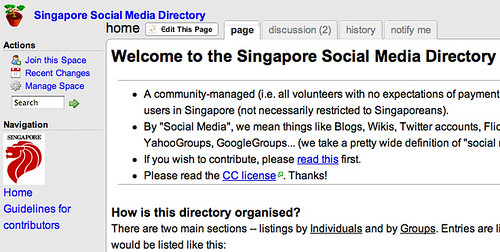
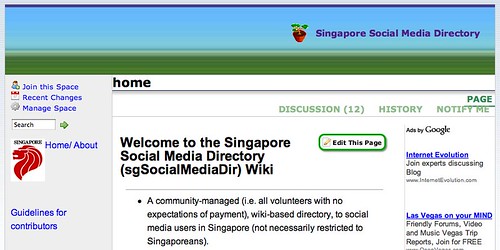
Singapore Social Media Directory » homeI agreed.

Might as well provide an update on this Social Experiment from its start nine months ago.

Cherian suggested a progress report of sorts, on how it's evolved since then.

I'll do just that by sharing 10 observations on how the experiment went, and also share some thoughts on where this experiment will go.


ABOUT THE DIRECTORY/ WIKI
For the full details of the Whys and Hows about the directory, read this post.

I wanted to see how Singaporeans would react to a community-managed Wiki. I called it a "social experiment" because anyone could edit the wiki. If we allowed anonymous edits, how likely would it be vandalised? And would the community contribute to it?

The directory/ wiki was created on 20 March 2007. As far as I know, it was the first of its kind and remains the only one today -- if you're talking about a community-managed Wiki focusing on Singapore and Singaporeans.


STATISTICS on USAGE & ENTRIES (for 2007)
There are about 80 entries for Individuals and 60 Group entries (or 140 entries total) so far. I estimate about 85% to 90% of the entries were by me, with the rest contributed by others.
  • Avg. Daily Page Views = 28 (or 7,900 page views total; most no. of views for a given day was 93)
  • Avg. Daily Unique Visitors = 34 (or 9,750 unique visitors total; most no. of unique visitors for a given day was 107)
  • Top 3 visits by countries = USA (46%), Singapore (42%), China (8%)
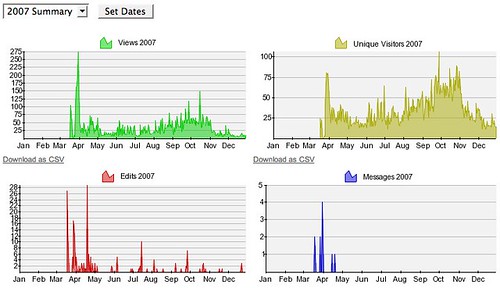
Usage - Singapore Social Media Directory » stats


OBSERVATION #1 - No vandalism
None at all, in the nine months (after 7,900 page views and 9,750 unique visits).

And no one listed any spam entry or a link to an advertising site either. I also didn't get any complaints or requests for me to remove any entries.

Of course one could argue that the directory isn't that well used. The probability of vandalism increases with an increase in usage. Perhaps the directory isn't seen as important enough (like Wikipedia for instance), but I feel that's besides the point. There was no vandalism, period.

My view is that if we let the experiment continue long enough, vandalism and abuse is a really a matter of WHEN and not IF. But if there's pattern or threshold, I can't tell from this experiment.

I think the risk of vandalism tends to be overstated.


OBSERVATION #2 - Tendency to only include entries that "belonged to me", rather than those belonging to others
This was the second major observation. It was clear very early on that apart from myself, no one else added entries that belonged to others.

I made a point to check every link created by others. Of the estimated 10% to 15% of the entries were contributed by other people, all of them listed entries where they had direct association.

As Kevin once observed: "... from a motivational perspective... most people only added their blogs, rather than to contribute what they’ve found out on the web."

Some guesses why this was so:
  1. The communuity-contribution mindset isn't there yet. The prevalent attitude seems to be one of "I want others to find me" rather than "I think others should find this".
  2. Mindset of "I do not have their permission" and hence playing-it-safe by not doing anything. Perhaps there were concerns of intruding into other people's privacy.


OBSERVATION #3 - Not everyone wants to list themselves in the directory
I'd expected people to voluntarily list their blogs in the directory. However, that didn't seem to be the case.
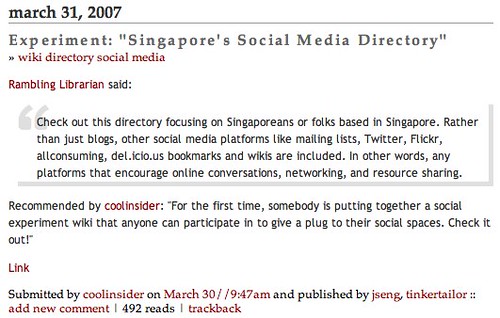
Experiment: "Singapore's Social Media Directory" - listed at Tomorrow.sgThe directory was plugged at Tomorrow.sg on 31 March 2007 (thanks to Walter), which led to a spike in the directory's page views and unique visits. However, the number of contributions didn't increase proportionately.

The Tomorrow.sg entry registered about 490 reads when I took the screenshot today. That might be a major contributor to the visits to the directory, but it didn't automatically translate to the number of contributions.

Possible reasons why the 4,095 unique visitors -- from Singapore -- did not result in a corresponding proportion of entries:
  1. Not all visitors use new media services, so they have nothing of their own to add
  2. If they have, they might not see any value in being listed
  3. Their motivation for blogging (or using social media services) might not be to get widely noticed. So it doesn't really make a difference whether people find their blogs or not.
  4. Some may choose not to have people find their blog or site.
  5. Tendency is for people to "take", rather than "contribute" (submitting something to the directory did not occur to them)
  6. They are not sure how to contribute to the wiki
The possible reasons may not be mutually exclusive either, i.e. there could be overlapping reasons.


OBSERVATION #4 - Few "mistakes" made by contributors
Singapore Social Media Directory » instructions for creating entriesOf those who contributed, all of them managed to adhere to the specified format. I've had to do very little editing of other people's entries.

Most users did it the "smart" way by copying and pasting an earlier entry, and then amending parts of it. I think the trick was to provide an example, and people would be able to follow the required format.


OBSERVATION #5 - Volunteers do step up to help
One user, who was a stranger to me, took the initiative to alphabetise the entries in response to a discussion on how to arrange the entries (see user "ModernBurrow", 31 Mar 2007 entry at this page).

His gesture surprised me, pleasantly. I didn't expect anyone to voluntarily help out. However, I think the directory has dropped off his radar screen, as there have not been further updates from him/ her. It was a positive outcome, nonetheless.


OBSERVATION #6 - Lack of widespread interest and awareness
I didn't have any expectations about usage. Compared to some of my personal blogs, the directory's usage is quite good.

But what the experiment seems to suggest so far:
  • Few Singaporeans are interested in getting themselves listed. Some might do so after I tell them about it but there are relatively more who don't
  • I get better responses when I invite people to list their entries, compared to sending out general calls via mailing lists
  • Poor word-of-mouth by Singaporean bloggers. I searched for "Singapore Social Media Directory" in Google blog search and retrieved 13 links, of which about seven are by Singaporeans

OBSERVATION #7 - Profile of those who list themselves in the directory
I click through every entry created by others. Judging from the links to their entries, none of those entries belong to teenagers (i.e. 13 to 19). I get the impression most owners are in their mid-20s to mid-30s, from tertiary students to working professionals.

My guess is that teens don't really want to let the whole wide world know about their blogs. This impression is reinforced when I ask some teens who have blogs. They confirm that they mainly share their blogs with friends rather than deliberately let the world know that that they have a blog.

I suspect this is also true for adults who blogs.


OBSERVATION #8 - Spin-offs
About a month after the Singapore Social Media Directory was created, one Singaporean blogger (Clapping Tree) created a Asia Social Media Directory at AsiaSocialMediaDir.wikispaces.com. I commented in her post that it was a good initiative.

Out of curiosity, I looked at that wiki's 2007 statistics today. By my calculations, the Asia Social Media Dir wiki has:
  • 22 Page Views Per Day on Average (comparable to the 28 for SgSocialMediaDir)
  • 22 Unique Visitors Per Day on Average P(Vs. 34 for SgSocialMediaDir)
  • Country of origin: 63% USA, 18% Singapore, 15% China (Vs. SgSocialMediaDir's 46% USA, 42% Singapore, 8% China)
The usage statistics seem to be consistent with the focus of the directory, i.e. more Singaporeans using the Singapore-focused directory.

I'd assumed that with its wider geographical coverage (Asia Vs Singapore), the contributions and access to the Asia directory would higher. But it doesn't seem to be the case (unless my calculations were wrong).

Perhaps being "Findable" is a factor (it helped that the Singapore directory was plugged by Tomorrow.sg). Also, although Asia has a wider geographical coverage than Singapore, the number of English-language blogs (and hence people who can read the directory) may not proportionately higher.


OBSERVATION #9 - Usefulness of the directory
Without any survey (formal or otherwise), this part is really my conjecture. Personally, I found the listings by Organisations more useful that individuals. Mainly because I've a greater need to look for institutional blogs than individuals.


OBSERVATION #10 - Keywords & Search is more critical than Categories
I deliberately avoided using subjects or categories for the directory. The only categories are alphabetical listings by "Individuals" and "Groups". The thinking behind this can be found here.

From using the directory, I found that that having meaningful keywords and having a reliable search feature is better than specifying fixed subject categories.

coverAs I understand from his book Everything Is Miscellaneous, David Weinberger suggests that the way to go with digital information is not impose any artificial constraints or limits on how entries were categorised. Because in doing so, we inevitably limit the scope of how items could be searched.

I find this to be true.

Even though I have created most of the entries, most times I rely on search feature to look for entries, especially for entries by individuals. I think the format (Title, Description, Keyword) is working out.

Of course the search isn't that precise, i.e. it lists the page which the entry appears but clicking through, you have to scroll (or do a FIND) to locate the exact entry. Still, it beats having to browse through each entry or page (or category, had we used it to organise the items).

However, that's not to say a directory-listing is useless. I think humans cannot yet move away from physical-world constraints. We're too used to having things compartmentalised. We expect things to be compartmentalised, if only for our psychological benefit.

I think having some categories (in this case, by Individuals and Groups) gives people an idea of what is IN the directory. But the real usefulness comes from the search feature.

If I were to build a Wiki, I'd pay attention to the search and indexing feature, and provide an easy way for users to tag keywords to entries.


FINAL REMARKS - Personal learning experience & future directions
After a year, I can say with greater certainty that the risk of a wiki being vandalised is not as great as one would think.

I'm glad I started the directory because from learning how it works and how people respond (or not respond) to it, I've gone on to help my NLB colleagues setup a Collaborative-Story Wiki for the Singapore Library Week (I was able to tell the developers specifically what features were needed, and discuss with my colleagues the likelihood of success and managing possible risks).

I've also created a wiki for my work with the IFLA Libraries for Children and Young Adults (see YA-guidelines.wikispaces.com)

Future directions
The Singapore Social Media Directory will continue to be available (so long Wikispaces continue to provide it as a free service).

It will still continue to be an experiment. I don't think the learning will end. I'll continue to update it, although I hope to see more community-participation. Perhaps after this update, more Singaporeans will learn about this and give ideas and feedback, if not actually contributing entries.

It is of some use to some people, I'm sure. If nothing else, I do use it from time to time.

Oh, I certainly DO NOT want this to be seen as "Ivan Chew's directory". I'd like to see myself as the catalyst. I also see myself accountable for the entries created there (someone has to).

That being said, I hope a core group of contributors will form sometime soon, from the Singapore online community. Student project, anyone?

Maybe at the appropriate time, I might propose that this directory be moved over to be hosted by the NLB Public Library Services, and then managed by library members. That would be really cool.

OK, comments and suggestions are welcome.

[Update: The entry at Journalism.sg, here]

Friday, April 20, 2007

Brief update on the Singapore Social Media Directory

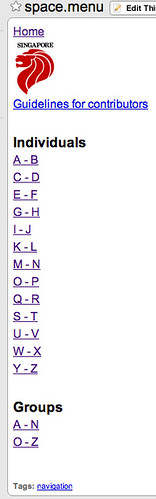
Updated navigation panelBrief update on the Singapore Social Media Directory:

I've expanded the Individual categories from four ("A-G", "H-N" etc.) to 13 ("A-B", "C-D" etc.)

Initially I wasn't sure if the wiki would be updated. Too many unpopulated categories might frustrate users (who click and find a blank page). Now that there's enough entries for each of the 13 pages, I might as well expand the categories now, since the social experiment hasn't crashed and burned. It hasn't exactly taken the Singapore Blogosphere by storm though, but that wasn't the point.

It's been an eye-opener for me so far. I'll post more details on the observations and learning points at a later date.

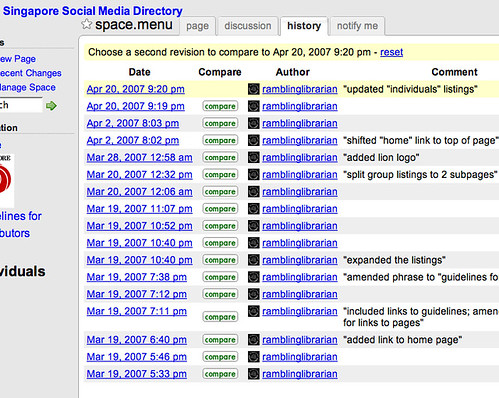
BTW, here's a feature for those not familiar with wikis (it's something I learned as part of the experiment): The cool thing about a wiki is that it allows users to track changes and compare versions.

For instance, to see the changes made to different versions of the navigation page, click on the "history" tab of that page, then choose the two versions to compare against.
Comparing changes

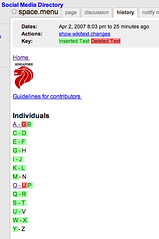
For Wikispaces.com, the insertions and deletions are highlighted in green and red respectively.
Details on insertions & deletions to the wiki page

Until I started using the wiki with an end in mind, I wasn't able to fully appreciate the usefulness of this feature.

OK, more updates soon.

Wednesday, April 04, 2007

Open letter: Response to ST article "Slice of Singapore on Wikipedia" (1 Apr 2007)

There was a Straits Times article titled "Slice of Singapore on Wikipedia", by Jocelyn Lee (1 April 2007). Check with your library or use a service like ASK! if you are interested in reading the full article. I've posted a summary of the article below. I'm jumping one step ahead by posting this open letter to the journalist:

Hello Joycelyn Jocelyn ,

My name is Ivan, aka RamblingLibrarian to my friends. I enjoyed your story on Wikipedia. I believe the point of the article was to inform people of the "dangers" of using Wikipedia and the inherent dangers of wikis. It's a good thing to raise awareness among your readers -- especially students -- on potential pitfalls of over-reliance on any one given information source.

If I've any "grouse", it's that a more balanced picture could be made about wiki-based information sources. Your story may lead people to conclude that wiki-based information sources are not legitimate.

I'm suggesting that one should not dismiss Wikipedia entries outright. The problem is maybe citing Wikipedia as THE only source (i.e. laziness of the user). It has less to do with Wikipedia per se.

The "danger" of using wikipedia is the same as using any website, where one can be over-reliant on one single source without verifying it with supporting information. How rigorous we choose to exercise this verification process is a separate issue.

Some articles (like this and this one) have suggested that Wikipedia may even be more reliable that traditional sources, or at least there's no conclusive way to prove that wiki-sources are less reliable.

The strength of a wiki is also its weakness, depending on perspectives. You've correctly pointed out that a wiki "allows the Internet community to contribute or modify entries". In a general sense, anyone can modify the wiki's content. Any information verified today might have been changed the next, perhaps maliciously. Another "weakness" is that there is no rigorous vetting process, unlike traditional information sources.

But I'd argue that these are similar issues with website information (just that with websites, access to editing is less open). And for wikipedia, there's a way to cite the specific version of the information (see this post). If one bothers to explore the "history" of the article, one can track the changes to the information -- this feature is not available in most websites. Again, I point out that all information sources requires some sort of verification.

Your story mentions how our national sport hero, Ang Peng Siong, had an entry in Wikipedia. Mr Ang was quoted as saying "At least the history of my life is shared with the generations to come...Hopefully they will be inspired by my story as well".

What soon follows was about one factual error -- the year where his 1982 freestyle world record (50m) of 19.86 seconds was formalised at the 1986 Fina World Swimming Championships, and not 1987 as stated. Then the statement that "Mr Ang's case is just one of many examples of the errors and inaccuracies which have crept onto the site".

I think one error doesn't not make an entry (or source) irrelevant. Frankly, I didn't even know an organisation like Fina existed, or that world records needed to be formalised, never mind the year. And the statement that there are "many errors and inaccuracies" reminds me of my bosses asking me this question when I make similar remarks: "How many exactly, compared to the total?" : )

Sometimes, a wikipedia entry is preferred over what's available from print or online sources. For example, I was looking for the discography for Guns N' Roses (Gn'R). What seems to be official Gn'R sites were terrible as a resource. This one (www.gnronline.com) is merely a landing page. This is mainly a tour calendar (www.gunsnroses.us) and this is more for publicity (web.gunsnroses.com). The more relevant sites were these three:
1) NNDB.com
2) Answers.com
3) Wikipedia.com

Of the three, I felt the Answers.com and the Wikipedia entries were better. And between these two, the Wikipedia entry was more comprehensive.

The point was that I've evaluated the Wikipedia entry against other sites (rather than take at face value) and it fitted the context of what I considered as "adequate information".

I hope you don't see this as a rant. As I said, I like what you're doing, to remind your readers about the pitfalls of a wiki-based information source. Ultimately, they have to make an informed choice.

Perhaps as a follow-up story, you could let your readers know that wikis do not equate only to wikipedia. Wikipedia is but a "brand name". The wiki tool has been applied to an information resource listed as encyclopedic entries. Wikis can be applied in other ways, so long the need is to have community-contributed and managed content.

Case in point, i.e. shameless plug, this recent experiment called the Singapore Social Media Directory (background here).

Here's another example of a community-collaborated page, where content is posted by individuals who have content to share, and who don't have the time (or in my case, the technical expertise) to create a website to allow multiple authors or hosting of files or maintaining an audit trial of edits to the document.

Every information tool and resource have their pros and cons. It's not a question of the tool, but how we choose to accept and use that information.

Thanks, and best regards,
Ivan


Here are highlights from the article in the Straits Times, "Slice of Singapore on Wikipedia", by Jocelyn Lee (1 April 2007).
  • The story starts by pointing out that "local personalities" and "uniquely Singaporean terms like 'kiasu'" can be found in Wikipedia.
  • Cites entry on 50m world record holder, Ang Peng Siong: "The 44-year-old swimming coach was not aware that he could be found on Wikipedia."
  • Also cites an error in the entry (discussed in the Open Letter above).
  • Quote: "Mr Ang's case is just one of many examples of the errors and inaccuracies which have crept onto the site."
  • Quote: "Because of its nature, the website has had its share of significant misinformation and juvenile vandalism."
  • Cites the case (in 2006) of former USA Today editor, John Seigenthaler, being erroneously accused in a Wikipedia entry of being involved in the murders of senator Kennedy and president John F. Kennedy. Wikipedia was forced to tighten submission rules.
  • Cites recent case (in 2007) how the credibility of Wikipedia was questioned again when news of one respected editor was deemed to have misled people about his qualifications.
  • Quotes Dr. Mark Cenite, assistant chair of the Wee Kim Wee School of Communication and Information: "When students are doing research projects, they should not cite Wikipedia as anyone can edit the content there"
  • Ends with a mention of how co-founder of Wikipedia, Larry Sanger, has started an
  • alternative called Citizendium (which attempts to introduce greater editorial rigor to entries).

Tuesday, March 27, 2007

Experiment: Announcing the "Singapore Social Media Directory" (via a wiki)

Announcing a "Social Experiment" -- the Singapore Social Media Directory -- sgSocialMediaDir.wikispaces.com -- (a wiki, btw). But I'm ahead of myself here.

Singapore Social Media Directory

You could say the wiki came about from the question: "Where can I look for blogs, especially those in Singapore?"

Participants in the blog-related talks and workshops I've given would always ask me that without fail. The simple answer is to use things like Google Blog Search or Technorati (just to name two). But they aren't very precise when it comes to looking for Singapore-based blogs. Or if we wanted to browse for Singaporeans who blog (i.e. no specific Singaporean blogger in mind). A directory would be a better tool for this purpose.

Why a directory?
We have Tomorrow.SG and Ping.SG, which are great at highlighting Singapore blogs (they call themselves "meta blogs"). But they don't keep a running list of blogs featured.

There are some directories focusing on Singapore blogs (e.g. www.bloggersg.com and www.sgblog.com). But the way they are organised -- by Subjects -- are more suited to listing websites than blogs. With blogs authored by individuals, the subjects and issues discussed in the blog are wide ranging and very fluid. I mean, how do you classify an individual's blog if he/ she writes about politics today and food the next?

Why a wiki?
Ever since I started thinking about wikis, I've wondered if a wiki could be used to create such a directory. Then about a week ago, I created a wiki for the first time, using Wikispaces (hat-tip to Kevin). BTW, the wiki went from idea to reality after a brief discussion with the folks in the Media Socialist group.

What's the focus?
The directory would focus on Singaporeans/ People or groups based in Singapore. Instead of just blogs, I decided to include all social media platforms being used (e.g. mailing lists, blogs, services like Twitter, Flickr, allconsuming, del.icio.us bookmarks, wikis). Any platform that individuals or groups used to facilitate dialogue, interactions, networking and resource sharing.

How it's organised
The directory would be used like the printed Yellow Pages. Instead of organising it by subjects, I thought alphabetical listings would be more effective. Each entry would be listed like this:
  • Name (real and/ or nickname, of the individual or group)
  • Description (concise statements of what the blog etc. is about)
  • Up to 20 phrases/ keywords (to further describe the blog/ medium)

Categorising by Subjects was useful, just that it wouldn't be effective as the main entry point. To compensate for this, that's where the "20 phrases/ keywords" come into play, where additional information not covered in the name or description could be provided. This allows the built-in search engine to retrieve the entry.

E.g. Try searching "librarian" Vs. "librarian ivan". Also try "singapore heritage" Vs. "heritage singapore".

The result, I hope, is a more effective way to organise and access individuals or groups -- catering to users who either want to browse or search.

How is this a Social Experiment?
Because the wiki will be opened for anyone to edit. You read me right. ANYONE. You don't need to be a registered member. Just click on the edit button, add your blog/ group, and save.

See, it's always easier to start something than to maintain it. Same with this idea of a Social Media Directory.

Wikispaces.com allows three levels of access to the wiki -- Public (anyone can view or edit); Protected (anyone can view but only wiki members can edit); Private (only members can view or edit, but this is a paid service).

Between "Public" and "Protected", I opted for the first one. Understandably, none of the members in the Media Socialist group could afford the time to maintain the directory constantly. If people emailed us to include their site,a bottleneck is likely to result (of course there might be zero submissions, but I'm an optimistic guy).

So that's the experiment. It's to see how this directory would be maintained. How entries would be created, with what frequency. Whether some one would delete the pages (doesn't matter if it's by accident or out of malice).

I think the fear is more of the last one. All it takes is just one idiot to ruin the party. We could trace the IP address of the culprit but that won't prevent the damage from happening in the first place. But I'll just have to maintain backups regularly (that's a feature from wikispaces). I'm also curious if the community would help maintain and restore vandalised pages.

It's worth trying out the idea. The cost of failure isn't that high. The world won't end if this experiment crashes and burns. No one will die of embarrassment if nobody responds to this.

So let the Social Experiment begin!

[Update: Social Experiment Update, Jan 2008]