Showing posts with label IFLA. Show all posts

Sunday, August 18, 2013

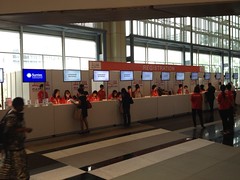
IFLA 2013: "Hello, may I help you?" #wlic2013

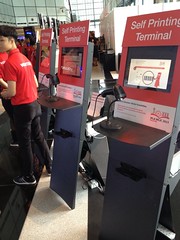
"Where can I get spare printer cartridges?"

"It's very busy out there... I need more people."

"I'm tasked to assist the IFLA Secretary General... Nooo don't take my picture!"

"A taxi uncle brought this back. Somebody left it in his taxi" (referring to a IFLA bag)

"Where's the technician? I finally got someone to unlock the room!"

"What's your role as a volunteer?"
"I'm a maid."
"A maid?"
"I look after (an VIP delegate)."

"I'm sleepy. The delegate is sleepy..."

"Waaaah! Uuuugh!"
(Exclamations and lamentations by some volunteers when told that the opening ceremony venue looked grand; their realisation that they have to man their posts.)

IFLA World Library & Information Conference 2013

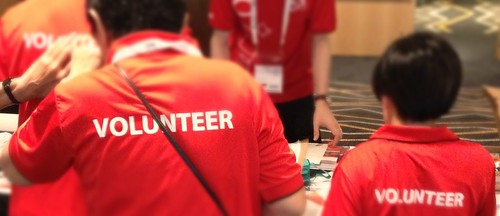
Volunteers are the lifeline of IFLA conferences.

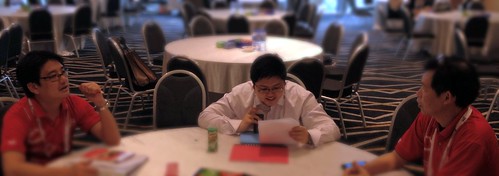
I dropped by the secret location of the IFLA volunteer HQ (just kidding about the secret location). It's normally out of bounds for delegates but my NLB colleagues let me in.

I wanted to share a peek of what goes on behind the scenes. Obviously I'm barely scratching the surface.

IFLA World Library & Information Conference 2013

IFLA World Library & Information Conference 2013 IFLA World Library & Information Conference 2013

The official opening ceremony was about to start when I wrote this.

3,500 delegates from 120 countries.

I'm not sure how many volunteers were involved.

Thank you to each one of you.

IFLA 2013: My Day-One #wlic2013

Registration was a breeze. I'm wasn't sure if that was a setup particular to the conference venue (Suntec Convention & Exhibition Centre). After registering, I just had one more step to do, which was to collect...
IFLA World Library & Information Conference 2013 IFLA World Library & Information Conference 2013 IFLA World Library & Information Conference 2013

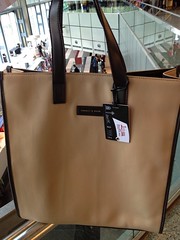
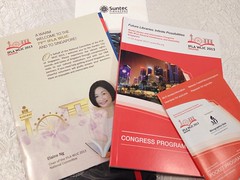
...the official conference bag. Didn't look like the typical conference bag, did it? The only outward sign was a luggage tag with the conference logo. That was removable. The bag was sponsored by a home-grown fashion company, Charles & Keith.  I tweeted that it was probably the most talked-about conference bag in IFLA's history. I felt rather metrosexual carrying the bag around. Not complaining though.
IFLA World Library & Information Conference 2013

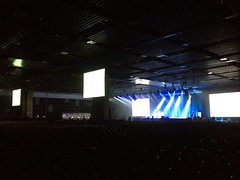
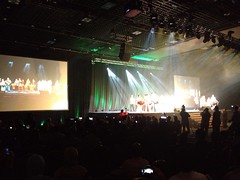
The conference venue was a large one. Had to be. We were later told there were 3,500 delegates from 120 countries attending the conference.
IFLA World Library & Information Conference 2013

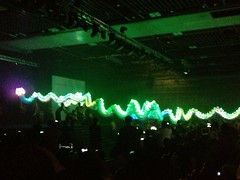
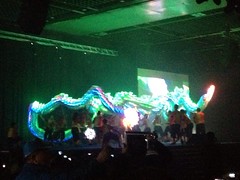
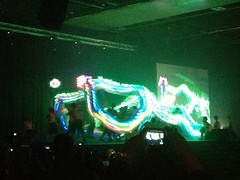
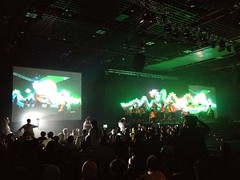
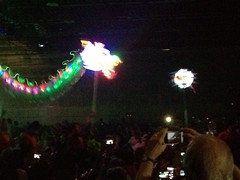
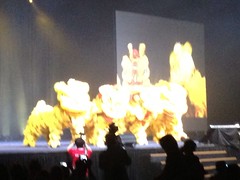
The opening ceremony opened with a Dragon Dance, featuring a souped up dragon in neon electric lights. I've seen plenty of Dragon Dances but never one with a jazzed up dragon like this. Two thumbs up.
IFLA World Library & Information Conference 2013 IFLA World Library & Information Conference 2013 IFLA World Library & Information Conference 2013 IFLA World Library & Information Conference 2013
IFLA World Library & Information Conference 2013 IFLA World Library & Information Conference 2013

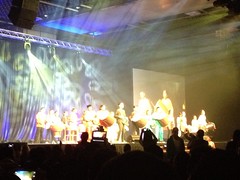
Next came a Malay-Chinese-Indian drums routine, ending with a short Lion Dance. If I was told of such a routine without having watched it, I would have thought it a cliche. But it didn't feel that way. In the context of an event involving participants from all parts of the world, such a symbolic display of racial integration was quite appropriate (it's more than mere symbolism though; go read Bertha Henson's brilliant piece on what it means to be "in Singapore").
IFLA World Library & Information Conference 2013 IFLA World Library & Information Conference 2013 IFLA World Library & Information Conference 2013 IFLA World Library & Information Conference 2013 IFLA World Library & Information Conference 2013

The speeches began next.

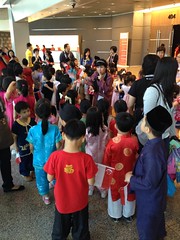
I had to step out of the for a while. Saw a group of children preparing for the next routine.
IFLA World Library & Information Conference 2013 IFLA World Library & Information Conference 2013

There's something special about a gathering of like-minded people. You just had to be there.

I thought the conference was off to a great start.

IFLA World Library & Information Conference 2013

Wednesday, August 14, 2013

IFLA 2013: Some links to help the first-time visitor to Singapore #wlic2013

The last time I blogged about IFLA 2013 was almost two years ago.

So it's finally here.

If you're like me, attending an event in an unfamiliar country, you would have questions like "How do I get around?", "Where to buy food?", "How much should I budget on a daily basis?", or "What to wear?"

And, if you also procrastinate like me, you might not bother to find out about local information until the very last minute. But then you might not do so because because your presentation is still not fully done and you're deep into panic mode LOL.

So I thought to share quick links to practical information, for the last minute prep.

General practical information
The LonelyPlanet site has practical information. I like Frommer's better, as it has more details. I didn't verify all information on prices but the amounts wouldn't change that drastically. At the very least, you should know there's a cost.


Power socket and supply
Singapore uses the 'Type G' British design. A universal adaptor socket would usually do the trick. The voltage is 220-240 volts, so you might want to check your equipment specs. Although I've never heard of any overseas visitors having their gadgets being fried by plugging in.


Internet Access
Most hotels should have WIFI. I'm not too sure if it's all free. There's always Starbucks and MacDonalds.


Maps: websites and apps
I recommend Gothere.sg. As a local, I use it myself. The site loads fast. I've found the information reliable. You can find out how to walk to places, in addition to taking the MRT system, public buses, taxis and private cars.

If you have an iPhone, you can consider the free Singapore Maps app from Apple Store.

This is the map of the MRT, i.e. public train system.


Weather
I refer to this site (from the National Environment Agency) all the time. You'll probably be staying in a hotel near the conference venue, so look for the square box that says "city".


Public toilets
Vast majority are free to use. You can find them in shopping malls. Plenty of public toilets, in reasonably clean condition, within walking distance.


Customs
I'm pretty sure librarians and information professionals will find they aren't going worry about the prohibited stuff (scroll to the bottom of this page). Information on this page, from the Singapore Customs, would also be useful.


-----

Singapore is a tourist-friendly place. I dare say most delegates can get by for the duration of the conference without too much planning. If you have your plane tickets, passport, credit card and some cash, you're good to go.

Oh, don't forget to bring a copy of your IFLA conference confirmation email. You would also have checked out the official IFLA WILC 2013 site.


The last time I attended a IFLA conference (more accurately, the IFLA World Library and Information Congress) was five years ago, in 2008. Had the privilege of attending IFLA in the years I served as the Information Officer for the Libraries for Children and Young Adults Section.

Preparing for a conference trip can often have anxiety-filled moments. I hope this post would be of some help.

See you at the conference.

Logo: IFLA World Library and Information Congress  79th IFLA General Conference and Assembly

Friday, August 19, 2011

Singapore Wins Bid to Host 2013 IFLA General Conference and Assembly

There's about two years to prepare. This should be interesting for librarians in Singapore :)

I hope to see some of my IFLA friends and colleagues again.

From NLB's media release, dated 19 Aug 2011:

Singapore Wins Bid to Host Prestigious International Library Congress in 2013

Release Date : 19 Aug 2011

Singapore, 19 August 2011 – Singapore has won the bid to host the International Federation of Library Associations and Institutions (IFLA) World Library and Information Congress to be held in August 2013. This announcement was made officially at the closing session of the IFLA World Library and Information Congress 2011 on 18 August 2011 in San Juan, Puerto Rico.
 
This marks the first time that Singapore is hosting the Congress, which is the flagship professional and trade event for the international library and information sector. The Congress takes place in August each year in a city selected through a competitive three-stage bidding process that is overseen by the IFLA Governing Board. The hosting of the Congress rotates among the IFLA regions of Asia and Oceania, Europe, Africa, North America and Latin America and Caribbean. Previous host cities included Gothenburg, Sweden in 2010 and Milan, Italy in 2009. The last Asian host city was Seoul, South Korea in 2006.
 
Singapore's bid to host the 2013 edition of the Congress was jointly submitted by National Library Board (NLB) and the Library Association of Singapore and supported by the Singapore Tourism Board (STB), Ministry of Information, Communications and the Arts and the Ministry of Foreign Affairs. The international convention in August 2013 is expected to attract over 3,000 participants from over 100 countries who will converge in Singapore to discuss the developments and new trends in the library arena. The programme will run over eight days, including three days of business meetings, a five-day conference programme, and three and half days of exhibition.
 
“Our successful bid to host the IFLA World Library and Information Congress will place us firmly on the world map of the library and information sector as the Congress offers a unique platform to promote knowledge sharing and exchange best practices within the international community. This will also pave the way for us to deepen relations and facilitate future collaborations with our global counterparts,” said Mrs Elaine Ng, Chief Executive Officer (CEO), NLB.
 
“We are very pleased to be the city of choice for the 2013 IFLA World Library and Information Congress. Singapore's vibrant and pro-business environment, bolstered by quality infrastructure, and a strong global network of strategic partnerships, will provide an ideal platform for the exchange of ideas and collaboration among delegates,” commented Ms Melissa Ow, Assistant Chief Executive, Industry Development (II) Group, STB.
 
“Further, Singapore's rich multi-cultural heritage, diversity of business and leisure offerings, and upcoming developments such as Gardens by the Bay, and the world's first River Safari, look set to provide guests and delegates with a differentiated experience of our constantly evolving city.”
 
A national committee, chaired by CEO of NLB, comprising representatives from the local library and information sector will be set up to oversee the organising of the Congress.

Here's more, from the current Library Association of Singapore president.

Saturday, July 25, 2009

SCL News June 2009: Newsletter of the IFLA Libraries for Children and Young Adult Section

Here's the latest issue of the SCL News (Jun 09), the newsletter of the IFLA Libraries for Children and Young Adult Section.
IFLA - SCL News Jun 2009 issue
PDF (1.05 MB) | Link to all issues

CONTENTS
  • The Chair Speaks - p1.
  • Editor’s Note - p2.
  • Teens: “What I’d Like The World to Read” p3-4.
  • Relocation of the French National Centre for Children’s Literature - p5.
  • Announcement: Sister Libraries project - p6.
  • New literary prize: "Insula Europea" - p6.
  • Minutes: SC Mid-year meeting, March 2009 - p7-9.
  • Read and Reap: Harvests of Reading - p10-11.
  • Give a Bath of Reading to the babies! - p12.
  • Standing Committee Contacts - p13-14.
  • Winner of the 2009 Astrid Lindgren Memorial Award - p15.
BTW, this would be the last time I'm editing the newsletter. My four-year term with the Section is up. I'll be relinquishing the membership to another colleague. I'll save the reminiscing for another post :)

Do check out the newsletter.

Monday, December 29, 2008

Part 3 - Drafting a "Web 2.0 + Young Adult services primer for librarians"

[From Part 2]

Sent the final draft to Ivanka yesterday night. Just checked my email this evening and she came back with some corrections. I made the changes on my master document and emailed it off.

Mission accomplished!

My task was to write at least 22 pages (Times New Roman, Font 12, 1.5 para spacing).

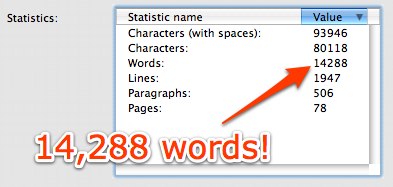
Final result: 78 pages, excluding the cover page (even if it was reduced to font size 10, it's still about 60+ pages).

No. of words - Intro to Web 2.0 for Librarians serving Young Adults

When I did my Masters nine years ago, the thesis requirement was 10,000 words. So does this document constitute one? LOL

The plan is for this document to be published as a IFLA professional report (like this Guidelines for Libraries serving Young Adults). I say "plan", just in case it might not get published (I guess I'm managing my expectations here, heh).

If you wish to take a look at the draft, I'd be happy to send you a PDF copy.

Friday, December 26, 2008

Part 2 - Drafting a "Web 2.0 + Young Adult services primer for librarians"

[From previous post]

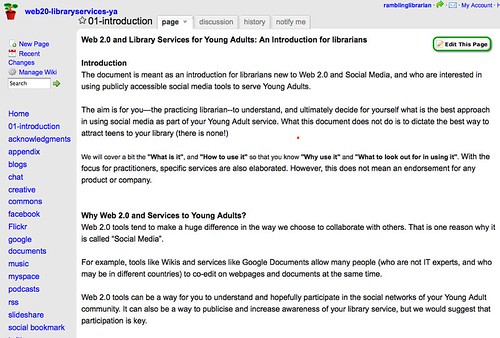
After thinking about it, I decided to start a wiki for the draft.

It's at web20-libraryservices-ya.wikispaces.com

web20-libraryservices-ya

I figured it would be OK for me to make the draft public, since a precedence has been set before.

Besides, there's a certain aptness to using a Web 2.0 tool, to draft a document about using Web 2.0!

My real concern was about working on both a draft at the wiki and on documents I'd saved on my computer. E.g. duplicating work and/ or getting updates mixed up.

I solved that dilemma by working on the wiki only.

As a backup, I exported the entire wiki to my computer.

The advantage of working on the wiki was being able to create and see the entire structure of the document. And I could easily shift text around (e.g. moving parts of the text from the introduction to the appendix).

I could also write To-Do notes for myself (just using the discussion page creatively).

It was also an efficient way to invite others to read the draft (e.g. send a URL rather than send as email attachment). Especially if they and I were on Chat.

Realised there are more benefits: Sending the URL with my periodic email progress updates meant that the person receiving my updates don't have to deal with pesky attachments and getting confused in the process. Especially the "please ignore previous email; here's the latest update" situations.

Plus, the receiver can make changes direct to the pages.

[Incidentally, creating this wiki made me ask the question: "When do I use a Wiki or Google Docs", heh. I added that part to Preetam's write-up.]

Only disadvantage/ risk was the connectivity to the Internet. A slow connection would cause delays to the editing. If the site goes down and I've not exported the updated versions, that'll really mess things up for me. Luckily that didn't happen.

Besides, I've used wikispaces.com for some time now (since this social experiment, which is still on-going). It's been reliable so far. And I know it well enough to use it confidently (contingent plans and all).

My deadline is 28th Dec. I'm about 90% complete for the draft, barring any major changes (I hope not!)

[Part 3]

Wednesday, December 24, 2008

Drafting a "Web 2.0 + Young Adult services primer for librarians"

On a whim, I posted this status update at my Facebook account yesterday:

Facebook Status

In case you can't see the image, my status said: "Ivan is writing a Web 2.0 + Young Adult services primer for librarians."

Within minutes, Isaak commented: "Need any help?"

Soon followed by another Facebook contact Kelvin, wrote: "Interesting - will you be making it available on your blog?"

Then today, Ivy commented: "I thought you are finally writing your own book! I'm looking forward to reading it."


Telling the world about your "status"
Thinking about it, I realised posting a status message about what I was doing (thinking or feeling) isn't a frivolous activity at all.

It's a way to de-stress (you have to try it to believe it!)

Also, it's an indirect way to seek inputs from others. Subconsciously, I'd hoped some people would offer to help.

This also turned out to be a nice way of illustrating the point of using social media for professional work, doesn't it? : )

Which brings me to the document I've been asked to write.


"Web 2.0 and Library Services for Young Adults: An Introduction for librarians"
On my last day in Zagreb, Dr. Ivanka Stricevic, Chair of the IFLA Literacy and Reading Section asked if I could write at least 22-pages on how librarians can use social media in serving Young Adults. Written in English, for translation into Croatian first.

My initial gut-reaction was "Noooooo!"

There are professionals out there who are more qualified that me to write this sort of thing.

But I asked for more information on what was required.

Ivanka explained:
  • By now, librarians would have heard of things like Blogs, Wikis, and services like Facebook and YouTube. But they might not have the time (or maybe confidence, even) to try those services for themselves.
  • I was involved in drafting the IFLA Guidelines for Services to Young Adults, so having me write this was a natural extension to that. And the guidelines did not cover Social Media in-depth.
  • Plus, I'm a librarian an a new media user and practitioner.
  • I'd have plenty of time to write something on the flight back to Singapore.

After some internal struggle, I said OK (wow, how could I argue against those reasons?)

Then I asked, "When do you need it?"

She told me.

I went, "Whaaat?"

Two weeks.

To come up with 22-pages, at least.

Anyway I've a deferment for SCL News, thanks to the Chair in my own IFLA Section, Ingrid (the newsletter was due the same time as this new assignment).


OUTLINE
This was what I drafted while waiting at the airport:
"Chapters" to be included:
- Facebook
- Images (flickr etc)
- Music
- Podcasts
- Twitter
- Video
- Wiki
- Second Life
- MySpace
- Ning
- Chat
- Google Docs
(some chapters need may be lumped together)

Keep language simple, concise. Document meant to be translated to other languages.

Approach it from an introductory level. Less of
"What is it". A little of "How to use it". Enough to let readers know "Why use it" and "What to look out for if I do it".

For practitioners. Examples on "how it can be applied" for Teens services.

Writing it was harder than I anticipated (so what's new?!)

Plus my tendency to procrastinate (I mean, I was letting my subconscious work out some things first... ahem).

But once I'd completed a chapter, writing went at a faster pace. Mentally tiring though, as it became more mechanical, just putting the facts together.

Plus I have to attend to my day job.

Still, I'm glad I took this up. I'm enjoying the writing and research.


A "Web 2.0" example to end this post
Yesterday, within an hour of this response, I took up Isaak's offer to help. Chatted with him in Gmail (he's moved to Australia but we can continue to collaborate efficiently, thanks to Web 2.0)

He agreed to draft the chapters on "Chat and Video-conferencing tools".

Then I spotted Preetam online as well. He blogs, among other things, instructional posts on using Web 2.0 tools. I asked if he had any posts on using Google Documents. He didn't but after I explained why I needed it, he agreed to help with that part.

I told them how they'd be appropriately acknowledged in the IFLA document, as co-contributors (I know they'd still help me even if I didn't mention it but I like to clarify such things at the onset).

Both guys sent me their drafts today (Preetam did it via Google Docs!)

Minutes ago, I sent Isaak my edited draft via Google Docs (in case he wants to add stuff).

This morning, I also "met" Ivy online. She was kind enough to comment on my drafts. Said she can evaluate it from the "techno-newbie" view point. She gave the green-light overall it, so I've greater confidence that I'm in the right direction.

Gotta love Web 2.0 (though in truth, it's really the personal networking and friendship that's key to making Web 2.0 work).


Two more days!
Am giving myself two more days to finish up all the text, tidy up the citations. Plus screen shots.

I'd like to share the drafts via this blog, or a wiki. Might be worth the time to do it, but we'll see.

My priority now is get everything written down as close to the final version as possible (still old-school thinking? lol)


[To be continued: Part 2 - wiki created!]
Saturday, August 16, 2008

IFLA 2008 (part 16): Last SC meeting & Goodbye, Quebec City

[From Part 15]
15 Aug, 2008. Quebec City.

Second & last SC meetingSecond and final Standing Committee (SC) meeting.

We discussed the rest of the agenda items left over from the first meeting.

Confirmation of the Section's strategic plan for 2009-2010. A review of the Section's programmes and presentation over the last five days. Agreement on the venue of the mid-year meeting (which I won't be attending), preliminary ideas for the pre-conference and conference in 2009, and even some ideas for 2010.

Somehow it felt like more was accomplished at this year's meeting.

Maybe it's because we finalised a few things.

Like the revised YA guidelines announced and presented on Tuesday (much work done by a colleague from the US). And a position paper on Information Literacy (thanks to a Japanese colleague).

Also some concrete steps on these two proposals. We've agreed they will proceed as projects.

Then it's a final round of good-byes.

It's back to own countries and our day-jobs.

Visit to Bibliothèque de Charlesbourg

OK, time to pack my bag.

It's been a pleasant and safe stay in Quebec City.

Au revoir.

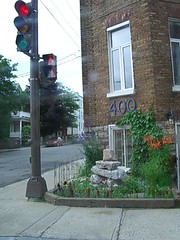
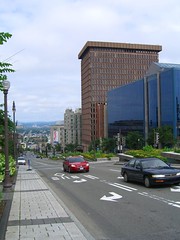
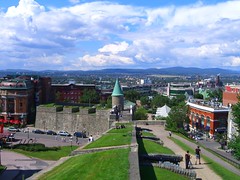
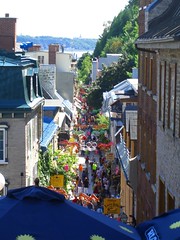
Quebec City suburbs Quebec city suburbs

Quebec City Convention Center Quebec City Rene-Levesque

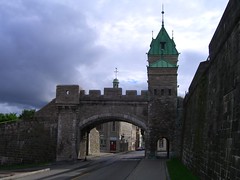
Quebec City - Old City Wall

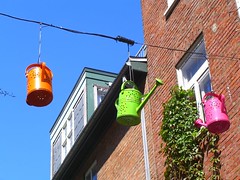
Quebec City street Quebec City - flowering cans

Quebec City fort walls

Friday, August 15, 2008

IFLA 2008 (part 15): Interview with "Pliny the Librarian" from Norway

[From Part 14]

14 Aug 2008. Quebec City, Canada.

I met Pliny the Librarian in person today. We even have an impromptu 10-minute video interview!

Totally unplanned. Video is unedited from start to finish (other than the intro/ end titles and a music soundtrack that I inserted, with whatever I had on my Windows laptop). View at YouTube if you want to see the annotations.

  • 0:06 - How Tord started blogging
  • 2:08 - What does he blog
  • 4:10 - When did he noticed Norwegian librarians were reading his blog
  • 5:13 - Does he encourage his students and academic peers to blog?
  • 7:38 - Does he face resistance from his academic peers (wrt blogging)?
  • 8:35 - How blogging helped him professionally

YouTube Link

I first learned of Pliny the Librarian when I was searching for blog posts about IFLA during the Oslo conference. He was maybe one or two of the bloggers I found, who were attending IFLA and blogging about it.

Then he linked to me again, for last year's IFLA conference.

This year I resolved to meet him in person.

But I forgot to write to him prior to my leaving Singapore. It was only last night that I remembered. There was only one day left to the conference (i.e. today).

So I went to his blog. Learned from his About Page that he's serving on the IFLA Statistics and Evaluation Section. Figured we should be able to meet (I knew where their Section was holding their presentations). I left a comment suggesting that we try to meet up at IFLA.

I was pleasantly surprised that he emailed me and agreed to meet.

At that point, I had no idea how he looked like.

This morning, I asked a Norwegian colleague if he knew Tord. Answer was Yes, and that Tord was a popular blogger among Norwegian librarians!

I was told he's often seen carrying a "big-camera" (i.e. a SLR).

Right after my Section's presentation, I popped by the room where his Section was. Presentations had already started. I scanned the room and couldn't find him.

Until I noticed the slides on screen indicated the speak was "Tord Høivik".

Aha!

For the next two hours (there were four other papers after Tord's), I sat through the presentations on statistics and evaluation in the context of National Libraries. Can't say it excited me, though I still learned a thing or two.

When the entire session was over, I walked to where Tord was. He was busy speaking to another delegate.

More waiting.

I think I sat down for another five minutes (what's another five after waiting for two hours, eh?)

Finally he was available.

I walked to him. Introduced myself.

He went, "Ah!"

Then gestured that we sit down to talk.

Tord was very friendly. Unpretentious. I like him immediately.

On a whim, I asked if I could interview him. On video.

He instantly agreed.

He was a natural.

Ivan Chew & Tord Høivik

Oh, did you know he's 66 years old this year?

Keep blogging, Tord!
(Update: Tord's "IFLA Quebec" blog posts and bloggers round-up here).

[Next: Part 16]

IFLA 2008 (part 14): Canada's Teen (online) Reading Club

[From Part 13]

8.30am, 14 Aug 2008. Libraries for Children and Young Adults Section.

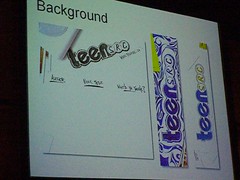
This presentation sounded interesting. It's a reading club for teens. And there's an online element. The paper can be downloaded here (PDF, 742KB).

Abstract:
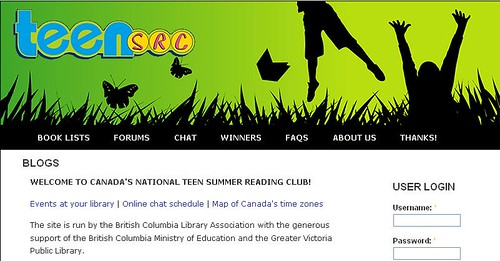
Canada’s Teen Reading Club is a library-based national online reading program for teenagers that promotes reading and libraries. The site features peer-to-peer book recommendations, discussion forums, scheduled chat times, and a creative writing section. The program is sponsored and administrated jointly by government, professional association and library partners. Librarian moderators from across Canada contribute to the site by previewing book reviews and moderating discussion forums. This presentation gives an overview of the site features, budget, privacy and safety concerns, and overall administration of the program.
Here's their website: www.teensrc.ca
Teen Summer Reading Club

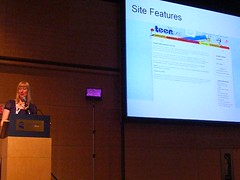
Ms. Kirsten Andersen (from the Greater Victoria Public Library) explained that it's targeted at teens ages 13 to 19.
Canada's Teen Reading Club

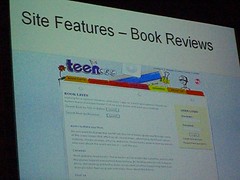
Basically teens submit a book review and get to win a prize. Librarians will review all submissions to ensure they are descriptive and aren't plot spoilers.
Canada's Teen Reading Club

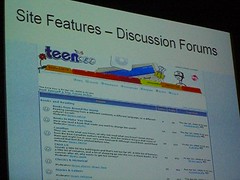
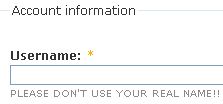
The website has a discussion forum, with a librarian or teen volunteer moderating each thread. They do not allow teens to use real names for privacy reasons.
Canada's Teen Reading Club

She said, "Things discussed are not always profound. Teens mostly want to socialise."

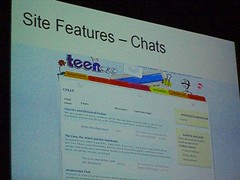
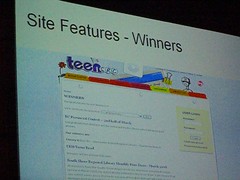
The "Off Topic" discussion thread is a very popular thread. The site also has a online chat feature, a ' Your Words' section for original writing, a Winners section, and Links page.
Canada's Teen Reading Club Canada's Teen Reading Club


Each summer has a different theme (e.g. movie, beach, scrapbook).

The project outcomes exceeded their goals. They received 5,000 book reviews and there was active participation in the discussion forum.

There are 600 libraries involved in some way, and 75 teen volunteers and librarians involved as moderators.

About 3,000 teens actively using the site. The highest number of users at any one time was 170. The site costs C$40,000 a year to maintain.

Quite cost-effective considering that it practically supports the entire Canada and with so many libraries involved. There are graphics that libraries can download and print for their own use.

They provided reading lists but since teens read other things not on the list, they created a section called "Other Stuff" which proved to be the most popular.

For the moderators, there's a hidden moderator forum, and teen moderator forum. There's also a wiki for libraries to add their ideas.

Why they started the service
Prior to this, they only had Summer Reading programmes for children ages 6 to 12. In Summer Reading, you read, record what you've , and redeem prizes.
Canada's Teen Reading Club

They recognised that teens spent time online. Kirsten said in Canada 95% of teens have access to computers. They also recognised that "peer relations are paramount" so in conceiving the project they decided to buid on the "teens' natural preferences" for peer recommendations.

Learning points
Teens are motivation by prizes. They have teens who would've contributed reviews without prizes but some teens also say they were there to win stuff.

Kirsten emphasised how they've been very careful about teens giving personal info online (they have a national Privacy Act, I think).
Teen summer reading club - registration page

Teens users are also fast to report spam. And some fedback that they glad librarians are moderating the site.

Future plans
The programme is currently slanted towards English. So they but will include French reviews to make it inclusive for provinces whose first language is French.

They also intend to involve Pre-teens.
Canada's Teen Reading Club

Q&A
Some one asked if there was a fee to use the site. Answer: It's free.

I asked how they verified that the teens who use the site are who they claim to be. Kirsten answered that they relied on trust (from what I see from the site, you can register for an account if you input the right fields). But people who volunteer as moderators have to make a personal appearance at the library.

I also asked if they expected it to be a success when you started? She replied yes (interesting... I wouldn't have that confidence in trying this for Singapore).


Thoughts
I think sometime in the near future, we should try this in Singapore. Will have to discuss with colleagues and see how to push for this.

But we certainly won't build our own site. For one, there are already Singapore agencies and sites with their established youth portals.

Most likely we'll see how to work hand-in-hand with agencies like Youth.SG. They already have a forum so maybe we could have a section there. Our librarians can moderate and manage that thread. We could work with Youth.SG for joint publicity.

The hard part for Singapore might be to get teens to actually participate.

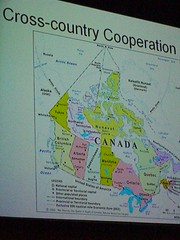
Kirsten explained that Canada is a vast country. Some small towns may only have a handful of teens. I can easily see how their site serves a need for Canadian teens to connect to their peers through reading.

Singaporean teens are such a busy bunch, and they can easily meet their friends face-to-face. They'd probably have online social circles.

But we'll see. Since we don't have to build the site itself (if we work through a partner), it's easy to start and just try it out.

[Next: Part 15]

Thursday, August 14, 2008

IFLA 2008 (part 13): More Web 2.0 in IFLA

[From Part 12]

At my first IFLA conference in Oslo, it seemed to me terms like blogs, wiki, Web 2.0 wasn't in IFLA's lexicon. But year by year, those terms appeared more in presentations and poster sessions.

This year seems like a bumper crop of sorts.

Here's what I spotted at this year's poster sessions:

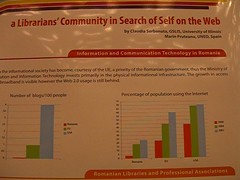
IFLA 2008 poster sessions IFLA 2008 poster sessions

IFLA 2008 poster sessions

IFLA 2008 poster sessions

IFLA 2008 poster sessions IFLA 2008 poster sessions IFLA 2008 poster sessions

This one cautions against jumping into Web 2.0:
IFLA 2008 poster sessions IFLA 2008 poster sessions

Of course, there are plenty of posters that aren't about new media.

And for some things, Web 2.0 just can't replace.
IFLA 2008 poster sessions

Next: Part 14
.