Saturday, August 30, 2008

Advisory Council on the Impact of New Media on Society (AIMS): Consultation Paper - Engaging New Media

My friend Cool Insider, Walter, alerted a bunch of us to the recently published report and recommendations by the Advisory Council on the Impact of New Media on Society, or AIMS (www.aims.org.sg)

AIMS, started in 2007, is a 13-member panel appointed by the Ministry of Information, Communications and the Arts (MICA) to study the impact of new media on Singapore.

The panel was tasked to:
  • To study the far-reaching social, ethical, legal and regulatory implications of a rapidly-growing Interactive Digital Media sector (IDM); and
  • To make recommendations to the Government on how these issues should be managed while keeping pace with the development of IDM in Singapore.
The panel's first report can be downloaded via this link (there's more reports to come, apparently).

The report would interest those interested in how the new media scene in Singapore would develop (gee, this line sounds like a bad book review, LOL!)
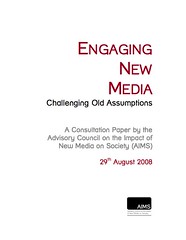
AIMS consultation paper - Engaging New Media.pdf (105 pages)

The 105-page report has four main chapters: E-Engagement, Online Political Content, Protection of Minors, Intermediary Immunity for Online Defamation -- what the panel calls "time-sensitive issues".
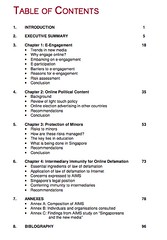
AIMS consultation paper - Engaging New Media (105 pages)

From their Executive Summary (p.5-17), the main recommendations are:
  • On E-Engagement: For the Singapore Government to reconsider its "cautious approach to engaging the public through new media" (p. 6) and to "push further ahead with e-engagement". The panel acknowledges there are risks if e-engagement is not properly thought through and implemented. They propose that the Government continue to invest in research and learn from countries which have started the process of e-engagement. Page 8 has a summary of some concrete steps on how to embark on e-engagement.

  • On Online Political Content: To liberalise Section 33 of the Films Act that prohibits the making, distributing and exhibiting of party political films. The ideal situation would be to create "maximum space for political discourse, but be sensitive at the same time to the need to keep out harmful material online". The panel suggests these ways to liberalise the law -- One is to narrow the scope of the law; Two is to repeal Section 33 altogether; Three is a combination of One and Two and repeal the Films Act in phases.

  • On Protection of Minors: The panel suggests that the longer term solution is to focus on education (on online dangers and safeguards) among the young and their parents. The current Family Access Network service provided by all ISPs [see editor's note at this page] should be made free to Singaporean households who wish to have it. More local research is needed to find solutions tailored to Singapore's context. Also, to collaborate with overseas counterparts to share research, ideas and resources on the universal issue of protecting minors. The panel also called for volunteers and community participation in the area of Cyber-safety. And to implement the above recommendations, AIMS also recommends an annual fund for the protection of minors and to a dedicated coordinating agency for the protection of minors. Finally, to lift the (symbolic) ban on 100 websites, once all the proposed measures are in place.

  • On Intermediary Immunity for Online Defamation: For the law to give limited immunity for Internet content hosts and aggregators where civil and criminal liability for defamation are concerned, if those intermediaries have acted in good faith and implement "take down" actions of defamatory content.

I spent maybe 35 minutes going through the report. It's an easy to read report with some illuminating insights on how other countries are dealing with similar issues.

For example, page 18 (E-Engagement) briefly explains how a student Facebook campaign forced HSBC bank to re-think its move to scrap its interest-free overdraft facility for British students leaving university (BBC article here, as cited in the report).

Pages 19 to 23 talks about the trends in New Media, Web 2.0, Blogging as a significant development, the "mass democratisation of information", using new media as a public forum.

Pages 23 to 24, and 27 to 30 suggests why the Singapore government needs to engage online.

Chapter Two - Online Political Content - was useful to me in understanding the background and issues surrounding the Films Act, Internet election advertising and political broadcasts. There's a coverage of how Japan, South Korea, Australia, and Canada deal with online elections advertising.

It also mentions the Singapore government's Light Touch policy towards Internet regulation. On page 41, the report asks if current regulations are still relevant, citing instances from the 2008 Malaysian general election and the 2007 Australian elections.

On the start of the report, on page four, it says:
The Council is aware that these recommendations will not satisfy everyone. There is always room for improvement and areas to study more closely. The Internet is a never-ending worldwide conversation. We see the recommendations in this report as part of an ongoing conversation that started when the Internet became part of our lives. To aid us in our efforts, we welcome feedback from the public to help us improve on our recommendations.

At the AIMS website, there is a feedback form for public to submit comments.

They plan to launch a blog on 1 September 2008. [Update: the blog is at blog.aims.org.sg]

[Related - TODAYonline's article on the Protection of Minors recommendation].

Wednesday, August 27, 2008

Why Kevin Googles instead of using his library

Kevin wrote about his recent problem in locating a book at his university's library.
  • At first, he couldn't find the book on the shelf even though the OPAC said it was available.
  • After he contacted the librarian (via their IM service), he was informed that it was at the New Arrivals shelf.
  • His next problem was not being able to locate the New Arrivals shelf.
Seems to me the problem could be avoided in the first place if the OPAC record showed both the permanent shelf location AND its temporary location (i.e. New Arrivals).

Admittedly, this is also a limitation of the our public library's OPAC. The current OPAC system can only display the permanent location.

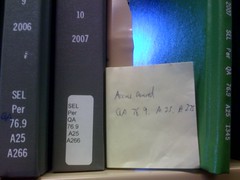
I had to smile at Kevin's photo. He wrote a note that says "Access Denied" and placed it where the book should be.

Come to think of it, this is a simple solution for library's whose OPAC cannot show the temporary location. If the volume of new arrivals isn't too high, I suppose it's worth the time to place temporary placeholders to direct users to the new arrival shelf.

In the second instance, it appeared that Kevin encountered a "navigational" issue within his library. I've not been to UB library so I can't comment on how clear its directions are.

This isn't a problem unique to libraries. We encounter the same thing in any large and unfamiliar location -- roads, shopping malls.

Kevin's suggestion of having in-library GPS is a dream for many librarians. If the technology becomes cheap enough, I'm sure libraries would be the first to implement it.

But from Kevin's post, I noted several things that were right.
  • He got the book eventually!
  • The book was acquired by his library, and he learned about it by checking his library's website
  • His library provided access to the librarians via Instant Messaging
I suppose I'm making a biased comment here (being a librarian myself) but in the age of Google and the Internet, it's easy to see what's wrong with the physical library service rather than what's done right.

Systems can be upgraded. Directional signages can be improved.

But I think what's more important is dialogue between library users and librarians.

No system is perfect.

In the midst of running the library, things are overlooked.

I'm glad Kevin blogged about it, and also offered constructive suggestions. I wonder if he sent his UB librarian his blog post link. I know the NLB libraries appreciates -- and acts -- on feedback like this.

Libraries may not be able to right every wrong immediately.

But what tends to tip the scale in favour of users would be the feedback of the majority.

When enough users ask for the same things -- constructively -- it'll be foolish for the library not to act.

Of course not everyone would want to inform the library directly. Libraries need to proactively seek what customers are saying -- in blogs, forums etc.

Or perhaps help from Friends of Libraries to pass those information along.

Libraries and libraries can always use whatever help we can get :)

[Related: 23 Jul 06 - A long term solution for how the library collection is organised?]

Thursday, August 21, 2008

Author Anita Desai at the National Library

Just saw this at High Browse Online:
Meet novelist, short-story writer and children’s author Anita Desai in person! Don’t miss this once in a lifetime opportunity to speak to one of the world’s most eminent writers!

Details as follows:

Monday, 25 August 2008
7.00 pm
The Pod, Level 16, National Library
Admission is Free. All are Welcome
.

More about Anita Desai:

Now a Professor of Humanities at MIT, Anita Desai was born in India in 1937 to an Indian father and a German mother. She was three-times nominated for the Booker Prize, but ironically, in a twist of fate, her daughter, Kiran Desai, won the prize in 2006 for her book The Inheritance of Loss. In 1993 Merchant Ivory released a film based on one of her books, In Custody. In 1990, she was awarded the Padma Shri, India’s highest artistic honour.

Cry, the Peacock
Call No.: DES
Anita’s first novel in 1963 sets out
the major themes that would
occupy her writing – the tensions
between modernity and tradition,
especially on Anglicized middle-class
Indian women.


Link

Wednesday, August 20, 2008

Kankakee Public Library revisited

I love Kankakee Public Library. I've blogged about their library several times.

On my way back from IFLA 2008, I made a personal stopover in the city of Kankakee for a short visit to their library. It was nice to see Cindy (if only briefly, as she was on leave), Steve and Camille again.
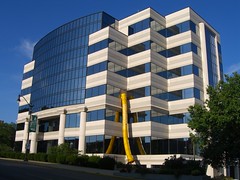
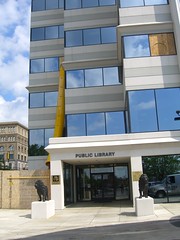
Their library occupies three floors of this building, with a fourth floor being added.
Kankakee Public Library Kankakee Public Library

Cindy (director) and Steve (assistant director) were so cordial and nice when I visited them in 2005. I remembered how they shared their vision for their library. They also asked interested questions about how we did things in Singapore. I also met Camille (in charge of Youth services) who was clearly enthused and passionate about her work.

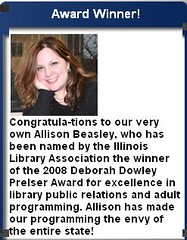
This time I met Allison (head of Adult Services and active blogger at their staff blog), after corresponding with her over email for about two years

[Btw a belated congratulations Allison, for I just learned from your library website that you've been awarded winner of the 2008 Deborah Dowley Prelser Award by the Illinois Library Association.]
Allison Beasley - Illinois Library Association the winner of the 2008 Deborah Dowley Prelser Award

Allison, Steve and I had a brief chat in Steve's office.
Kankakee Public Library

Steve shared about their new plans for their library extension. The additional floor would have an auditorium. In the layout drawing that Steve printed, I noticed an area in the auditorium marked as "podcast/ vodcast room".

I said out loud, "This must be (planned) by Steve!" :)

The new floor will also have a room with the equipment for library users to create their own podcasts and vodcast. They have the option of letting the library use the audios and videos.

I asked how they would ensure the content is appropriate. Steve said the library wouldn't be obligated to use everything that users produce (makes perfect sense to me).

Their podcasts have 1,800 downloads a month (wow!). They make their podcasts available via iTunes, which was a clever way of making their podcasts more accessible.

Services to teens
I was particularly interested in their services to teens. Camille took time out of her schedule to meet me.
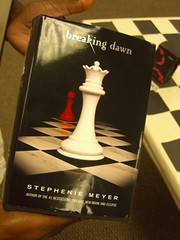
Camille (didn't take a picture with her, unfortunately) shared about how this book was the current favourite (something like 790 reservation requests, woah!).
Kankakee Public Library Kankakee Public Library

She informed me about how the trend of crossover titles and authors (i.e. authors who typically wrote for teens were writing for the adult market, and vice cersa) encouraged teens to move into adult collections.

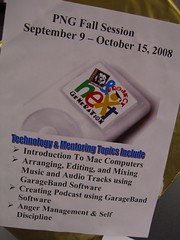
I noticed this poster on the table and asked about it. Camille explained that this was a programme by application only. It was specifically targeted at male teens. The application form even required parental consent (which I thought was a good way to engage the parents in the programme).

Basically, the participants (about 10 per programme) learn how to use Mac computers to produce content (visual, audio, video). I think they get to go on study trips too.
Kankakee Public Library
[I'll ask Allison if they can share more about this programme in their staff blog].

Camille showed me their Manga and Anime collections. The Manga collections were more popular than the DC or Marvel ones, she said.

From our conversations about YP collections, it's clear we share the same issues. It's interesting to learn how they tackle it. For instance, they also have parents who complain that some graphic novels seem violent and have scantily clad women.

Kankakee PL's response was to explain their collections policy (they remove the offensive titles if required). They'd post bookmarks and posters near the Manga section, informing parents that some Manga and graphic novel titles require parental guidance.

Here's a neat idea: Spa Night for teen girls!

Teen girls were introduced to topics like personal grooming and health. Related books and materials were also introduced.

I asked Camille if they have gaming in the library. She said they've introduced it for some time now, and they found it successful in attracting teens to the library (which they subsequently introduce related books as part of the event). Male teens is their primary target group.

She said the ALA now has an advocacy page on gaming in libraries (see this and this).


I can go on with nice things to say about Kankakee PL.

But the best compliment may have come from my friend.

My friend lives and work near Kankakee. He isn't a librarian. He drove me to the library that day and he stayed to chat with Steve and Allison.

Later as we drove away, my friend said he was impressed with what Kankakee Public Library did. That their work was "uplifting" during this difficult economic situation they are facing (case in point -- that day's paper reported funding cuts for schools in their area).

I understand exactly what my friend meant by uplifting.

Kankakee Public Library, especially their staff, throws off positive vibes.

Kankakee Public Library

Saturday, August 16, 2008

IFLA 2008 (part 16): Last SC meeting & Goodbye, Quebec City

[From Part 15]

15 Aug, 2008. Quebec City.

Second & last SC meetingSecond and final Standing Committee (SC) meeting.

We discussed the rest of the agenda items left over from the first meeting.

Confirmation of the Section's strategic plan for 2009-2010. A review of the Section's programmes and presentation over the last five days. Agreement on the venue of the mid-year meeting (which I won't be attending), preliminary ideas for the pre-conference and conference in 2009, and even some ideas for 2010.

Somehow it felt like more was accomplished at this year's meeting.

Maybe it's because we finalised a few things.

Like the revised YA guidelines announced and presented on Tuesday (much work done by a colleague from the US). And a position paper on Information Literacy (thanks to a Japanese colleague).

Also some concrete steps on these two proposals. We've agreed they will proceed as projects.

Then it's a final round of good-byes.

It's back to own countries and our day-jobs.
Visit to Bibliothèque de Charlesbourg

OK, time to pack my bag.
It's been a pleasant and safe stay in Quebec City.

Au revoir.

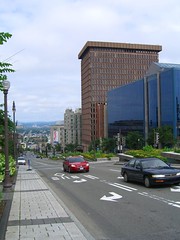
Quebec City suburbs Quebec city suburbs

Quebec City Convention Center Quebec City Rene-Levesque

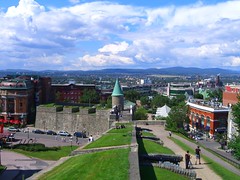
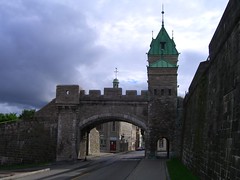
Quebec City - Old City Wall

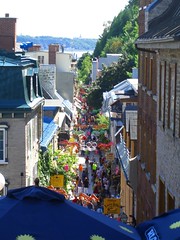
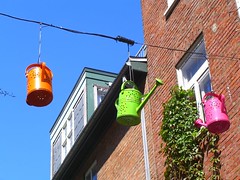
Quebec City street Quebec City - flowering cans

Quebec City fort walls

Friday, August 15, 2008

IFLA 2008 (part 15): Interview with "Pliny the Librarian" from Norway

[From Part 14]

14 Aug 2008. Quebec City, Canada.

I met Pliny the Librarian in person today. We even have an impromptu 10-minute video interview!

Totally unplanned. Video is unedited from start to finish (other than the intro/ end titles and a music soundtrack that I inserted, with whatever I had on my Windows laptop). View at YouTube if you want to see the annotations.

  • 0:06 - How Tord started blogging
  • 2:08 - What does he blog
  • 4:10 - When did he noticed Norwegian librarians were reading his blog
  • 5:13 - Does he encourage his students and academic peers to blog?
  • 7:38 - Does he face resistance from his academic peers (wrt blogging)?
  • 8:35 - How blogging helped him professionally

YouTube Link

I first learned of Pliny the Librarian when I was searching for blog posts about IFLA during the Oslo conference. He was maybe one or two of the bloggers I found, who were attending IFLA and blogging about it.

Then he linked to me again, for last year's IFLA conference.

This year I resolved to meet him in person.

But I forgot to write to him prior to my leaving Singapore. It was only last night that I remembered. There was only one day left to the conference (i.e. today).

So I went to his blog. Learned from his About Page that he's serving on the IFLA Statistics and Evaluation Section. Figured we should be able to meet (I knew where their Section was holding their presentations). I left a comment suggesting that we try to meet up at IFLA.

I was pleasantly surprised that he emailed me and agreed to meet.

At that point, I had no idea how he looked like.

This morning, I asked a Norwegian colleague if he knew Tord. Answer was Yes, and that Tord was a popular blogger among Norwegian librarians!

I was told he's often seen carrying a "big-camera" (i.e. a SLR).

Right after my Section's presentation, I popped by the room where his Section was. Presentations had already started. I scanned the room and couldn't find him.

Until I noticed the slides on screen indicated the speak was "Tord Høivik".

Aha!

For the next two hours (there were four other papers after Tord's), I sat through the presentations on statistics and evaluation in the context of National Libraries. Can't say it excited me, though I still learned a thing or two.

When the entire session was over, I walked to where Tord was. He was busy speaking to another delegate.

More waiting.

I think I sat down for another five minutes (what's another five after waiting for two hours, eh?)

Finally he was available.

I walked to him. Introduced myself.

He went, "Ah!"

Then gestured that we sit down to talk.

Tord was very friendly. Unpretentious. I like him immediately.

On a whim, I asked if I could interview him. On video.

He instantly agreed.

He was a natural.

Ivan Chew & Tord Høivik

Oh, did you know he's 66 years old this year?

Keep blogging, Tord!
(Update: Tord's "IFLA Quebec" blog posts and bloggers round-up here).

[Next: Part 16]

IFLA 2008 (part 14): Canada's Teen (online) Reading Club

[From Part 13]

8.30am, 14 Aug 2008. Libraries for Children and Young Adults Section.

This presentation sounded interesting. It's a reading club for teens. And there's an online element. The paper can be downloaded here (PDF, 742KB).

Abstract:
Canada’s Teen Reading Club is a library-based national online reading program for teenagers that promotes reading and libraries. The site features peer-to-peer book recommendations, discussion forums, scheduled chat times, and a creative writing section. The program is sponsored and administrated jointly by government, professional association and library partners. Librarian moderators from across Canada contribute to the site by previewing book reviews and moderating discussion forums. This presentation gives an overview of the site features, budget, privacy and safety concerns, and overall administration of the program.
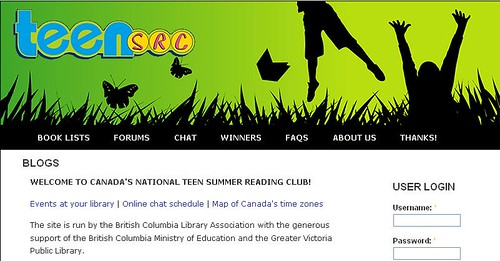
Here's their website: www.teensrc.ca
Teen Summer Reading Club

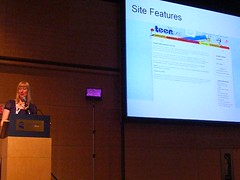
Ms. Kirsten Andersen (from the Greater Victoria Public Library) explained that it's targeted at teens ages 13 to 19.
Canada's Teen Reading Club

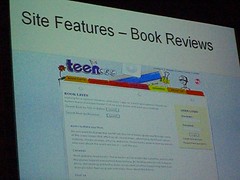
Basically teens submit a book review and get to win a prize. Librarians will review all submissions to ensure they are descriptive and aren't plot spoilers.
Canada's Teen Reading Club

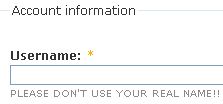
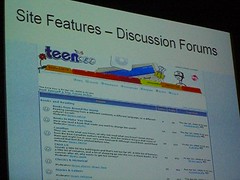
The website has a discussion forum, with a librarian or teen volunteer moderating each thread. They do not allow teens to use real names for privacy reasons.
Canada's Teen Reading Club

She said, "Things discussed are not always profound. Teens mostly want to socialise."

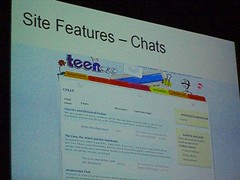
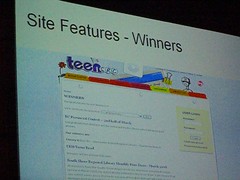
The "Off Topic" discussion thread is a very popular thread. The site also has a online chat feature, a ' Your Words' section for original writing, a Winners section, and Links page.
Canada's Teen Reading Club Canada's Teen Reading Club


Each summer has a different theme (e.g. movie, beach, scrapbook).

The project outcomes exceeded their goals. They received 5,000 book reviews and there was active participation in the discussion forum.

There are 600 libraries involved in some way, and 75 teen volunteers and librarians involved as moderators.

About 3,000 teens actively using the site. The highest number of users at any one time was 170. The site costs C$40,000 a year to maintain.

Quite cost-effective considering that it practically supports the entire Canada and with so many libraries involved. There are graphics that libraries can download and print for their own use.

They provided reading lists but since teens read other things not on the list, they created a section called "Other Stuff" which proved to be the most popular.

For the moderators, there's a hidden moderator forum, and teen moderator forum. There's also a wiki for libraries to add their ideas.

Why they started the service
Prior to this, they only had Summer Reading programmes for children ages 6 to 12. In Summer Reading, you read, record what you've , and redeem prizes.
Canada's Teen Reading Club

They recognised that teens spent time online. Kirsten said in Canada 95% of teens have access to computers. They also recognised that "peer relations are paramount" so in conceiving the project they decided to buid on the "teens' natural preferences" for peer recommendations.

Learning points
Teens are motivation by prizes. They have teens who would've contributed reviews without prizes but some teens also say they were there to win stuff.

Kirsten emphasised how they've been very careful about teens giving personal info online (they have a national Privacy Act, I think).
Teen summer reading club - registration page

Teens users are also fast to report spam. And some fedback that they glad librarians are moderating the site.

Future plans
The programme is currently slanted towards English. So they but will include French reviews to make it inclusive for provinces whose first language is French.

They also intend to involve Pre-teens.
Canada's Teen Reading Club

Q&A
Some one asked if there was a fee to use the site. Answer: It's free.

I asked how they verified that the teens who use the site are who they claim to be. Kirsten answered that they relied on trust (from what I see from the site, you can register for an account if you input the right fields). But people who volunteer as moderators have to make a personal appearance at the library.

I also asked if they expected it to be a success when you started? She replied yes (interesting... I wouldn't have that confidence in trying this for Singapore).


Thoughts
I think sometime in the near future, we should try this in Singapore. Will have to discuss with colleagues and see how to push for this.

But we certainly won't build our own site. For one, there are already Singapore agencies and sites with their established youth portals.

Most likely we'll see how to work hand-in-hand with agencies like Youth.SG. They already have a forum so maybe we could have a section there. Our librarians can moderate and manage that thread. We could work with Youth.SG for joint publicity.

The hard part for Singapore might be to get teens to actually participate.

Kirsten explained that Canada is a vast country. Some small towns may only have a handful of teens. I can easily see how their site serves a need for Canadian teens to connect to their peers through reading.

Singaporean teens are such a busy bunch, and they can easily meet their friends face-to-face. They'd probably have online social circles.

But we'll see. Since we don't have to build the site itself (if we work through a partner), it's easy to start and just try it out.

[Next: Part 15]

Thursday, August 14, 2008

IFLA 2008 (part 13): More Web 2.0 in IFLA

[From Part 12]

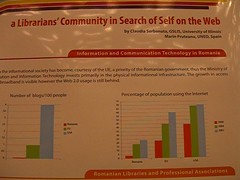
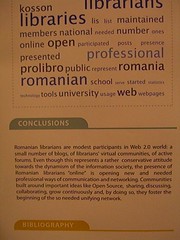
At my first IFLA conference in Oslo, it seemed to me terms like blogs, wiki, Web 2.0 wasn't in IFLA's lexicon. But year by year, those terms appeared more in presentations and poster sessions.

This year seems like a bumper crop of sorts.

Here's what I spotted at this year's poster sessions:

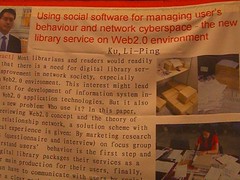
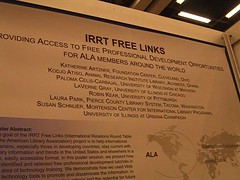
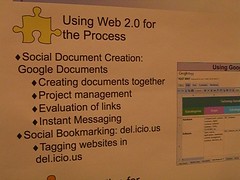
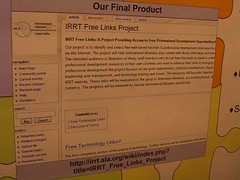
IFLA 2008 poster sessions IFLA 2008 poster sessions

IFLA 2008 poster sessions

IFLA 2008 poster sessions

IFLA 2008 poster sessions IFLA 2008 poster sessions IFLA 2008 poster sessions

This one cautions against jumping into Web 2.0:
IFLA 2008 poster sessions IFLA 2008 poster sessions

Of course, there are plenty of posters that aren't about new media.

And for some things, Web 2.0 just can't replace.
IFLA 2008 poster sessions

Next: Part 14
.

IFLA 2008 (part 12): Adhoc meeting

Update on the Sister-library and the Youth Expression project proposals (previously mentioned here):

Our small working group hard at work

After this morning's visit, a few of us met to discuss the scope of the two proposals.

Final decision:
  • The two projects will not be combined
  • The Sister-library proposal will be tabled as the strategic plan for 2009. A framework needs to be developed. A working team will be formed
  • I'm tasked to proceed with a prototype for the Youth Expression proposal. I guess people need to visualise how this can be done. Linn (from Norway) has agreed to help connect me to a library in her country for this prototype stage (if you're a librarian reading this and want to be involved at this stage, I'd love to hear from you)
More to be discussed at our second and final SC meeting.

But we're getting there.

I wish I'd recorded the audio of our discussions.

This is a group who come from different backgrounds. Different working styles. We don't share a common first language. It can be hard to articulate what we want to express. Or understand what has been said.

Clarifications were sought. Objections were raised.

There were disagreements.

But it was about ideas and not personalities.

I love librarians :)


Previous: Part 11
Next: Part 13

IFLA 2008 (part 11): Visit to Bibliothèque de Charlesbourg (Charlesbourg Public Library)

[From Part 11]

13 Aug 08, 8am. Libraries for Children and Young Adults Section off-site programme.

This is a long post. Plenty of pictures.

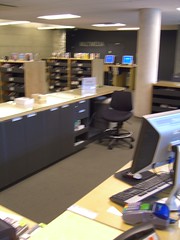
This morning, we visited the Bibliothèque de Charlesbourg (pronounced "char-le-boo").
Visit to Bibliothèque de Charlesbourg Visit to Bibliothèque de Charlesbourg Visit to Bibliothèque de Charlesbourg Visit to Bibliothèque de Charlesbourg Visit to Bibliothèque de Charlesbourg

Visit to Bibliothèque de Charlesbourg

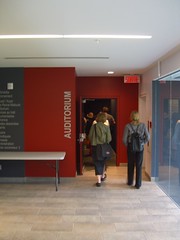
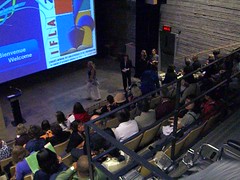
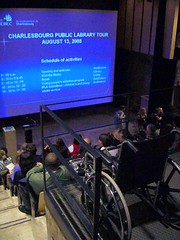
We were ushered into a very cosy auditorium.
Visit to Bibliothèque de Charlesbourg Visit to Bibliothèque de Charlesbourg

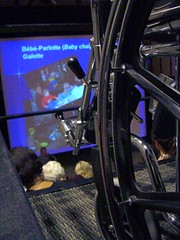
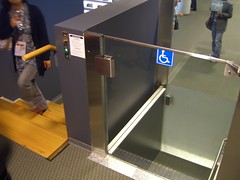
I love how they constructed this balcony to accommodate wheelchairs and maybe baby prams. So thoughtful!
Visit to Bibliothèque de Charlesbourg Visit to Bibliothèque de Charlesbourg

The library was started in October 1981, then relocated to its new premises in October 1983. It's said to have one of the best Young Adults service and programmes.

They serve 74,000 residents. Renovated two years ago (enlarged the library space by three times, at a cost of €6.3 million Euros -- wow, did I hear that right?)

I canbelieve it cost that much.
Visit to Bibliothèque de Charlesbourg

It's an impressive building.

Visit to Bibliothèque de Charlesbourg Visit to Bibliothèque de Charlesbourg Visit to Bibliothèque de Charlesbourg

Our guide explained how the building is designed to be eco-friendly (something about the roof but I didn't catch the details).

Visit to Bibliothèque de Charlesbourg Visit to Bibliothèque de Charlesbourg Visit to Bibliothèque de Charlesbourg Visit to Bibliothèque de Charlesbourg Visit to Bibliothèque de Charlesbourg

The interior was designed for efficient traffic flow. The designers aimed to make it easy to find things and for the place to feel like a second home.

[I found this to be true. It's huge and looks complex but somehow moving from section to section was straight forward and along structured path ways. The 6.3m Euros was well-spent].
Visit to Bibliothèque de Charlesbourg Visit to Bibliothèque de Charlesbourg Visit to Bibliothèque de Charlesbourg Visit to Bibliothèque de Charlesbourg Visit to Bibliothèque de Charlesbourg

I believe this is the self-checkout machine. It was the only one I saw in the library. The library isn't into self-help services it seems.
Visit to Bibliothèque de Charlesbourg

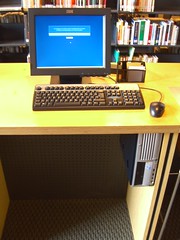
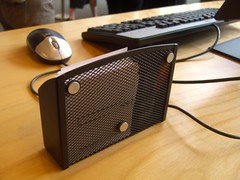
The OPAC stations are clustered together. Very simple yet elegant designs. Their CPU unit is exposed. I guess it eliminates the heat issue but wonder if any users have itchy-fingers and switch the machines on/ off.
Visit to Bibliothèque de Charlesbourg Visit to Bibliothèque de Charlesbourg

The holder for the paper (for users to copy the Call Number) is bolted down. Nice.
Visit to Bibliothèque de Charlesbourg

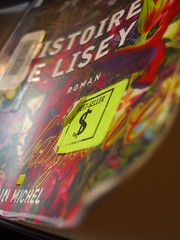
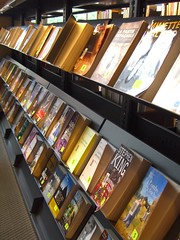
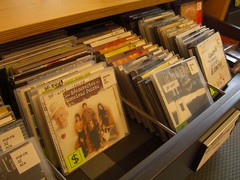
Here's something new to me: Library items with the "$" symbol on the cover means users have to pay a fee per item to borrow. This is the Bestsellers and popular items section. The fee is around $3 Canadian.
Visit to Bibliothèque de Charlesbourg Visit to Bibliothèque de Charlesbourg
They have adopted to use fees to regulate demand. I wondered how they dealt with complaints by those who say they cannot pay.

There's WIFI access in the library (not sure if it's free or fee).

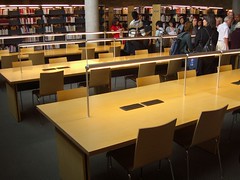
Here's the study area.
Visit to Bibliothèque de Charlesbourg

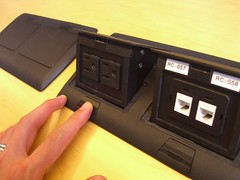
Table-top has concealed power and LAN points.
Visit to Bibliothèque de Charlesbourg

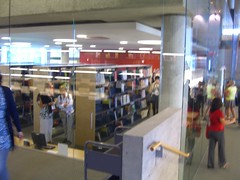
Their Children's Section is enclosed in glass (stops the noise).
Visit to Bibliothèque de Charlesbourg

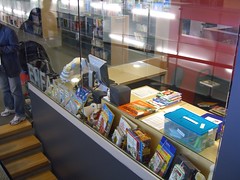
From the outside, the desk of the Children's Librarian is visible.
Visit to Bibliothèque de Charlesbourg

Here's the inside of the section.
Visit to Bibliothèque de Charlesbourg Visit to Bibliothèque de Charlesbourg Visit to Bibliothèque de Charlesbourg Visit to Bibliothèque de Charlesbourg

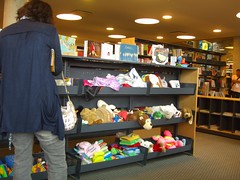
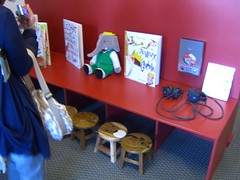
A shelf of toys!
Visit to Bibliothèque de Charlesbourg

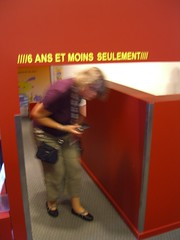
There's a presentation room for kids. I think the sign says "No Admittance over 6".
Visit to Bibliothèque de Charlesbourg

When I stepped in, the space looked impressive. It wasn't apparent there was this space from the outside.
Visit to Bibliothèque de Charlesbourg Visit to Bibliothèque de Charlesbourg

At the corner there's a audio/ headset.
Visit to Bibliothèque de Charlesbourg

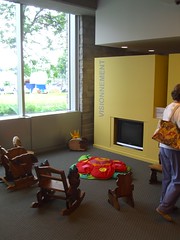
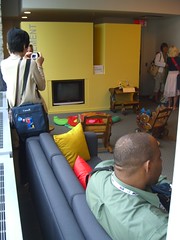
There's an area where the kids can watch stuff from a TV (videos or TV programmes I think). Parents can sit on the couch overlooking the kids.
Visit to Bibliothèque de Charlesbourg Visit to Bibliothèque de Charlesbourg

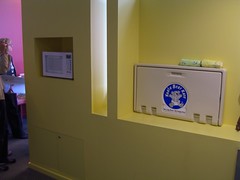
Behind the wall (where the TV is installed) is a nappy changing fold-up board and a microwave oven for heating up milk! Wow.
Visit to Bibliothèque de Charlesbourg Visit to Bibliothèque de Charlesbourg

Visit to Bibliothèque de Charlesbourg

Upstairs is the Young People's section, if I'm not wrong. I'm guessing from the beanbags that it is! Correction: Their library inter-shelves the Young Adult and Adult collections.
Visit to Bibliothèque de Charlesbourg Visit to Bibliothèque de Charlesbourg Visit to Bibliothèque de Charlesbourg

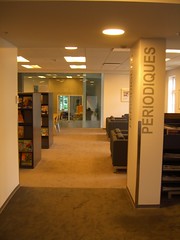
Straight ahead is the Periodicals section.
Visit to Bibliothèque de Charlesbourg
There are a few steps up. The designers provided a lift (no space to build a ramp, I think).
Visit to Bibliothèque de Charlesbourg Visit to Bibliothèque de Charlesbourg Visit to Bibliothèque de Charlesbourg

There's a consistent clean, cool feel to the whole place. It's modern and cozy.
Visit to Bibliothèque de Charlesbourg

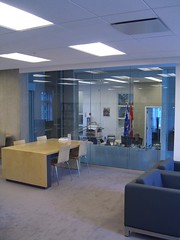
The cool thing is that right across the other side, you can see the office. I wonder if that's the library director at her desk?!
Visit to Bibliothèque de Charlesbourg

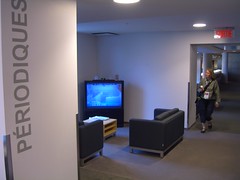
Walking out, you see a TV lounge area. Nice.
Visit to Bibliothèque de Charlesbourg
What's cool is that you can look across to the library office!

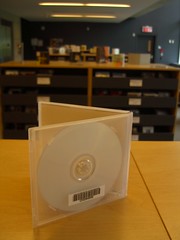
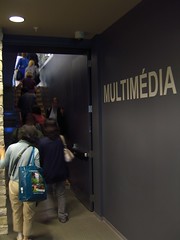
The Multimedia section is in the basement (kind of like a hangout for teens and young adults as well).
Visit to Bibliothèque de Charlesbourg

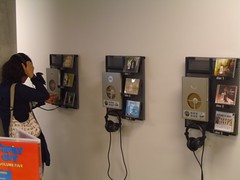
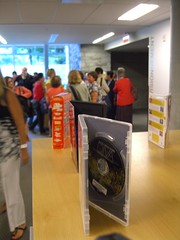
The AV materials are free to watch in the library (deposit required to use the player). Payment of S1.50 to borrow (I think it's a cheaper rate in consideration for teens).
Visit to Bibliothèque de Charlesbourg Visit to Bibliothèque de Charlesbourg

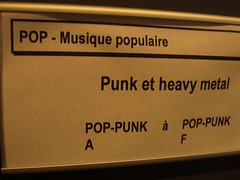
They have punk and heavy metal music in their collections! Wonder if they carry Joe Satriani (man, if they put a drum/ guitar/ bass kit in the basement...)
Visit to Bibliothèque de Charlesbourg

This is a place I'd definitely want to hang out.
Visit to Bibliothèque de Charlesbourg Visit to Bibliothèque de Charlesbourg Visit to Bibliothèque de Charlesbourg Visit to Bibliothèque de Charlesbourg

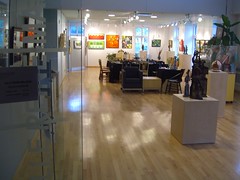
At the ground floor, the library is connected to an exhibition space.
Visit to Bibliothèque de Charlesbourg

Services and programmes they provide:
  • Reading day in a public space
  • Reading day in schools
  • Introduction to reading and writing
  • Public library week
  • Read & Get Reading (seniors reading to kids - www.lireetfairelire.qc.ca)
  • They have a mascot in their storytelling for kids. Average 34 kids per session. It's so popular they require reservations.
  • Storytimes in pajamas
  • Arts and science workshops
  • Summer reading month (last week of June to end Aug. There are prizes when kids complete 5, 10, or 15 books)
  • Film screenings (to give more reasons for users to visit. The screenings are held at regular times so that there is a routine).
  • They introduced a character Chien De Lisard, aimed at young adults ages 13 to 21 (see www.bibliothequesdequebec.qc.ca/chien). At the site, teens can post on what they read (the presenter mentioned they wanted an "edgy and mildy subservive atmosphere" for the site)
  • For the 8 to 12 year-olds, they have a literary society rather than reading club format. Each activity is independent of the other and has themes.
  • Four times a year, daycare centres receive 65 books for children and daycare workers. Part of encouraging daycare centres to recognise importance of reading to young children.
  • They organise teacher meetings; send information packs to schools
  • A "School bag package" for teachers to hold classroom activities in the library


Visit to Bibliothèque de Charlesbourg Visit to Bibliothèque de Charlesbourg Visit to Bibliothèque de Charlesbourg

Very, very nice. I'm impressed.

The physical space is well thought-out. It's a huge space yet it's not overbearing. There are clear spaces for Children, Teens and Adults (though I feel the teens section ought to have it's own enclosed area like the Children's section, and with a different feel).

Their services seems quite comprehensive and proactive.

From this visit, what's interesting to me are the consistent trends of:
  • Libraries moving towards an inter-generation theme
  • Children's services remains at the forefront of the public library services
  • Services to Youths is also deemed important. And most libraries in any country face the same challenges in trying to get teens to read
I'm also interested in how they reach out to the adults aged 30 to 49. I was too busy taking pictures and copying notes that I didn't get a chance to ask.

[I realised I've done a better job reporting what this library has done -- in terms of services to Children and Teens -- than what I've blogged about for Singapore's public libraries. Maybe I should invite a Canadian librarian over to give an objective assessment!

Anyway, if you're a Singaporean reading this, we may not have six million Euros to spend per library but otherwise what we have is pretty consistent :)]

Next: Part 12

Wednesday, August 13, 2008

IFLA 2008 (part 10): "You Can't Take Me Home"

[From Part 9]

I got tired of blogging about the "serious stuff".

So...

Here's a very cool T-shirt (but worned by an uncool-looking dude, I'm afraid!)
"You Can't Take Me Home"

My Norwegian colleague, Linn, gave out T-shirts her library produced as part of a project. In the centre of the T-shirt, it says "Lkke til hjemlan".

It means "You Can't Take Me Home".

I guess you have to be a librarian to appreciate the joke. LOL

Back to the serious stuff.

[Next: Part 11 - Visit to Bibliothèque de Charlesbourg]

IFLA 2008 (part 9): Revised guidelines for library services for young adults

[From Part 8]

8.30am, 12 Aug 2008, Quebec City. Libraries for Children and Young Adults Section.

This morning, our Section presented the revised guidelines for library services for young adults (which will be available at the Section webpage soon).

Specifically, it was Patricia Muller from USA (Left in the picture) who did the presentation.
Presenting revised guidelines: Library services for young adults

Not surprising to see 140 to 150 people attending. As with previous years, there are lots of people interested in Children and Young Adults libraries.
Presenting revised guidelines: Library services for young adults

In her presentation, Pat emphasised that the librarian should have some form of training before assigning them to Young Adult (YA) services. At least, not simply because so-and-so staff is available.

"You cannot provide effective services to Young Adults without their inputs," says Pat. And the work you assign to them has to be meaningful (i.e. not ask them to paste stuff or as additional labour).

The revised guidelines features "Ten Service Goals":
  1. The library has established clear policy statements concerning the right to free access by young adults to library resources and information sources; and respect for the rights of young adults to select materials appropriate to their needs without censorship.
  2. The library program for young adults is effectively managed according to best practices.
  3. There is equitable distribution of resources to support programs and services for young adults.
  4. Library staff is (should this be are rather than is?) knowledgeable about adolescent development and age appropriate resources for young adults, inclusive of those with special needs.
  5. The library provides a wide spectrum of current materials of interest to young adults to encourage life-long learning, literacy, and reading motivation.
  6. The library provides resources to support the educational needs of young adults.
  7. The library assists young adults in acquiring the skills to effectively access all library resources and become information and computer literate.
  8. The library fosters youth development by providing opportunities for young adults to participate in planning and implementing library programs and services for themselves.
  9. The library creates an area just for young adults that is attractive and interesting to them.
  10. The library works in partnership with other community agencies and organizations to support all aspects of healthy, successful youth development.
The ten goals are not meant to be prescriptive. Some countries may want to modify those goals.

Pat advised that it's not possible to accomplish all ten goals. Just start with one and move on to others. Sound advice.

Pat also said the website is a important marketing tool.

"Flashy - that's what they want!"

She acknowledged that having a website would require resources. The key thing was to try (I say, try a blog!)

I took some shots of participants snapping up the printed copies after the presentation.
Presenting revised guidelines: Library services for young adults Presenting revised guidelines: Library services for young adults


Q&A session
The questions (and the inevitable commentary) came fast and furious.

"How do you treat young adults? As teens or as adults?"

"Should we use the term 'Young Adults' or 'Teens'?".
One suggestion was to use the word teens. One participant shared that teens preferred to be considered as adults.

One participant asked if anyone has integrated music as part of library itself (rather than a library programme).

I scribbled a note to Ingrid, who was chairing the session. I asked that she tell the participants about our mailing list. Those excellent questions and comments ought to be posted there!

I suspect many in the room were practitioners. Who were interested in "How To" questions.

Seems we all face the same issues when it comes to delivering services to teens.

[Next: Part 10]

Tuesday, August 12, 2008

IFLA 2008 (part 8): Reading in hospitals & new technologies

A presentation, also from France, after this one (part 7).

This one was about a book lending service in Paris public hospitals.
Reading in hospitals & new technologies

The presenter, Ms. Claude Guerin, spoke in French. I copied what I could from her powerpoint which had accompanying English translations. Any factual mistakes are mine.

Some facts that I found interesting
  • There are 26 "hospital district agencies" and 3,000 health establishments (in Paris alone?)
  • One out of five (I'm not sure if it's in France or just Paris) are hospitalised each year
  • The reading initiative in hospitals arose from an inter-ministerial agreement; a "culture in hospitals agreement" (I found this PDF of a supplementary handout that was distributed at the session).
  • Reading was a "a significant social practice in hospitals"
  • System-wide, there was an average of 2,700 publications per hospital (a 5% increase; I'm not sure compared to when).
  • 95% of the collections books, 7% AV items, marginal number of electronic resources (note: these are just averages and scale varies from library to library)
  • Most collections are leisure-related (e.g. Fiction). Practically no health subjects
  • About 33% of hospitals have weekly carriages to rooms; 33% have a library within the hospital; 33% have a "book on request" service for patients via phone call to the hospital staff
  • 73% have volunteers to help in providing the service
  • 24% employ non-professional employees in hospitals
  • 2% employ trained librarians
  • 1% are assisted by librarians seconded from from public libraries
  • 32% of the hospitals are planning for multimedia workshops

Reading in hospitals & new technologies

From their experience, the public (i.e. patients) expects AV materials, digital resources, materials adapted for the elderly and disabled, documents on the consequences of diseases or on how to live a handicap.

Some libraries have started offering computers (for patients to use for work purposes and to email their family, search about pathologies, or search for convalescent homes)

One pediatric hospital provided laptops loaded with educational software. They let the child patient surf the net, email their parents or with other patients. Social networking among the kids!
Reading in hospitals & new technologies


My thoughts
Libraries in hospitals. Why not?!

The patients are a captive audience. I'm sure doing something constructive, like reading, while recuperating is a positive activity. Of course we'd want to avoid violent or depressing themes.

Learn a skill when recuperating in hospital. Booktalks. Book discussions...

Library services in hospitals can enhance the health care service in Singapore. It might come with a fee, depending on the scope of service. Or hospitals can work with public libraries who can offer outreach services which are currently free.

Perhaps co-funding between the MOH and MICA? Or even with MCYS if we're talking about the Class C wards. I can imagine HPB coming into the picture too.

The more I think about it, the more a browsing/ lending service in the hospital makes sense.

If I'm a non-reader, it might be a way to get back to reading. During the recuperation stage, recovering patients might want to know more about living with their health condition. Or maybe psychology-related books, like those on Positive Thinking.

Even if I'm a reader, the last thing I'd plan for a stay in the hospital are reading materials. Visiting relatives may not bring reading materials in for me.

Oh, the social networking aspect just sounds great. Imagine, patients logging in to the hospital library online portal, seeking fellow patients out, discussing their condition and experience in privacy and perhaps anonymity, with occasional moderation by qualified hospital staff.

Definitely an area to explore.

We'll see.

[Next: Part 9]

IFLA 2008 (part 7): E-reading for disabled persons

[From Part 6]

Monday, 11 Aug 2008, Quebec City. Libraries Serving Disadvantaged Persons Section.
E-reading for disabled persons

"E-reading for disabled persons: The French digital library for the Disabled" by Monique Pujol.

Monique spoke in French but her slides had English explanations so I was able to follow (good thinking, 'cos translation receiver headsets might fail.)

E-reading for disabled personsShe shared about their digital library serving people with disabilities, based in the city of Boulogne-Billancourt. The project was a multi-party collaboration. It involved the Paris Public Hospital Network, commercial companies (who provided digital content, computer hardware) and disabled persons associations.

The service is offered via this website - bnh.numilog.com


Collections
  • They acquire recent (i.e. popular) & classical works
  • 55% Fiction and 45% Non-fiction items
  • So far they have1,120 written works, 210 audio items, and 7,000 documents.
  • The use the PDF format, as it works with Text-to-Voice softwares like JAWS
  • Something about adopting "PRC for palm PDA smartphones", as it allows text enlargement (I think it's this)
  • Audio formats would be WMA and MP3

Costs
About 50,000 Euros per year to maintain the website and for acquiring the digital books

Users & Fees
  • The service is for individuals or institutions
  • It's only for users with disabilities of any form. Proof being the disability association they belong
  • There's an annual joining fee between eight Euros (for city inhabitants) to 20 Euros for non-residents
  • There are 400 registered users, out of which 40% have some form of motor-disabilities and 47% have some form of visual-disability

Results of evaluation
They conducted a study with the help of university students. It was a national sample, using an online questionnaire. Some person-to-person interviews were also done to collect testimonials.

On the minus-side, Users reported an insufficient number of "copyrighted resources" ( I think this means current and popular materials that aren't free or in public domain). The formats and technology was also a challenge to users.

On the plus-side, users liked the remote access service and some felt they had a greater degree of independence in obtaining information materials.


Future plans
Overall the project was deemed as feasible. They now plan to create a telephone hotline for users who need assistance on how to use the service. They intend to expand to youth collections, start a selection committee, and plan to hold discussions with hospitals and agencies.


My thoughts
I wondered how many persons with disabilities in Singapore currently use the digital books and audio collections that are already available via the NLB library website (National and Public libraries). I suspect not many. It's something my colleagues and I can try to ascertain.

Compared to five years ago, the NLB digital collections have improved a lot in terms of quality. There's ebooks and audio. Access and use of digital resources has steadily increased. I suspect a lot is via word-of-mouth.

I don't forsee the quality of collections to be the major issue (although there will always be the issue of bestsellers not in the digital collections, but this is really the publisher's perogative).

Part of the issue may be the lack of awareness of our current digital services, by people with disabilities. This can be addressed through regular promotions and publicity activities, via the organisations serving people with disablilities.

I've a feeling the biggest issue would be web accessibility, where the site is accessible to people using screen-to-voice softwares etc.

It's not easy to create a 100% disabled-accessible site AND still make the site "interesting" to majority of users. I think most developers (and the organisations who commission them) don't really make sure there is web accessibility for people with disabilities. Either because of cost and time constraints, or lack of awareness of such a need, or they feel the priority is for the general population. Frankly, my employer is no exception.

But in truth, it's easy to hide behind the excuse of "organisation inertia".

I think things will happen when someone wants to make it happen. That someone don't have to be a person at very senior levels. Of course the lower down in the organisation hierarchy, the longer time it will take.

I'll have to start with myself then.

Seems there are two options here:
  1. Re-design the existing site (or sections in the website) to ensure the digital resources are disability-friendly
  2. Don't try to aim for a disability-friendly site that is exactly the same. Build a sister-website. A no-frills one. Aim to just provide access to the digital resources.
Option 1 would take a long, long time to achieve. And probably not go anywhere. It could cost a lot more and likely to result in compromises in design and features.

I'm inclined towards option 2. The sister-site could be a blog (costs nothing to set up if we use free online services). Include "hardcoded" links on the site to selected e-resources.

Idea needs more work. Maybe the users feel this won't be useful at all. I'll need to discuss with colleagues, and also people in agencies like DPA, SPD, SADEAF.

We need to talk to some of their clients. First we ascertain how many of them are aware of the current digital services and content. If they are already using it or have tried to use it, what are the problems.I'd like to think of this sister-site as a side door to some (not all) of the content and services.

A no-frills "side door"
It's unlikely the site will be a full one-stop portal to the digital content. The different digital content sources have varying degrees of disability-access (in the digital content business model, the service providers own the content and merely gives us a right to access for a subscription fee).

For those cases, users who want more could email the librarian for assistance. Will the librarians be overwhelmed? Who knows until we try?

My point is that the site could be a poor cousin to the full web service. And users won't be fully independent in using the service.

But at least it's there.

[Next: Part 8]

Monday, August 11, 2008

IFLA 2008 (part 6): Senior Spaces - the library place for baby boomers, older adults & their families

[From Part 5]

Sunday, 10 Aug 2008 (Quebec City).

Mr. Alan Kleinmann, from Old Bridge Public Library in the US, spoke about his library's Senior Spaces project (see also, seniorspaces.blogspot.com!)

The room was almost filled for this presentation organised by the Libraries Serving Disadvantaged Persons Section.
Alan M. Kleimann's presentation on "Senior Spaces"

Alan said it was a clear indication that there's an interest in this area for years to come. And that the librarians are planning for their own service!

[Probably true. And from what I observe, mention 'Seniors' and you'd tend to attract more participants than if you mention 'Disability' in the programme title].

Alan mentioned that the shift in aging population happening all over the world (true, as cited in this presentation for my Davies Forum talk -- see slides 12 to 17).

At his library, they recognised that baby boomers working for past 20 to 30 years have not used libraries. Also, since there's a specific space for children, why not for seniors? (in fact, Children's spaces was not common in the early days of public libraries).

Hence their 'Senior Spaces' project, serving "all three generations of older adults—the baby boomers not yet retired, older adults who have retired in the last few years, and the elderly many who can no longer get to the library".
Alan M. Kleimann's presentation on "Senior Spaces"

What is in this Senior Spaces
The Senior Spaces includes the physical aspect, programmes, meetings (among seniors), learning, a bookstore, "and more" (apparently they have gaming!)

Books remain at the focus of what they created. They have events like "Senior Fridays", a club called "Savvy Seniors" who plan outings for themselves.

There's an extensive large print collection with a Face Out shelving (Alan says the large print collection goes out like hot cakes).
Alan M. Kleimann's presentation on "Senior Spaces"

They have free computer classes for seniors. They want to use their libraries to help seniors bridge the digital divide (I totally agree with this approach).

They formed an advisory board comprising of two library board members and library customers. He says the advisory board suggested things which they wouldn't have thought about, like a Foreign Film club.

They teach users how to use the assistive software.

Another cool feature -- the librarian's desk is right smack in the Senior Spaces. Just a table and chair rather than an imposing service counter desk. This arrangement came out of necessity (lack of space) but it worked beautifully, according to Alan (and I would think so).

They have an active seniors club (I think this is the picture showing the Savvy Seniors, who organise their out outings).
Alan M. Kleimann's presentation on "Senior Spaces"

Gaming in library - for seniors
Alan showed this slide with a senior next to a young lady (talk about inter-generation!) The punch line was the lady's visually impaired. And with the Wii game set in the library, she played bowling for first time in 10 years.
Alan M. Kleimann's presentation on "Senior Spaces"

Here's another one that just says "inter-generation" as well.
Alan M. Kleimann's presentation on "Senior Spaces"
Promoting the service
They conduct outreach programmes (like this one to their Senior Center).

They use flyers.

There's a prominent wall to promote books that might attract baby boomers.

Here's a really nice idea -- a "Memory Case". Seniors contribute stuff from their past and showcase it in the library.
Alan M. Kleimann's presentation on "Senior Spaces"
According to Alan, some seniors were so proud that they could do this so they got all their friends to come and told people about the library service.

They've gone into "Web 2.0 space", as in this blog with contributions from their users (like this post).


How they sought approval for the space
Alan explained that they incorporated the Senior Spaces proposal in their strategic plan, which was approved by their library board. They sought external funding in addition to what the board granted. They raised USD$30,000 but Alan emphasised that they were prepared to do the same with less money. They saved money by doing the space planning on their own.

Future plans
This includes more blogging activities, vodcasts, podcasts.

They plan to develop a presence in SecondLife. He sees their library's roles as teaching seniors technology (about YouTube, Web, Blogs).

Alan suggests that it's easy to create a Senior Spaces project in libraries. You just need a sign board to tell people the space exists, have the appropriate book display, and furniture.
Alan M. Kleimann's presentation on "Senior Spaces"

In ending, he says, "I hope you begin to think about democratic changes that are coming".


Q&A
Someone asked, "Will users mind being labeled as 'Seniors'?"
Alan says this issue is not clear cut. There are some who embrace the term and some who just refuse to use the service because of the name (to their loss). Old Bridge PL do have criticisms about the term Senior Spaces but it was their advisory board who adopted the name. They kept it because the seniors themselves couldn't come up with any better alternatives.

"How do you define a Senior?"
The US official definition is 65 but there's no clear cut benchmark even in the US. Alan jokes that their library considers the 50 to 70 year olds as "young seniors" and the Above-90 as "elderly".


My thoughts
In Singapore, the Toa Payoh library has a Seniors Corner. It's the only one with a clear demarcated physical space.

In comparing that one with Old Bridge PL's, it obvious to me now that the success of the space is more than just having a physical presence.

In fact, the physical aspect of the space did not come up very strongly in Alan's presentation, and yet he shared a very compelling story of his project.

So it's really about having a whole suite of activities -- programmes, customer involvement and empowerment, online and offline publicity and activities.

The key success criteria seems to be a strong group of regular seniors who use the space. And who readily identify themselves with the space.

It might be a challenge for Singapore libraries to try this. My feeling is that most of our seniors don't want to be in the limelight. They are from a generation whose thinking is that they'd rather remain in the background of things. For instance, something like the Memory Case may be difficult to try.

But having said that, I feel if we don't make the attempt to try, we won't know. For all I know, it could be a wrong perception on my part.

Definitely something I'd explore with my colleagues when I get back.

Alan's paper can be downloaded, here (PDF, 88KB).

[Next: Part 7]

IFLA 2008 (part 5): Conference opening ceremony

[From Part 4]

Sunday 10 Aug, 9.30am. Quebec City Convention Center.

Huge venue.

I counted 4,096 seats.
IFLA 2008 - opening ceremony

The ceremony started with an ethnic dance by Canada's aboriginal people (or First Nation people). That was interesting. Though I felt it seemed repetitive (it was performed several times during the opening ceremony, and also during that evening's cultural performance).
IFLA 2008 - opening ceremony

This was an interesting performance!
IFLA 2008 - opening ceremony
I overheard someone say that it was a traditional song/ lullaby (unfortunately, no English explanation so I'm guessing here). What's interesting was their "singing", if it can be called that, was a mix of something guttural, melodic and rhythmic. Nice.
(Update: someone took a video and posted to YouTube. Web 2.0 comes to IFLA whether they like it or not, heh)

The Governor-General of Canada (equivalent to the President, I think) spoke. She was a very distinguished looking lady and sounded elegant as she delivered her speech (in French).
IFLA 2008 - opening ceremony

More speeches (this was Dr. Claudia Lux, President of IFLA). Nice of her to deliver her speech in in French, German, and English.
IFLA 2008 - Claudia Lux

IFLA 2008 - opening ceremony IFLA 2008 - opening ceremony

This is my fourth IFLA conference.

Overall impression of this one -- the performance was average.

Maybe it's because I don't speak or understand French. The performance included a narration in French. Then there was a poetry reading also in French.

I'm fine with that.

When in a different country, one should try to immerse in their culture.

But wished there were English subtitles or translations for the performances. I'm not sure how many other delegates spoke French.

In fairness, translation booths (manned by translators) and the receiver headsets were available.

French is one of the official language of IFLA. As per IFLA's practice, translators for the official languages were available for the opening ceremony.

But I didn't borrow a headset (queue was too long).


We all have an international audience
I thought for international audiences, the performance should involved more music and dances -- things that don't require language skills as a prerequisite to appreciate.

Which brings to mind: this is something libraries must consider as we upload content to YouTube. It's something I've mentioned before.

On the Internet, your audience is International.


You might as well market your library globally
Of course libraries should consider their primary audience first. If a French library puts up a video for its users, obviously they'd use French.

But it would be an excellent marketing tool if you provide English subtitles, or in the title or blurb, for a video in YouTube.


At least an English translation please
OK, I'm biased towards English. It's a first language in Singapore.

Also from my brief search on the Internet, English comes up tops.

While there's no definitive answer which is the most widely spoken language (see this, this, this and this), English is definitely in the top four or five.

Unless you want to try learning Mandarin.

I found English much easier since it's a phonetic-based language rather than a ideogram-based language like Mandarin.

But I digress...


Would I view the performance more favourably if I had English translation?
Can't tell.

Unless IFLA makes a video of its conference opening ceremonies, provide English subtitles or captions. Then I can give a comparison.

Come to think of it, IFLA ought to upload the opening ceremonies on YouTube.

It'll be excellent marketing material for IFLA.

With English subtitles and captions. Heh.

[Next: Part 6]

Sunday, August 10, 2008

IFLA 2008 (part 4): Taking the public bus in Quebec City

Bus ride in Quebec City, CanadaI took the public bus from the conference venue back to my hotel.

Not wanting to repeat the "Vienna experience" mentioned here, I did my homework before coming to Quebec City.

I found out you had to buy a ticket before hand, or prepare exact change (I specially looked for a convenience store and bought them a day earlier).

On the bus, I observed how people pulled the rope or pressed the bell to signal for a stop (I did just that when I wanted to alight).

BUT what I didn't notice was how you had to PUSH the bus door from the inside to open!

(Darn it! I didn't know that.)

There I was standing at the steps. The driver and other passengers must have wondered why I'm not getting down. The bus moved on. I missed my intended stop.

Luckily at the next stop two passengers wanted to get down. That's how I learned about the need to push the door from the inside.

Sigh.

What's with me and buses?

(To think that I was feeling smug about knowing what to when taking the Quebec public bus).

Heh.

[see: Part 3; Part 5]

Saturday, August 09, 2008

IFLA 2008 (part 3): Standing Committee meeting no. 1

[From Part 2]

Standing Committee meeting I, Section: CHILD-YA9 Aug, 2008. 11.30am:

Attended the first Standing Committee (SC) meeting this morning.

There was the usual greetings of colleagues, who only get to meet once a year. Some would give out tokens, collaterals of their library's reading initiatives, printed copies of their country reports.

Or a box of chocolates or sweets. Out of love :)

Very informal. But the agenda is serious stuff, at least this is what our SC is well-known for in IFLA circles.

My usual part was to provide updates as the Section's Information Officer (i.e. updates to the Section's website in the past work year, highlights of the newsletters, mailing list).

I managed to explain more about the proposal for a "Youth Expression" project.

The other proposal was from Viviana, for a "Sister Library" project (i.e. a scheme to pair up libraries, to facilitate professional knowledge exchange and mentorship).


The "Youth Expression" proposal
I've blogged about the proposal at this post.

It was first mooted last year at the Durban conference. After a year, we're one step closer towards implementing it (that's the pace of how things work, when most SC members get to meet once a year and all are doing this on top of our regular work).

I was given some air-time to elaborate what the project was about. I explained that it was essentially about three things:
  • A project where libraries, libraries and youth volunteers can play a central role
  • About Youth Expressions
  • Global Connectedness (i.e. library to library, youths to youths -- on an international scale)

After my explanation, Ingrid asked the billion-dollar question (with a smile): "So what's next?"

"Well, it's for us to discuss if we will do this, or maybe no."

We certainly had a solid discussion, in my opinion.

There were comments that the inclusion of ages 13 to 25 was too broad and had to be narrower. But others felt it was fine and that's how it would for their libraries. Final consensus: To provide two separate age groups.

One SC member questioned the philosophy of the proposal. The question was whether a professional body like our IFLA Section should play a role in proposing a "direct service project" Vs. guidelines and policies.

In response, a few other SC members felt that the proposal was a tangible showcase of the sort of work done by the Section. The role of the Section would be to convince other libraries to take up this initiative (if the proposal is approved).

[I know I'm biased in saying this -- but I totally agree! The Scope Statement in the Section's mission statement is to "promote international cooperation in the fields of library services to children and young adults". I see this proposal as a way to extend IFLA's mandate, where our Section would play a facilitator's role in creating an opportunity for libraries all over the world to take part].

Other comments were that the scope (of "Youth Expression") may need to be refined and made more specific. One SC member asked if there were any specific example of how this proposal could be implemented.

In response, there was consensus that the proposal was a framework. Once agreed, we would work on details. Perhaps a project to produce a "How To" manual or some practical guide. For instance, how much time for a library to carry this out, the equipment needed, the typical costs, how to deal with time zone differences, the issue of language translation of works contributed by youths whose first language might not be English.

Sister-Library
Viviana Quinones (she's from Paris) proposed a "Sister-library" programme. Where libraries on a lower development scale would be matched with one that can provide expertise, mentorship, perhaps funding to the "sister-library". It was a model that has been successful between African and French libraries.

This proposal was also viewed favourably by the SC members.

I voiced that the Sister-Library proposal could answer the question of "WHO can I partner with", and the youth expression proposal would be "WHAT do I do with my sister-library".

We ran out of time and would be continuing the discussion at the second SC meeting this coming Friday.


Looking Ahead
I'm happy that both projects were viewed favourably.

I like the Sister-Library proposal. But I'm more keen to try out the Global Youth Expression idea. Not simply because it's a proposal from me.

On the contrary, I see that it's no longer my proposal, but the Section's.

I'm more keen because I feel the activities and practices for the Teens segment has been a relatively neglected area. My sense is that there are more papers and sharing of best practices on Children's Services, and much fewer on those for young adults. Partly because services to teens/ young adults are much more challenging compared to implementing those for Children.

It doesn't surprise me the Youth Expression proposal had a lot more questions and concerns (it seems to be true for the proposals I come up with even in NLB, heh). Maybe it's because it's never been done before, on that scale.

Let me tell you -- it's SCARY putting up a proposal to an international audience!

It's hard enough getting buy-in with my own colleagues in NLB. I had clueless how my international colleagues would react.

I was mentally prepared for the proposal to be thrown out. I wasn't surprised by the concerns raised. I was glad they were raised. If those concerns can be adequately addressed, the project would be stronger for those differing views.

Oh, now that I've experienced it, I can share that having your idea supported by another professional and practioner from another country -- it's just priceless.

But as I said, it's no longer my proposal, but the Section's.

The idea's been put on the table. Nothing's confirmed. We'll have to see how the committee feels should be the way to go.

[Aside: All the IFLA technical committees (e.g. sections and divisions) would have their business meetings one to two days before and after the actual conference.

Most meetings, other than the IFLA governing board, are open to observers. Observers are conference delegates who aren't necessarily part of the section or in any committee. Some observers end up joining the respective section, 'cos they like what's being discussed and feel they can contribute as well.

Typical meeting agenda: report of the Section's activities for the year, update on projects, review of conference activities, financial reports. The minutes of meeting are published on the respective section webpage, like
this one from my section.]

Next: Part 4

Friday, August 08, 2008

IFLA 2008 (part 2): Arrived in Quebec City

View from Hotel in Quebec CityIt's a gray rainy morning in Quebec City.

Woke at seven. Had a quick breakfast. Back to the room to clear emails and stuff.

Took a break to write this quick post.

I had a chance to use my extremely limited French vocabulary last night, when I took the taxi from the airport to the hotel.

The cab driver spoke in French and must have been asked me where I wanted to go. I said the hotel name. And gave him the address I'd written (good to be prepared, non?)

"Est-ce que vous parlez anglais?" I asked.

"Ah, a lee-tle bit," he replied.

We attempted some small talk during the 15 minutes to the hotel. Where did I come from. First time here?

He looked like he was in his mid-50s. He was munching on a sandwich as he drove. I asked what was his work hours was like.

Until eleven, he said.

Reached the hotel. Smooth and uneventful ride. Paid and tipped him.

"Merci."

We both smiled.

I'd like to believe the first person I meet (including the customs and immigration officers) would set the tone for the rest of my stay in a foreign land.

I'm looking out my hotel room now. The sky is still gray. It's still raining.

But I believe I would enjoy my stay in Quebec City.

[From Part 1; See Part 3]

Thursday, August 07, 2008

IFLA 2008 (part 1): Off to Quebec City, Canada

2008 IFLA conference logoBy the time this is published, my plane should have taken off.

Looking forward to the conference.

And dreading it at the same time.

Plus-side: I'll be meeting my Section's Standing Committee colleagues again.

Down-side: I'll feel so... helpless. When traveling in a foreign city, I sometimes have to learn the basics from scratch.

Like taking the bus.

I remember in Vienna, passengers have to press a button on the outside of the bus to open the bus door. The driver won't open the door for you unless they see you really need assistance.

So there I was, standing outside the door looking at the driver, expecting the door to to be opened for me.

The driver looking at me, probably thinking, "What's wrong with this fella?"

I'm thinking, "What's wrong with the driver? Why won't he open the door for me?"

In the end, he opened the door. And gave me a funny look.

Sheesh.

I've been checking out these websites (after I did my preliminary research using a travel guide borrowed from the library). I tend to seek these information:
  • Safety
  • Getting around
  • Local customs & etiquette (e.g. tipping, greetings)

Found these quite useful:


[Next: Part 2]

Tuesday, August 05, 2008

Post-workshop reflections: "Your Library and New Media: Collaboration through Social Networking"

Yesterday I conducted this 2.5-hour workshop for 16 participants. About 12 were MOE teachers while the rest were in education-related jobs.

"Your Library and New Media: Collaboration through Social Networking"

Not one of my better sessions, I'm afraid.

On a scale of 1 (poor) to 5 (excellent), I'd give the workshop outcome, and myself, a "2".

Several frustrations:
  1. The event organiser did not get in touch with me, until I had to contact them just two working days before the session! This left me with only a weekend to work on the content. And I was clueless on number of participants, profile, background
  2. I'd planned for a workshop format but was informed it would be a talk (so I modified my approach accordingly). To my horror when I reached the venue, it was a computer-lab and obviously the expectation was for a workshop
  3. With myself: I was complacent! I still think the organiser was sloppy but I should've chased them earlier. I was aware of the many unknowns yet I went in cold on the day itself. Didn't plan for contingencies. Over-confident, I think.

Here's what we managed to cover (outline was worked out on the spot):
  • 2pm: An overview of what Web 2.0 was about
  • 2.30pm - 3pm: A hands-on exercise on using Posterous.com
  • 3pm - 3.30pm: Tea-break
  • 3.30pm - 4pm: Group discussion on ideas and desired outcomes for what they wanted to achieve for their school library, and ideas for using new media (this part was sloppy, and I take the blame). Also made them input their discussion points on to a Wiki
  • 4pm - 4.15pm: Review of the wiki activity. Also demo of how to restore pages and deal with vandalism (a bit sloppy, 'cos I temporarily couldn't find the link to restore the pages)
  • 4.15pm - 4.30pm: Discussion on application, use of new media for collaboration (ended up with me doing most of the talking; I think most of them didn't feel this part was comprehensive enough)
  • 4.30pm - 5pm: Explanation of Creative Commons, its relevance to a school library, how to search for CC content, and how to license one's work using CC (this part was me talking, and I can't tell if I convinced them to see themselves as content producers, and how sharing was part of social collaboration)

What I did right
I arrived about one hour earlier. Managed to whack out a outline for hands-on activities, worked out the new approach mentally.

Another thing done right: I didn't complain and got to work instead. When I realised the venue was for a workshop and not a talk, I sorely wanted to. But it wouldn't have helped anyone and would certainly have wasted precious time.

When I sensed the participants had a different expectation, I modified my approach rather than bulldoze through the session (but the outcome was partly successful). During the hands-on exercise at 2.30 - 3pm, when I went around checking on the participants. That was when I sensed and got some feedback that the participants didn't really want hands-on. I asked the group what they'd like to focus on, and modified the subsequent approach.


What could've been done better
Before starting the session, I tried to get participants to share what they expected out of this workshop. But I didn't get everyone to share (they did it in groups) and I didn't write down the points so that I could revisit those points. And also use those points to focus the discussions.

I didn't establish that critical rapport with the group. Upon hindsight, I think I could have given more time for each individual to share their thoughts. I realise teachers liked to express themselves and have their thoughts heard. Getting them to share might also clarify their expectations, their skill level, their organisational context.

Next time I'd schedule when each group could edit the wiki pages. The mistake was to allow all groups to edit the wiki. Net-effect: everyone overrode everyone else's work! Next time, I'd assign a scribe for each group, and also give each group a specific time to edit. And warn them not to override.


The participants
When I shared my woes to two other teacher-friends separately (they weren't in the session), they consoled me to say that teachers were a tough bunch to teach!

But to be fair, the teachers were cordial and they patiently went along the discussions and group activities as instructed. I think if they really wanted to be difficult, they could.

Problem was, I didn't manage to engage them in terms of the depth of discussions and the ideas generated. That was the biggest disappointment for them and for me too.

At one point (around the 4pm to 4.30pm segment) I felt as if I'd lost them when the discussions didn't get into the level of sharing and the ideas and sharing from them weren't forthcoming.


Their expectations
I felt most gave very tentative responses when asked to share what they wanted to get out of the workshop.

I had my share of participants who didn't read the workshop blurb!

I felt most of them weren't that sure what they wanted from the session. They had a general sense of wanting to learn something practical, but generally just came to see what they could get out of it. But when they didn't get the sort of specific ideas and discussions, they were disappointed.


Final thoughts
I'm not sure how they collectively rated the session (don't think the organisers would be sending the collated feedback my way).

I won't say this was a disaster.

There were signs that some participants learned something. For instance, they maintained eye contact throughout, showed non-verbal responses, they actively took notes at certain points.

Also, when we ended the session, I told them the workshop won't have to end there. I gave them my email. Said I'd be happy to share more individualised responses, if they have specific questions after the workshop. Quite a few wrote down the email. That should mean something. :)

Still, I didn't feel that sort of satisfaction I've experienced with some other workshops.

In the final analysis, I can only say as a trainer, I've got ways to go.

I feel a trainer of excellence would always manage to make participants feel the session was worth attending. Regardless of the situation.

"Your Library and New Media: Collaboration through Social Networking"

At one point while reflecting on this workshop, I wondered if I should decline future training invitations from this particular organiser. Or of such a scope (e.g. teachers, new media). Quite likely they wouldn't want to ask me back, heh.

I didn't even feel like blogging this. A part of me didn't want to share the less-than-positive aspect of the workshops I conduct.

But I posted it anyway. To clarify my thoughts, if nothing else. If faced with the same situation again, I'd know what to do without being overconfident.

Well, if any of the workshop participant manage to find your way to this post, as I mentioned in the closing remarks of the workshop, be as honest as you want to be.

Let me know what could've been done better for you.

Monday, August 04, 2008

The Creative Commons Connection (Part 3): Should I allow my work to be exploited?

[From Part 2]

Prior to Molly's talk, I'd read her earlier post on The Psychology of Creative Commons.

Where she shared her thoughts about this other blogger (Paul Courant) who changed his blog's Creative Commons license -- from Attribution-NonCommercial (BY-NC) to simply Attribution (BY) only.

NOTE: When you adopt a Creative Commons license with a NonCommercial (NC) label, if someone wants to use it for commercial purposes, they'd have to seek your explicit permission. If they intend to use it for non-commercial purposes, they don't have to contact you for permission because you've already given permission in advance. And in both cases, they'd have to attribute your work, i.e. acknowledge you as the creator/ owner.

Basically, Paul Courant is saying to the Whole Wide World that so long you attribute him as the creator, you can share/ make copies/ amend his original work/ sell his work without paying him any royalties.

Let me repeat that for you: he's giving advanced permission to you to make money from using his work, without paying him a cent.

I bet you're asking, "Why would anyone want to do that?"

It's mind-boggling, isn't it?

Why would you allow your work to be exploited?

Look up "Exploit" in any dictionary and they'd all agree that using someone's work without compensating them qualifies as exploitation.

Unthinkable!

But is it?

Reading Paul's explanation and Molly's thoughts (plus what she elaborated in her talk), my interpretation is this:
  1. You expect a very low chance that anyone would ever pay you for your work
  2. Your main aim is for your work (and hence your name and reputation) to be spread as far and as wide as possible. This aim is more important than you actually earning money from your work
  3. So you only ask to be credited as the author of the work
  4. It's possible some people may make money from your work and NOT even give you credit in name
  5. But you accept this fact
  6. Plus, the very act of allowing others to benefit commercially from your work, without having to pay you, increases the chance of your work (plus your name and reputation) being cast wider
  7. There's even a chance that someone will decide to pay you in the end!

So it's not so crazy after all.

We see the equivalent of this happening all the time. By retailers.
  • "Use first, pay later".
  • "Buy now, and if you're not satisfied, full money-back with no questions asked".
Granted their motivations may be different (i.e. reduce perceived risk of purchase) but I'd argue the net effect is the same (i.e. increase use).

In fact, anyone who adopts a "Attribution" only CC license (i.e. automatically allow commercial use) is acting like an entrepreneur.

You're weighing the risk of not being attributed at all against the potential increase of (using Molly's term) "maximising influence".

That's taking power into your hands.

Far from being exploited, you're empowering yourself.

Risk of exploitation is already there
Each time I publish my text or music online, I'm prepared for it to be used or modified without permission. Or attribution even.

Who's to say someone hasn't already taken advantage of my words or music, profiting from it (monetary or otherwise) without benefiting or attributing to me?

The reality is that once I've publish my work online (words, pictures, videos) I don't have 100% control over it anymore.

Most individuals like you and I won't have the means or access to sophisticated digital content/ rights management systems, and even those aren't 100% future-proof against copyright violation.

Am I ready for it?
This is the million-dollar question, isn't it?

Here's my answer; this is the license I'd be adopting from now on:
Creative Commons LicenseThis work by Ivan Chew is licensed under a Creative Commons Attribution 3.0 Unported License. You are free to share, copy, modify, sell this work. You don't have to pay me (although you might want to make a donation to a charitable organisation of your choice!) I only ask that you credit and link to "Ivan Chew, RamblingLibrarian.blogspot.com". You don't necessarily have to notify me but I'd always appreciate a friendly email.

I'll also be modifying the license to Attribution-only, for my music. The new ones will definitely use the above license.

For my particular license, I've added additional text ("You don't have to pay me... You are free to share... friendly email"). I feel the current CC license could be improved, to make it clearer on the terms of use and how people can attribute.

This doesn't mean I have to stick to this particular CC license. It'll depend on the situation. But most times, I'd use this.

My motivations
I'm doing this because I've long decided that I'm not going to make money out of this blog (hence, no ads in my blog).

If you make money from using my work, good for you!

I hope you'll make a donation to a charity, in lieu of paying me. We both get to earn positive karma this way.

It feels good to give. My words away, I mean.

(Whether it'll be taken is another matter!)

I'm prepared for not being credited at all, even in name.

That's OK by me too.

'Cos that's your karma.

I'm perfectly happy with mine.

p.s. Thanks to Molly, for her talk. She was the tipping point!

Sunday, August 03, 2008

The Creative Commons Connection (Part 2): My grouse with Copyright

[From Part 1]

This is a rant.

My rants aren't eloquent. They generalise. And would be full of holes (so feel free to criticise).

Still, I want to get this off my chest.

My grouse with Copyright.

Often, the "safe" way to deal with copyrighted materials is to adopt a conservative position.

For instance, not to use the content unless explicit permission has been obtained.

My grouse is with how we librarians suffer from a lack of confidence in dealing with copyright. Few librarians can specialise in copyright law.

That lack of confidence stems from our inadequate understanding of copyright law.

I'm frustrated at how librarians -- being non-lawyers -- have to defer our decisions about the use of copyrighted materials, or the publishing of our materials, to lawyers.

Those legal positions are often a matter of interpretation by individual lawyers.

Because there might not be legal precedents.

And they probably do not want to stick their necks out.

I just hate outsourcing my decision-making on intellectual property issues to lawyers. I'd rather be clear on how and what to do.

In the digital age, everyone is a potential content producer (you take pictures with your digital camera, don't you?).

And potentially a online publisher (do you post photos online?).

My grouse with Copyright is that in the digital age, it's going to put librarians at a disadvantage.

We'd end up not being able to use much of the material published by individuals. Or we're not able to publish much of our materials online because we're advised to take conservative positions.

I believe that in the digital age, some librarians must become content producers as well.

We should not just limit libraries to be intermediaries, portals or mere repositories.

We have the capacity to create and share content, relevant for our users.

That's why I believe Creative Commons is important for libraries.

My colleagues and I were talking about how Molly did a great job with her talk on Creative Commons :)

She spoke with certainty and clarity, especially when handling the Q&A.

She spoke about Copyright and Creative Commons in terms that was easily understood.

"Certainty" and "Clarity".

To me, that's what copyright legislation ought to provide.

For commoners to be clear and certain of what to do, to protect their rights. Or share their works in ways which they are comfortable.

[Next: Part 3] Should I allow my work to be exploited?

Friday, August 01, 2008

The Creative Commons Connection (Part 1): Molly Kleinman, on Creative Commons and Copyright

Molly the Librarian gave a talk at the National Library this afternoon.

Not this Molly but this one (this joke is kinda stale by now... Sorry, Molly K!)

She spoke to 70-plus participants. Excellent turn out! And a very engaged and interested crowd.

Not surprising.

Mention "copyright" and librarians inevitably perk their ears.

It's so timely that Molly's personal visit to Singapore was right on the heels of this announcement. She's in Singapore for a week, after giving a Creative Commons talk and a workshop at a conference in Kuala Lumpur.

My main take-away from Molly's talk was this:
If libraries want to have their works (like subject guides and publications) shared with a wider audience, they should adopt CC licenses and embed it online. Doing so makes it easier for people to find your works, using servies like Google. That is, if your objective is for your works to be found and used.

But I'm getting ahead of myself here...


The Creative Commons Connection
I was connected to Molly (right) via Jude (left). He's one of the guys in the Media-Socialists group (his wife, in the middle, says it's more accurate to call ourselves "Social Media-ists", and I agree!)


And from today's Q&A during Molly's one-hour talk, what she had to say made strong connections with the 70-plus librarians from NLB and LAS members.

I enjoyed Molly's talk. There's a nice logical flow to her presentation, backed by her solid practitioner's know-how. She was able to explain copyright concepts in clear and concise terms. And she gave practical advice for libraries and librarians.

Here's a almost blow-by-blow account of Molly's talk:

Copyright/ Creative Commons: A problem and a complementary solution
Molly spoke about Copyright and US law, and problems with current the copyright system. In some cases it was difficult or impossible to contact copyright holders. The copyright status of some older works were uncertain (especially for works published between periods where copyright law has changed).

She explained how copyright law is complicated and skewed in favour of big corporations. Individuals are often at a disadvantage in terms of trying to use copyrighted works or understanding their own rights.

Ah, this is where Creative Commons (CC) comes in.

[Aside - here's a quote from CreativeCommons.org's About page:]
"... Balance, compromise, and moderation — once the driving forces of a copyright system that valued innovation and protection equally — have become endangered species. Creative Commons is working to revive them. We use private rights to create public goods: creative works set free for certain uses. Like the free software and open-source movements, our ends are cooperative and community-minded, but our means are voluntary and libertarian. We work to offer creators a best-of-both-worlds way to protect their works while encouraging certain uses of them — to declare "some rights reserved."

What's Creative Commons? Check this out. Or this, if you prefer a video.

"CC is not going to fix everything", says Molly.

CC is not a government organisation. It's not endorsed by governments.

CC simply makes the "legal language" understandable in terms or language that fits the local context (an immense help if say, English isn't your first language).

Molly went through the four basic elements in CC, what each meant, and how they can be combined: Attribution, Non-Commercial, Share-Alike, No-derivative

Basically, CC provides:
  1. A "human-readable" code, i.e. expresses the legal terms which us mere non-legalistic mortals can understand (here's one example)
  2. A "lawyer-readable" code, i.e. the terms expressed in full legal documentation (here's the code from the same example above)
  3. A "computer readable code", which is the HTML code. Basically you obtain a HTML code where you can incorporate in your blog or website. This allows search engines to locate your page identified as CC-licensed. Here's an example:

    Creative Commons License

    This work by Ivan Chew is licensed under a Creative Commons Attribution-Noncommercial-Share Alike 3.0 License. For permissions beyond the scope of this license, please contact via RamblingLibrarian@gmail.com.

Before and After Creative Commons
Before CC, there was no easy way for creators to give away rights. Or for creators to share in limited ways, even if they wanted to.

There was only one way, which was "Contact Me. Ask Permission. I'll Give it. Only then can you Use It."

Molly explained that CC helped solve:
  • Ambiguous copyright status ('cos if you adopt a CC license, you're making your copyright status absolutely clear)
  • A lack of good resources that are free from copyright (Google's Advanced Search options allows you to specify for CC-licensed items, and so does Flickr's)
  • The difficulty in sharing library-produced content more broadly (see following section)

Where does CC and Libraries come together?
"Libraries produce a lot of great stuff", says Molly.

Like subject guides (here's the NLB public library's example).

If your library wants to make your resources used by people outside the library, put it online, apply a CC license, make it easy for people to understand the terms and conditions of use and even distribute your work.

(To me, that's free marketing and publicity, without the library losing their rights).

Molly suggested two ways libraries can use CC to engage our public
  1. Collect CC licensed work and teach our users how to find it
  2. Adopt CC licenses for subject guides produced by the library, and encourage creators outside the library to use the licenses
[So simple!]

CC resources
Here are the resources she recommends:

How should libraries use CC works
Very important practical advice, as explained by Molly:
  1. Make sure your use complies to terms of CC license
  2. Include a link back to the original work (URL or hyperlink)
  3. Attribute/ mention the original creator
  4. Include the CC license also

At one point, someone asked Molly what could be licensed (answer: anything that can be copyrighted, can be licensed).

How to choose a CC license
More practical advice from Molly:
  1. Do you hold the copyright?
  2. Are you comfortable with people profiting from your work? (it's the internet: you publish what you can afford to lose!)
  3. Are you comfortable with people changing your work?
  4. Do you want derivatives for your work to carry the CC license?

[You can give this online form a try. Basically, you answer the questions, and CC will generate the relevant codes for you, including the HTML codes for you to embed in your blog].

Another participant asked for the proper way to cite CC works. Basically you credit the author/ creator of the work like how you'd credit a work found online.

There's no hard and fast rule on this.

If you ask me, libraries can take the lead and set the guidelines!

Show the world how to cite Creative Commons works. :)

[Next: Part 2 - My grouse with Copyright]