- At first, he couldn't find the book on the shelf even though the OPAC said it was available.
- After he contacted the librarian (via their IM service), he was informed that it was at the New Arrivals shelf.
- His next problem was not being able to locate the New Arrivals shelf.
Admittedly, this is also a limitation of the our public library's OPAC. The current OPAC system can only display the permanent location.
I had to smile at Kevin's photo. He wrote a note that says "Access Denied" and placed it where the book should be.
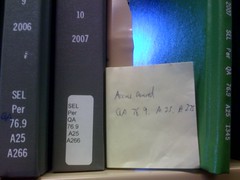
Come to think of it, this is a simple solution for library's whose OPAC cannot show the temporary location. If the volume of new arrivals isn't too high, I suppose it's worth the time to place temporary placeholders to direct users to the new arrival shelf.
In the second instance, it appeared that Kevin encountered a "navigational" issue within his library. I've not been to UB library so I can't comment on how clear its directions are.
This isn't a problem unique to libraries. We encounter the same thing in any large and unfamiliar location -- roads, shopping malls.
Kevin's suggestion of having in-library GPS is a dream for many librarians. If the technology becomes cheap enough, I'm sure libraries would be the first to implement it.
But from Kevin's post, I noted several things that were right.
- He got the book eventually!
- The book was acquired by his library, and he learned about it by checking his library's website
- His library provided access to the librarians via Instant Messaging
Systems can be upgraded. Directional signages can be improved.
But I think what's more important is dialogue between library users and librarians.
No system is perfect.
In the midst of running the library, things are overlooked.
I'm glad Kevin blogged about it, and also offered constructive suggestions. I wonder if he sent his UB librarian his blog post link. I know the NLB libraries appreciates -- and acts -- on feedback like this.
Libraries may not be able to right every wrong immediately.
But what tends to tip the scale in favour of users would be the feedback of the majority.
When enough users ask for the same things -- constructively -- it'll be foolish for the library not to act.
Of course not everyone would want to inform the library directly. Libraries need to proactively seek what customers are saying -- in blogs, forums etc.
Or perhaps help from Friends of Libraries to pass those information along.
Libraries and libraries can always use whatever help we can get :)
[Related: 23 Jul 06 - A long term solution for how the library collection is organised?]


Thanks for highlighting this Ivan.
ReplyDeleteAs you've mentioned, the problems you've spotted could occur in any library. It's a basic issue, no matter how informational a library can be, locating the physical material is always an issue.
While some libraries employ expensive RFID solutions, my proposal is for a basic interface which locates materials, by mapping the Library of Congress Classification Code to the given library's floorplans.
In essence, we could trade geographical longitude / latitude for LOC classification code as in-building map coordinates. All this could be achieved through software.
Like how major bookstores make it easy for patrons to locate books graphically as a "red dot" on their store map (via their book search kiosks), libraries shouldn't force complex classification codes upon unwary patrons. I'm suggesting that we need to bridge that missing complexity divide.
Thanks for thinking with me! :)
Hi there, I'm a librarian at UB and I subscribe to Kevin's blog. I agree that this information about new books should be indicated in the OPAC. We've found that new OPAC we switched over to a couple years ago has many limitations we were not aware of as far as customization. We are currently working to improve it and comments like the type that Kevin brings up are definitely needed!
ReplyDeleteI remember in library school reading about a study, I think back from the days of the card catalogue. Students were asked to write down pertinent details about items they wanted on strips of cardboard, and then place them at the point in the shelves where they thought the book should be, but couldn't find it.
ReplyDeleteI seem to remember there was a high number of people who placed there slip in completely the wrong spot.
I thought it was a nice exercise. Good for info literacy of the students too, as I imagine they would be a bit more mindful about where they searched.
I *do* agree that the OPAC whould clearly show where a book is now, not where it usually lives. And that Kevin's example should not happen.
BTW - the Bridging Worlds conf in SG looks sooooooo good. I wish, wish, wish I had found out about it earlier than a week ago. I might have been able to go :( Good luck with it.