Saturday, October 24, 2009

Some high-profile musicians who use CC licenses (or "Digital Civics and Intellectual Respect")

Creative Commons Creative Director, Eric Steuer, was quoted at this eMusician.com article:
Can you name some of the other high-profile musicians who use CC licenses?
We've worked with all kinds of artists. Beastie Boys, Deerhoof, Dangermouse, Pearl Jam, Girl Talk and T-Pain are just a few that use CC licenses.

How do you think Creative Commons and copyright fits into this new music industry?
We're in a transition period. And I think that an approach like a CC license can be a critical part of the new music industry because it puts the artist in control to permit which rights they want to grant and which rights they want to keep. I think you'll have more luck getting people involved with your music if you're clear about what you want them to be able to do and tell them how you want to be attributed. This clarity will be integral to the relationship between people who consume and listen to music and people who create and publish it.

I like what ccMixter.org creator, Victor Stone, (cited in this interview) said about the Internet being a "copy machine":
The Internet is a copy machine - it's a natural state of the thing. Denying that, is akin to feeling oppressed because, as a blacksmith, your business is being trampled by these new fangled auto-mobiles. Get over the fact that horseshoes are yesterday's technology and start figuring out how to leverage the natural 'copy state' of the new machine.

Digital Civics and Intellectual Respect
Publicity, marketing, monetisation, commercialisation, copying... I'm not sure why or how, but suddenly I'm thinking about students and our education system.

I'm thinking, kids shouldn't grow up merely being taught about protecting/ respecting Intellectual Property rights only. There ought to be another way of looking at all that. Something more fundamental that "protecting one's rights".

I remember when I was in Primary School, we had "Civics and Moral" classes. I'd like to think schools ought to start introducing "Digital Civics" classes.

How they can go about making conscious choices when (not if) they publish, as well as use, content on the Internet.

I've not thought much about this idea so at this point, I can only say this Digital Civics class should first introduce the idea of "Intellectual Respect". Then "Intellectual Property", "Copyright" and "Creative Commons" can follow.

Sunday, October 18, 2009

Trying out Google Wave: Some thoughts

Received my Google Wave preview account a few days ago.
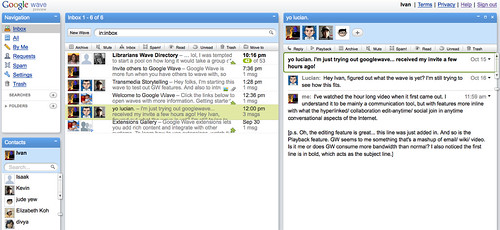
Ivan's Google Wave pane

As I used Google Wave and also revisited my earlier post, here are some thoughts:
  • First reaction was to treat Google Wave like email. But that would be limiting its potential for use.
  • I think of Google Wave as an online document (wiki/ email/ google docs) that allows conversations (add/ remove participants/ follow discussion threads).
  • With Email, we tend to think of recipients primarily as readers. Google Wave recipients are more like potential participants and document collaborators/ contributors. They can edit directly onto your original document (i.e. email in that traditional sense) and/ or reply as sequential threads.
  • I understand Google Wave to be mainly a communication tool, with features more inline with what the hyperlinked, collaboration (edit-anytime), social (join in anytime) conversational aspects of the Internet.
  • A wave can get pretty very long. Akin to reading a discussion forum thread. This is where the Playback feature comes in really useful. You can replay, like a video, the thread of the document from start to current status, showing who added what and so on. You can also skip and forward. Nice.

Interestingly, and gratifyingly, librarians have started something going on Google Wave.

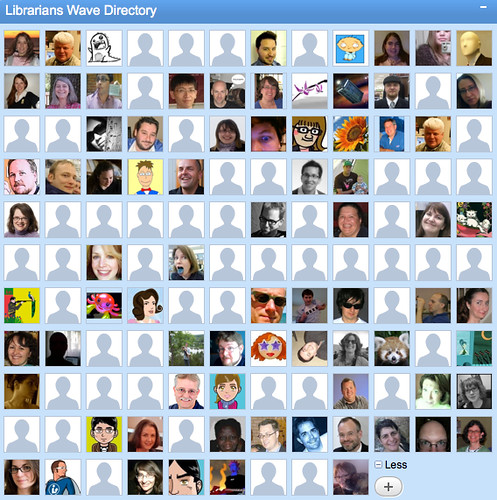
Colleen Greene (@colleengreene), Systems Librarian from Pollak Library, California State University, Fullerton, started a Librarians Wave Directory. By the time it got to me (I think it was Aaron Tay who added me), there were 117 people in the wave:
Google Wave: Librarians Wave Directory

I was going to add an entry to that wave but couldn't make up my mind to try an alphabetical listing from the top or bottom. Along the way, some librarians forgot to adhere to the alphabetical listing request.

Instead of adding to the 'directory' in Colleen's initial document, I posted a reply instead:
I found that clicking the "117 more" link at the top was a nice way of seeing the directory in a graphical view. One enhancement that would be nice was if the mouse-overs had some consistent display, like name/ blog URL of the person. And would be nice to be able to embed an Excel spreadsheet in a wave.

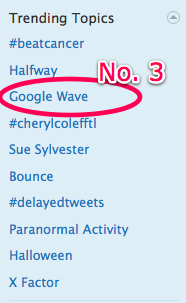
It didn't surprise me Google Wave just became a trending topic on Twitter (though about an hour later it seemed to have dropped off the chart).
Twitter trending topic - Google Wave

It also didn't surprise me to read some tweets that went along these lines: "Woohoo, I've got my Google Wave account! But I've got nobody to Google Wave with :(".

Google Wave is a cool tool but ultimately you ought to have something to say or friends to connect.

I'm at ramblinglibrarian@googlewave.com, btw.

Right... and I wonder when I'll receive the first Google Wave spam.

Monday, October 05, 2009

Open call for participants for a Gaming preview session at Jurong Regional Library, Saturday 24 Oct.

This is published with my employer's permission.

The Public Libraries (Singapore) would like to invite participants to a Gaming preview session on SAT October 24, 2009, 10am to 1pm at Jurong Regional Library's Verging All Teens space (Level 4). Lunch will be provided.

The Public Libraries intends to run a series of gaming events for the public. But before that, we hope to try out the session with a small group, to get your feedback and refine the programme format.

We plan to have about 20 participants for this preview session. If you're interested in helping the library test the programme format, please email me at RamblingLibrarian@gmail.com not later than 15 Oct '09.

Also, please let me know if you have special dietary needs (e.g. Halal food, Vegetarian). We will need to confirm the number of participants by 15th Oct (first come first serve).

More information below:
---------------------------
Why is the Public Libraries organising this preview session?
We hope you can try the games and let us know what you think of the programme. The library would like your inputs on how to refine the activity before we open it to the public at large.

What do I have to do at this preview session?
  • The entire event is about 3 hours (including lunch) on Saturday 10am - 1pm, at Jurong Regional Library (Level 4, VAT space).
  • You will get to play a mix of console games (Wii Tennis, Bowling, Mario Kart Wii, and Dance Dance Revolution) and also board games (Carcassone, Rat-a-Tat-Cat, and Blokus.). The session will be facilitated by our librarians and volunteers. Depending on the games, players will be grouped into teams (which we think is a nice way of getting others to meet and make new friends).
  • Lunch will be served, and the librarians will have a short chat with all participants. We hope to get your views on the games and the programme format -- basically your opinions on how you feel about the proposed gaming programme. You may also have questions like "why is the public library offering gaming?". We will answer any questions you have on that day.

Is this session open to bloggers only?
Nope. The main aim of this preview session is to have participants test out the games and format. We hope to get your views on how to improve the session before it is open to public. Of course the library would like to have as many people publicise the event (on your blog, or to your friends on MySpace, Facebook, Twitter etc.)). But only if you choose to do so. In any case, you're welcome to take photos and videos during the preview session.

Can I invite other friends to come along?
Sure! Feel free to pass this message. But we need everyone to register with us, so that we know how much food we need to prepare for lunch. We plan to have around 20 people for this session but if more people are interested, we'll see what we can do with this happy problem.
---------------------------

I'll just add that in offering a Gaming activity, the last thing we wanted was for people to adopt a "play and scoot" mentality (they can go to the games arcade for that). The gaming session is designed such that it would encourage personal exploration, and participant discussion and interactions. As well as introducing related library materials and resources through those games.

Well, you'll have to find out more about what all that is about. If you can attend the preview session.

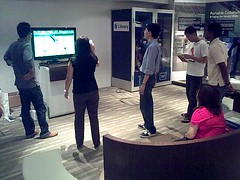
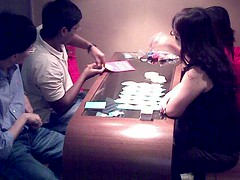
Here are some pictures from our testing session. BTW, thanks to the guys from the NTU Board Games Society: Pratheepan, Aloysius, Ben. They lent us some board games and also took time off their school schedule to show us how the board games work. During our planning session, they gave us ideas on how to facilitate the board games. Their members will also act as volunteer faciltators during the "live" sessions.

Wii bowling

Gaming is not just console games

At first I thought this was "Risk" but it's called "Carcassone". It involves luck and intellect as well.
Carcassone - board game

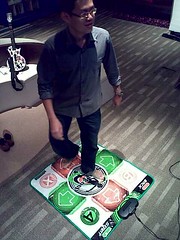
My colleague, Aaron Tan (btw he's also the initiator for this Gaming event), showing us how to Dance his way to a Revolution. Or was it Dance in a Revoluntary way? Why is it called Dance Dance Revolution anyway?
Dance Dance Revolution

Unfortunately, you won't be a Guitar Hero. At least not for this round. We're not having this game for the time being (but maybe our preview session participants may think otherwise).
Wanna be a (Guitar) Hero?


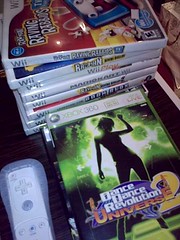
Console game titles

Sunday, September 27, 2009

Musings about Music: Lilly Allen, File Sharing, the Music Industry, NiN, Creative Commons

"But when you're between the devil and the deep blue sea, you need to stop worrying about pirates, and adjust your sails".

And so ends Dan Bull's brilliant video riposte in response to UK musician Lily Allen's support of stronger measures against illegal file sharers:


Kevin alerted me to the video via this post at Torrentfreak.com (26 Sept '09), where it explains:
This week Lily Allen’s views on file-sharing have been the hot topic. While some agree with her calls to ’save’ the industry from a fate worse than death, others did not subscribe to the doomsday scenario. One of those is UK musician Dan Bull who has written a brilliant song-come-open letter to Miss Allen...

... Say what you like about Lily Allen. Agree with her. Disagree with her if you like. Whatever the position, it’s difficult to take it away from her – she has done more in the last week to raise the online debate over illicit file-sharing than any other artist in recent months.

... “After Lily’s hectic week I’ve made a pro-filesharing song and video calling her up on a few of the claims she’s made,” UK musician Dan Bull explains to TorrentFreak.

“I’ve also tried to outline some of the main moral arguments for filesharing in the lyrics. Hope you enjoy, and hope the readers do too.”
LINK

Until that video and post, I had no idea who's Lily Allen (see her Wikipedia entry and her official website).

Except for this re-post (23 Sept '09) by TheIndependent.co.uk, I've not managed to read any of Allen's actual comments and entries (blog posts have been taken down). Though I understand the controversy has to do with her support of stronger measures against illegal file sharers and downloaders.

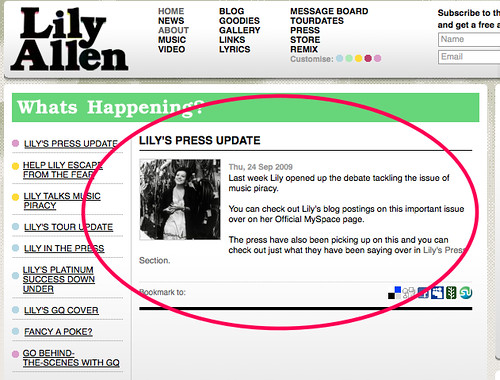
Lily Allen - press update (

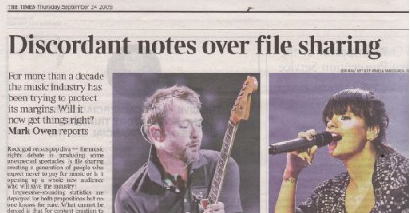
The Times, Thur 24 Sept 09 - Lily Allen and views on File Sharing

Over at the Sydney Morning Herald, they have this article (25 Sept '09) that gives more details on the controversy. Also says Allen will reportedly quit the music business altogether because of abuse towards her (arising from her support of stricter measures against illegal downloading and file sharing). This was also covered at Torrentfreak.com (24 Sept '09) two days before their Dan Bull post.


WHO STANDS TO LOSE MORE IN THE "MUSIC INDUSTRY"?
I can't say I know a lot about the music industry. Been reading articles like this, this, this one and this.

Each time I read about "the music industry" it makes me wonder, "Who makes up the Music Industry anyway?" Or rather, who stands to lose the most with the loss of music CD sales.

Musicians are just one part of the equation. Then there are the producers, session musicians, technicians. And of course the music lables -- publishers, distributors and marketing.

From what I've read, a large part of the profits go to the 'music labels', i.e. the company who signs on, grooms and markets the singer/ band. It's largely the labels who are lamenting the loss of sales, rather than the musicians. From what I've read so far anyway.


YOU CAN'T RUN AND YOU CAN'T HIDE
Nothing is immune against digital piracy. It's happened (and will continue to happen) to book publishing as well.

Some people seem forget that intellectual piracy isn't unique to the online platform. It's just that when content goes digital, the content is now separate from the container. The problem is exacerbated since distribution is now in the hands of the many when it once was the domain of a few.


A TURNAROUND?
This Guardian article (12 Jul '09) reports, they cited a survey that showed "the number of teenagers illegally sharing music has fallen dramatically in the past year". And that "legal digital sales are also seeing an unprecedented boom, although sales are far from making up from the shortfall created by the collapse of the physical market. Digital singles were up 41.5% in 2008, while physical singles sales plunged 43.5%..."


WHAT ABOUT CREATIVE COMMONS?
I hardly read anything about the Creative Commons in the mainstream press. Seems to me the mainstream press carry more stories on the damage of copyright violations to the music industry, while there is a relative silence on positive alternatives.

Like how Nine Inch Nails' CC-licensed Grammy-nominated album topped the 2008 Amazon MP3 sales charts (Nate Anderson covers this nicely at arstechnica.com; see also this CC case study entry).

When a band like NIN releases an album with a CC-license (they specifically adopted the BY-NC-SA license) and also sells it at Amazon.com, it means:
  • The band is explicitly allowing users to copy, transmit, re-post, share and remix the work under the specified conditions as detailed in the CC license.
  • The band retains the rights to their own music; they do not give up any of their rights.
  • They also have the rights to sell their own music; releasing their work under CC does not affect their rights to sell/ release their work in other ways.

Also, I would say the band has balls.

For a big name like Nine Inch Nails, I suspect it would have taken a respectable amount of faith in their musical abilities, and the dedication of their fans, to make their CC-licensed album work. NIN probably makes more money from their live gigs and tours. But that's not the point.

By explicitly allowing their music to be copied and transmitted, I think NIN recognised that they can't stop their fans -- and would-be fans -- from doing it anyway. Might as well just give permission to people on HOW to do the RIGHT THING.


COLUMN ON CREATIVE COMMONS
I don't blame the mainstream press for not covering much on CC. Writing about CC is just about as exciting as reporting on Copyright (which is what CC is about in that sense).

Unless there is something newsy to report, I doubt if we will hear about CC in the mainstream press. Unless they decide to run a regular column on Intellectual Property. Like how some mainstream papers have regular columns on money and investment matters.

Come to think of it, why don't they have a regular column on IP, Copyright and Creative Commons?


PUBLIC NEED AND EDUCATION
If mainstream papers can run columns and Q&A type of sections for romance, money and health, why not Intellectual Property? Invite readers to write in to experts, stuff like that. I bet it will answer a reader's need for information, and also serves as some form of reader education for the mainstream paper.

Afterall, IP is a way of life.

Almost everyone is a potential content creator (photographer, writer/ blogger, videographer). Or if you think negatively, almost everyone is a potential copyright abuser and digital pirate.

If we aren't already.

Sunday, September 20, 2009

Stuttering: some resources and related links

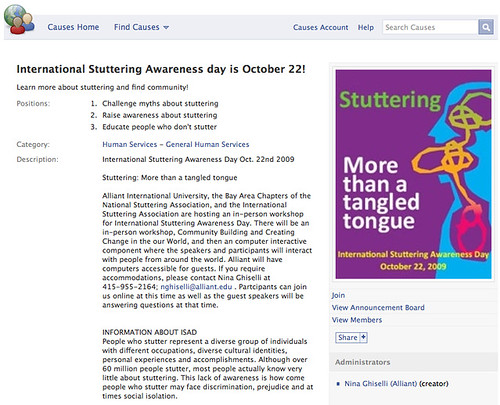
Learned about the International Stuttering Awareness Day, October 22:
International Stuttering Association - ISAD
International Stuttering Awareness Day (ISAD) occurs on October 22nd and is designed to raise awareness about the challenges that people who stutter experience. ISAD is a joint endeavor by persons who stutter and their families and professionals (educators, researchers and clinicians) interested in stuttering. ISAD provides a framework for building a more humane, just and compassionate world for millions of people who stutter

ISAD is co-sponsored and recognized by major international stuttering organizations such as International Stuttering Association; the International Fluency Association; European League of Stuttering Associations and American Speech-Hearing Association Division on Fluency and Fluency Disorders as well as national organizations which you can find on the International Stuttering Association website (www.stutterisa.org).
Source: International Stuttering Association (ISA) - www.stutterisa.org/ISAD.html (last accessed, 20 Sept '09).


After I posted that on sgLEAD, I searched more on the topic and found some interesting information on the condition:
  • A study published by the British Medical Association, as cited here, reports that "... bilingualism before the age of 5 has a significant effect on stuttering compared to children who speak only one language before this age".
  • The above results seem to be supported by this research paper led by the Singapore General Hospital, Australian Stuttering Research Centre, and National University of Singapore. From the abstract, the results show that "... English-dominant and Mandarin-dominant BWS exhibited higher %SS and SEV scores in their less dominant language, whereas the scores for the balanced bilinguals were similar for both languages."
  • This NUH flyer/ newsletter article says: "In Singapore at least 1% of the population stutters, with more males and females suffering from this problem." (PDF can be downloaded here).
When talking with people who stutter, the best thing to do is give them the time they need to say what they want to say. Try not to finish sentences or fill in words for them. Doing so only increases the person's sense of time pressure. Also, suggestions like "slow down," "relax," or "take a deep breath" can make the person feel even more uncomfortable because these comments suggest that stuttering should be simple to overcome, but it's not!
  • Stuttering is not just something you are born with. It could occur after a stroke, some illness or accident (as mentioned in the 5th para of this document from MOH; PDF here).
  • According to this article by Metta Welfare Association (page 2; PDF here) "Stuttering is a neurological condition, for which treatment and management protocols are different for the pre-teen and teenage/ adult populations."

How can one get speech-language therapy services in Singapore?
As advised by the Speech-Language and Hearing Association Singapore:
If you have a concern about communication difficulties or swallowing, consult your family doctor or general practitioner, who can then make the necessary referrals to the nearest / most suitable service available. A referral is usually required to access services in hospitals. Alternatively, individuals may directly approach a private Speech and Language therapist for an appointment.

I found these public and private hospitals, agencies and companies in Singapore that offer services for Stuttering/ speech therapy:
[The list may not be exhaustive; all sites were accessed on 20 Sept '09]


You can easily find the definitions for Stuttering from Internet sources, but to properly assess and diagnose it would require specialist help.

What I've read so far all agree that Stuttering is a treatable condition, but there is no cure (meaning, one has to keep working to keep the condition in check). And they all advocate early intervention and treatment (makes sense, because the longer you delay diagnosis and treatment the longer you delay your ability to overcome the problem).

Some books that are in NLB libraries:

Stuttering: Its Nature, Diagnosis and Treatment/ Edward G. Conture
cover
ISBN: 0205319246
NLB Call No.: 616.8554 CON (REFERENCE)
Abstract (from the NLB 'New Arrivals' site):
"This highly readable, clinically oriented book combines theory and therapy and examines all facets of stuttering, from possible etiologies through assessment to treatment. While considerable uncertainty still exists regarding the precise cause(s) of stuttering, Conture provides the reader with an even-handed coverage of fundamental knowledge, methodology, and procedures for effectively dealing with stuttering in children, teenagers, and adults. The book goes beyond a "how to" manual. Rather, Conture's clinical handbook provides both students and clinicians a source for principle-based procedures and strategies for the management of stuttering. Focusing on people who stutter as people first and people who stutter second, the material covers assessment and management of stuttering within the realities of everyday living, concomitant speech and language problems and clinical practice. For those in the fields of communication science and disorders and speech pathology."

Finding my voice: Youth with speech impairment/ Joyce Libal
Finding my voice : youth with speech impairment_ Joyce Libal
ISBN: 1422204227
NLB Call No.: 618.92855 LIB (Young People's Section)
Abstract (from the NLB 'New Arrivals' site):
Speech impairment is a common challenge among youth. Unfortunately, it is a challenge that, despite its frequency, can cause severe emotional and social distress for those who experience it. Stigma and prejudice can present particularly difficult emotional trials and social roadblocks to youth with speech impairments. All too often, these young people are assumed to be less capable, immature, or even unintelligent because of their communication barriers.

Education is the key to dissolving the common assumptions and prejudices held against those with speech impairments. Fortunately, more and more people are learning that speech impairments do not mean these children are less intelligent or less capable than others. Today many doctors, teachers, and organizations are committed to educating the public about speech impairment. They are helping youth with these conditions break down their communication barriers and reach their full potential. In Finding My Voice: Youth with Speech Impairments, you will learn about different types of speech impairments and about speech therapy. Along the way you will meet David, a boy who struggles with stuttering, and Martha who conquers problems with articulation. As David and Martha navigate the many challenges speech impairments pose, you will learn about the struggles, fears, joys, disappointments, and triumphs they meet while on their journeys.

BTW, you might want to head over to the International Stuttering Awareness Day Causes Page on Facebook:
Causes on Facebook | International Stuttering Awareness day is October 22!

Tuesday, September 08, 2009

Love at First Type

My first PDA was a Palm Tungsten-T. Bought it back in 2003.

Back then, I remember a colleague commented that I seem to like "IT-stuff". We were at a meeting. I was using my Palm Tungsten-T, with its foldable keyboard, to record notes from the discussion. To that colleague, it seemed strange not to use pen and paper to take notes.


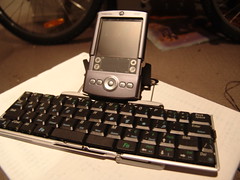
"Palm Pilot - Tungsten T", originally uploaded by talios.

I replied that I didn't use IT just because it was cool. I went purely for utility, I said.

The PDA allowed me to be more productive. I wanted a way to reduce the time copying notes on paper to digital (e.g. preparing Minutes of meetings in a Word document, or sending them out via email). The PDA was a worthwhile investment. What I typed into my PDA could be synced to my computer at my office cubicle and sent out immediately. I cleared my backlog of notes and updates that way.

But thinking back, my decision to buy the Tungsten-T wasn't entirely utilitarian.

It was a case of love at First Type.

The Story
My wife was the first to buy a Palm Tungsten-T (she's the real IT-person in our home). Up to that point, I have never had a PDA. It did not occur to me to get one. Not even when I saw my wife using it, even though I could logically deduce it would improve my work productivity.

Until I saw the foldable keyboard my wife bought with her Tungsten-T.

The foldable keyboard was beautifully designed. When folded up, it was the size of a cheque book. Sleek looking, encased in brushed aluminum. Lightweight but felt sturdy. When open, its size was way smaller than a conventional PC keyboard cousin.

What sealed my decision to get a Tungsten-T myself, with the foldable keyboard, was when I tested the keyboard.

Its touch and feel was the same as a conventional keyboard, if not better. What impressed me was that in spite of its size, it had exactly the same functions as a typical keyboard. The size of the keys was the same but the overall keyboard size was reduced. The designers combined up to three functions in selected keys on the foldable keyboard, so that reduced the number of keys needed.

Improved office productivity
The PDA and the keyboard was a worthwhile investment. Using it drastically improved my work productivity.

Instead of typing handwritten meeting notes to a email memo after each meeting (with the inevitable three to four days delay), I eliminated the need for handwritten notes by typing directly into the PDA, doing a 'Hotsync' to the PC/ laptop, then a quick copy-n-paste job to the email memo.

And after I tried out the Calendar feature on the PDA, I stopped using my printed calendar. It took a little getting used to, but the change was worth it. I could update my daily tasks much more easily, and I could set alarms for future deadlines. My printed calendar used to be stuffed with so many post-it notes of To-Do items, not to mention peppering my desk with post-it note reminders. The PDA eliminated that.

Also, I tend to do my best thinking when not consciously thinking about work. Like traveling on the train or bus. With the PDA, I could take down notes quickly whenever those *ahem* brilliant ideas strike. Or if writing was not possible, then hit the record button on the PDA to store audio.

But all that were just consequences of getting myself the PDA. I discovered the PDA's utility after I gave myself time to try it out.

In reality, I fell in love with its foldable keyboard first.

My Tungsten-T and its foldable keyboard served me well. I retired them five years later when the touchscreen failed and was beyond economical repair. I bought a Nokia e61, which had similar office productivity features, plus a phone.

I still have my Tungsten-T as a keepsake. But in truth, I've kept because of its foldable keyboard. From time to time, I still unfold the keyboard, slot the PDA onto it. And remember the good times.

Sunday, August 30, 2009

Encouraging students to read: Allow them to exercise choice

Came across this New York Times story (via LISnews), on how a Middle School teacher in the USA, Ms. Lorrie McNeill, allows her students to choose their own books for their literature class. Subsequently her students have to discuss the books with their teachers and peers, and also have to keep detailed journals about their reading.

This quote from the NYT article sums up the rationale of such an approach:
"... assigning books leaves many children bored or unable to understand the texts. Letting students choose their own books, they say, can help to build a lifelong love of reading."

The preceding paragraph quoted proponents of the traditional approach saying that assigning students what to read "builds a shared literary culture among students, exposes all readers to works of quality and complexity and is the best way to prepare students for standardized tests".

There are merits to assigned readings. It depends on the objectives. But the quoted arguments for the "teacher knows best" traditional approach seem weak to me.

A narrow list of reading materials, no matter how "good", has inherent limits on promoting a broad "literary culture". And what is a literary culture" anyway? One's ability to appreciate and analyse stories, or simply having the common experience of reading (maybe hating) the same text? "Quality" is also subjective (whose standards -- the student or the teacher?) And tests can always be redesigned and still have some degree of standardisation.

What I agree is on the complexity of the chosen book. Complexity could be in terms of ideas, plots and sub-plots, sub-texts, allegories and analogies, writing and language styles. For instance, E. M. Forster's The Machine Stops and Frank Herbert's Dune are both considered Sci-Fi classics, and could be said to relate to human society and relationships. But Dune is a lot more complex and detailed, with much more depth in the characters and plot.

Overall, if we are talking about students between the ages of 13 to 16 (i.e. teens), my sense is that complexity is less of an issue compared to getting them excited about reading. The bigger problem is getting students genuinely interested in reading, in the context of the classroom.

Perhaps a hybrid approach could be adopted: students get to propose their text and teachers, with the school librarians, would evaluate what the students proposed.

Which also means there should be some guidelines or criteria on what is deemed as appropriate selections and what is not. Make such guidelines available, so that students can evaluate and justify their selections. In that sense, their learning begins even before the class formally starts.

The best guidelines would have some degree of subjectivity. So in cases where teachers and students choices don't agree, students should be allowed to discuss options with the teacher. The discussion process would allow teachers to evaluate the students reading and analytical abilities.

So I feel Ms. McNeill is definitely on the right track, where motivating students to read is concerned.

And if students are motivated to read, then they are more likely to learn better.

Monday, August 24, 2009

Leadership, Ethics, and Online Collaboration

I was re-invited by Dr. Paul Wu (NTU, School of Communication and Information) to be in their Professional Seminar series, held last Saturday. Instead of speaking (as was the case in the previous two years) I was asked to be part of a panel discussion on "Leadership, Ethics and Collaborative Culture".

My two other panelists were Professor Cheong Hee Kiat (President, SIM University) and Mr. Heng Chiang Gnee (ex-CEO of SembCorp Environment). I wonder how many students wondered, like me, what this simple librarian was doing there, in light of these two very distinguished gentlemen!

Prior to the session, students viewed our talks from last year (recorded on video). I thought this was an excellent way of re-using content. Prof. Cheong spoke on Leadership, Mr. Heng on Ethics. My talk was on Librarians 2.0 (social media, librarians, collaborative culture).

Reading the programme theme made me wonder what was the connection between leadership, ethics and online collaboration. As I shared during my brief introduction for the panel discussion, the linkages seem to be this:
  • Collaborating and participating online is a demonstration personal leadership; and
  • To do it well requires one to exercise (our own) ethics
I've overly simplified things. So here's more. Before the session, I had typed a longer elaboration into my mobile phone. I didn't get to elaborate on those points, so I'll post them here (with some additional points after hearing Prof Cheng and Mr. Heng). BTW, much of what you'll read next is largely based on personal opinions rather than research. In anycase, feel free to critique and comment.


Online Collaboration
While human societies have been collaborating for centuries, I would suggest that online collaboration is a new phenomenon. And a different game altogether.

The Internet has only been with us for about 15 years, since 1995. Most of those years has been about communication like email and website publishing (the latter seems to be centred on Business-to-Business and Business-to-Consumer models).

Then social media came into the scene in the last five years or so, e.g. blogs, photo and video sharing. One can say social media is still about communication and publishing, albeit on a more individualised and personal way. But I think that planted the roots for greater individual participation and collaboration.

I don't think we're not seeing a lot of online collaboration at the moment. Of course, how one defines "collaboration" is arguable. I just don't think we're there yet.

But I'm confident we will see online collaboration on a greater scale. Particularly when we consider movements and trends like Mashups, Creative Commons and remixing (think "ccMixter").

The next wave will be about a non-explicit type of collaboration, or serendipitous collaboration, I think. Where you share content online with the intent of it being reused and you don't really know who will make use of it, or how.

Of course one may ask, "Why participate and collaborate?"


Exercising Personal Leadership
My claim is that participating online is an exercise in personal leadership. It is less about formal power that comes with formal roles but more with increasing one's Expert, Charismatic and Reference power (see Power Control Theory).

For instance,when this ex-A*Star researcher-now-turned taxi driver started his blog, particularly after the local papers ran his story, he probably became the de facto voice for all Singapore cabbies overnight. Without planning to be one, he is a leader in his own way. It started with him participating online by starting his blog.

But starting a blog (or a Facebook, Flickr or YouTube account) is one thing. How do you do it well. Or at the very basic level, how do you stay out of trouble? That's where ethics come in.


Ethics, values and online reputation
Ethics is about one's values, translated into conduct. In the online world, what matters the most is one's reputation.

Or to put in another way, in the online world, all we really have is our reputation.

How we act online can make or break our real-life reputation. Increasingly, we don't have participate online to have our real world reputation broken. All the sex scandals/ online sxposés have proven that. Citizen-journalism (or some might say, Net-savvy Kapoh citizens) is here to stay.

The world is our Ethics Panel.


The "Leadership-Ethics-Collaborative Culture" connection
Why participate and collaborate?

Because to do so is a demonstration of one's personal leadership. And to do it well (as defined by others) would depend on how we translate our ethics -- our values and moral principles -- into actions. On and offline.

There's another connection.

Not all of us want to "participate online" by starting our blogs or post videos to YouTube. Nonetheless, we will become online participants whether we like it or not. It doesn't have to be scandals. It starts at the instant a friend or family member shares a photo online, with us in it.

For those who make the conscious choice, the value we derive from our online activities would depend on our personal values and beliefs. Not in a religious sense. But the sort of values and beliefs that a greater good may come out of what we share online.

Monday, August 17, 2009

Conviction about our own profession

[First posted at sgLEAD, under the title "Excerpt from a Special Needs education blog: EDU240"]

I discovered this blog by chance: edu240extension.blogspot.com
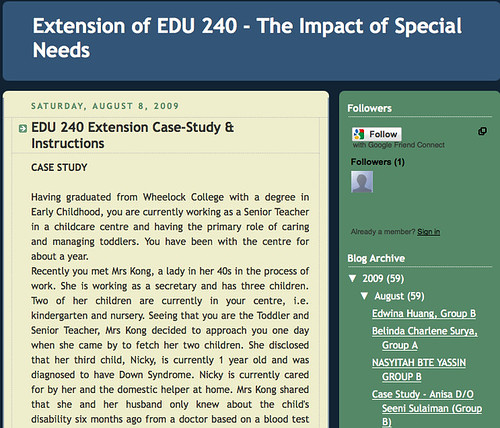
Extension of EDU 240 - The Impact of Special Needs: EDU 240 Extension Case-Study & Instructions

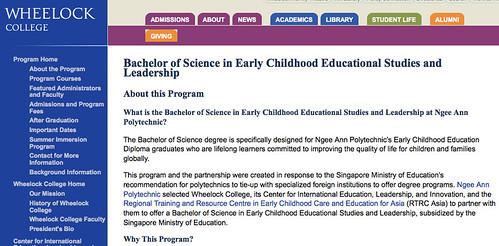
Though there's no About page or descriptive header, I can tell the blog is part of some Special Needs education course for educators. This post mentions "Wheelock College" and "degree in Early Childhood", and appears to be this programme:
Wheelock College, Early Childhood Educational Studies and Leadership

The blog was created recently (Aug 09). So far, the posts are responses to this case study:
Having graduated from Wheelock College with a degree in Early Childhood, you are currently working as a Senior Teacher in a childcare centre and having the primary role of caring and managing toddlers. You have been with the centre for about a year.

Recently you met Mrs Kong, a lady in her 40s in the process of work. She is working as a secretary and has three children. Two of her children are currently in your centre, i.e. kindergarten and nursery. Seeing that you are the Toddler and Senior Teacher, Mrs Kong decided to approach you one day when she came by to fetch her two children. She disclosed that her third child, Nicky, is currently 1 year old and was diagnosed to have Down Syndrome...

... Mrs Kong shared that initially she and her husband had a tough time coming to terms to their child having Down Syndrome. Though they have more or less come to terms with the doctor's diagnosis, she said that there are times where they do not really believe that Nicky has Down Syndrome as their two older children are normal and it seems that Nicky is always cheerful and smiling...

(a) What would you reveal to Mrs Kong regarding your professional view about children with Down Syndrome and their future in Singapore?

(b) Given the limited information provided, what would you advise Mrs Kong about:
(i) Enrolling Nicky into the centre's toddler class;
(ii) Nicky's diagnosis of having Down Syndrome.

(c) What would you disclose to Mrs Kong about special education, special school and inclusive education in Singapore?

LINK

As a layperson, reading that case study and the accompanying responses was pretty educational. The case study is fairly detailed and highlights what parents of children with Special Needs might be going through. Sharing the various responses is also a good way of tapping on the "wisdom of the class".

I'm interested in what a "model response" might be.

I didn't read though all the posts. But seemed to me most responses adopted the classic "pyramid" approach of giving background info before giving the actual answer that the other person wants to know. Some chose the empathy/ reassurance approach. That is still an indirect answer to me.

None of what I've read seems to have addressed the crux of the question: "Do I -- the Special Needs educator -- feel children with Down Syndrome have a future in Singapore?"

In fact, the main clue in the case seems to be this sentence: "Mrs Kong is very confused and overwhelmed with all these information."

The last thing Mrs. Kong needs is more information. Her concerns needs to be addressed directly (tactfully, but head-on).

Seems to me this question is a trick question: "What would you reveal to Mrs Kong regarding your professional view about children with Down Syndrome and their future in Singapore?"

It boils down to what the individual Special Needs Educator believes.

Seems to me there can only be one answer (the difference is how it's phrased according to one's style).

I feel the answer is this:
Children with Down Syndrome have a future in Singapore.

This is what I believe.

That is why I am a Special Needs educator.


I felt this was a trick question because it has nothing to do with facts or figures. It's all about one's personal conviction about one's own work. Whether we believe in the work that we do.

Of course, I'll back up my statements by citing examples. Like how the Singapore government has recognised the need to take proactive steps wrt persons and young children with special needs, and many things have been put in place since the "Enabling Masterplan 2007-2011".

Will also qualify that every individual's future is different. Even more so for a child with Down Syndrome. That's where parental acceptance and support, working with the system, comes in.

But all that's just background information.

It's ultimately that look in the eye -- that surety in one's voice -- that will say it all to parents like Mrs Kong.

It's not about bluster. Or how loud you say it.

I think it can only comes with one own's rationalisation and decision to continue with the job. You can't fake that sort of conviction.

And the same level of conviction applies to any job.

Friday, August 14, 2009

Who better to verify?

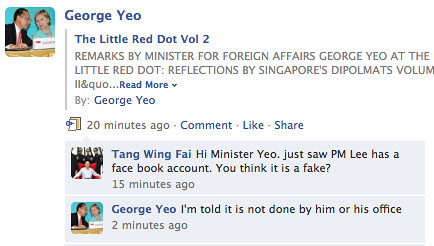
"Hi Minister Yeo. just saw PM Lee has a face book account. You think it is a fake?"

"I'm told it is not done by him or his office"

That settles it!
Facebook | George Yeo clarifies!

BTW, he is the real deal.

.