Friday, April 13, 2012

P. Krishnan: His literary Journey

Now that I'm with the National Library (office is at the NL building, Victoria Street), I get to see all the exhibitions that have been put up for the public. I also thought I should 'archive' them or at least have a simple pictorial record that they once existed. Hence this blog post.

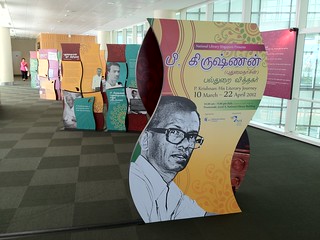
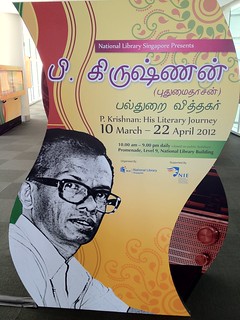
Here's an exhibition that will end on 22 Apr, 2012: "P. Krishnan: His literary Journey".
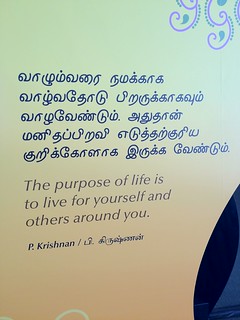
P. Krishnan: His literary Journey

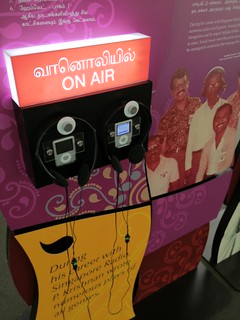
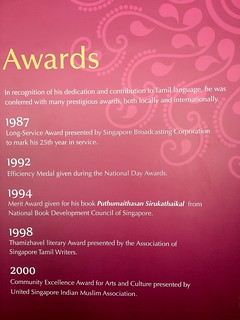
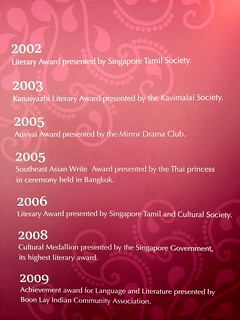
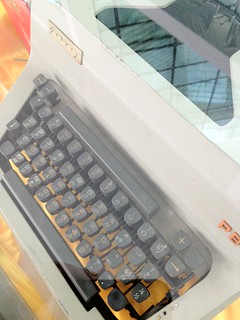
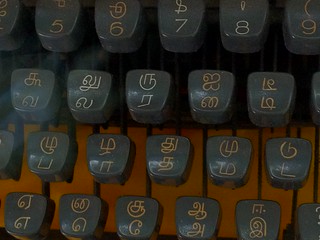
P. Krishnan is one of Singapore’s illustrious Literary Pioneers who writes under the pseudonym of Puthumaithasan. Focusing on social issues, his writings are peppered with a tinge of sarcasm and a dash of comedy. Visitors to this exhibition will have a chance to listen to excerpts of his famous radio play “Adukkuveetu Annasamy”, about life in the HDB heartlands as well as view excerpts from the Tamil adaptation of the TV drama, Macbeth. This showcase is an opportunity for the younger generation to know about this pioneer and appreciate his contributions to Singapore Tamil literature.

Date: Saturday Mar 10, 2012 - Sunday Apr 22, 2012
Time: 10:00 AM - 09:00 PM
Venue: Level 9 - Promenade in National Library Building
Lang: English

Source: golibrary.nlb.gov.sg/Exhibitions/41106/P__Krishnan__His_literary_Journey.aspx (last accessed 13 Apr 2012)

P. Krishnan: His literary Journey

P. Krishnan: His literary Journey

P. Krishnan: His literary Journey P. Krishnan: His literary Journey

P. Krishnan: His literary Journey

P. Krishnan: His literary Journey

P. Krishnan: His literary Journey

Sunday, April 01, 2012

iremember my childhood: Being caned by my father

For the Singapore Memory Project. I guess it's really for myself:

(Original Twitter sequence has been edited slightly)
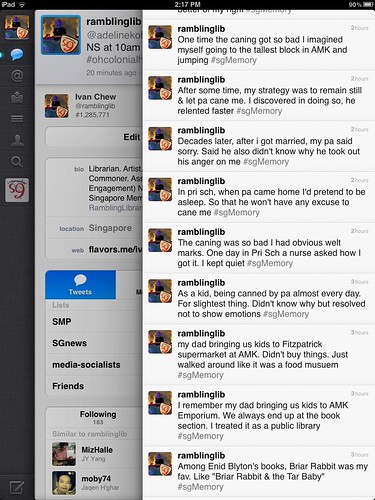
"@ramblinglib: As a kid, being canned by pa almost every day. For slightest thing. Didn't know why but resolved not to show emotions #sgMemory”

“@ramblinglib: The caning was so bad I had obvious welt marks. One day in Pri Sch a nurse asked how I got it. I kept quiet #sgMemory”

“@ramblinglib: In pri sch, when pa came home I'd pretend to be asleep. So that he won't have any excuse to cane me #sgMemory”

“@ramblinglib: After some time, my strategy was to remain still & let pa cane me. I discovered in doing so, he relented faster #sgMemory”

“@ramblinglib: One time the caning got so bad I imagined myself going to the tallest block in AMK and jumping #sgMemory”

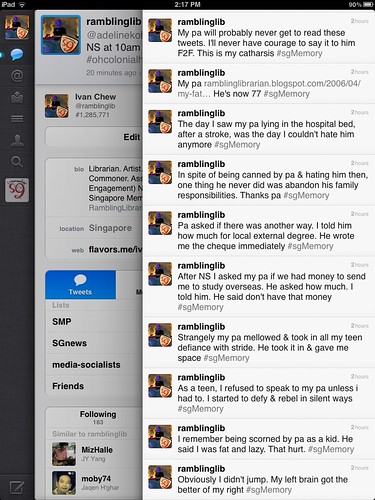
“@ramblinglib: Obviously I didn't jump. My left brain got the better of my right #sgMemory”

“@ramblinglib: I remember being scorned by pa as a kid. He said I was fat and lazy. That hurt. #sgMemory”

“@ramblinglib: As a teen, I refused to speak to my pa unless i had to. I started to defy & rebel in silent ways #sgMemory”

“@ramblinglib: Strangely my pa mellowed & took in all my teen defiance with stride. He took it in & gave me space #sgMemory”

“@ramblinglib: After NS I asked my pa if we had money to send me to study overseas. He asked how much. I told him. He said don't have that money #sgMemory”

“@ramblinglib: Pa asked if there was another way. I told him how much for local external degree. He wrote me the cheque immediately #sgMemory”

“@ramblinglib: In spite of being canned by pa & hating him then, one thing he never did was abandon his family responsibilities. Thanks pa #sgMemory”

“@ramblinglib: Decades later, after i got married, my pa said sorry. Said he also didn't know why he took out his anger on me #sgMemory”

“@ramblinglib: The day I saw my pa lying in the hospital bed, after a stroke, was the day I couldn't hate him anymore #sgMemory”

“@ramblinglib: My pa http://t.co/LB9WVUNa He's now 77 #sgMemory”

“@ramblinglib: My pa will probably never get to read these tweets. I'll never have courage to say it to him F2F. This is my catharsis #sgMemory”

Full story:
I suppose it was this tweet that made me remember a particular childhood episode, when I was around 10 years old. Remembering about my father and a period where he seemed to viciously cane me for the slightest reason.

My father used the thin rattan cane (the defacto tool of corporal discipline Asian parents used at that generation). It wasn't just "tough parental love", for the frequency of me being caned was almost daily. My younger brother and sister were spared mostly, I recalled.

I can't remember how long that caning went. I'm not sure when it stopped. I still recall pretending to be asleep when I heard my father come home. So that he won't find an excuse to cane me.

The caning was serious enough to break skin, result in bleeding and noticeable welts. Bad enough that my mum had to apply some ointment to cover up the broken skin. I would go to school with visible cane marks.

When I was 10, my father was in his 40s (he was considered to have married late, for his generation). My father was a strong man. And it didn't help that I was an emotionally sensitive child. At 10 years old, I once even thought of ending my life just to spite him.

My father seemed to have focused his anger on me. I was not naughty as a child at all. I attended school, came straight home, did my homework, never talked back to my elders (kids my generation were spoken of, but not spoken to). OK I cant say I was a perfect child, but I was far from being a bad one.

In truth, my father was not a cruel man. He was generous to his friends, our neighbours, and our relatives. Maybe that was why it hurt me, in more than the physical sense. The 10 year old me never understood why he couldn't be generous and forgiving to his own firstborn.

There were negative consequences, in that I deliberately became a very morose and serious child. I remember "experimenting" with not saying anything to my father for days. Days became weeks. And then it became natural.

In my teenage years, that refusal to talk to my father (other than functional statements) became little rebellious acts. Part of it was the teen angst and the onset of hormonal changes. One time, it occured to me why young lions were chased out of the pride. They would otherwise kill the top male lion, their sire, because there was no room to maneuvour.

My father and I didn't have a destructive relationship but we were never close. I knew he tried to be better towards me, and there was an episode where I was very gateful to him for supporting my contiuning education. But even so, my feelings towards him never quite swung completely towards the good. There was always that shadow of resentment.

It took decades before those childhood scars could truly start healing. One poignant point was when my father said something close to an apology for that childhood caning episode. A self-admission.

I was with my wife and my parents, at a hawker centre eating desserts. My parents were in their 60s by then. I had moved out of my parent's apartment after getting married. It was a home visit with my wife.

We talked about how some things had changed, or remained the same, in the neighbourhood. My father started sharing, with my wife, how I was as a child: that I liked to draw and read. He remembered that I was a good boy, even as a toddler.

Out of the blue, he said how at one point he would come home and cane me for any reason. He was not sure why he was that angry. A part of him knew he had been too harsh. And yet he could not stop himself and he continued to take his anger out on me. He recalled not caning me only when he saw me asleep (when I heard that, I had goosebumps -- and I also secretly congratulated myself for displaying some smarts as a 10 year old).

With his relevation, or confession even, there came an awkward pause.

There was my father, sounding apologetic. All my life, I've not seen that side of him. I looked at my wife. I looked anywhere except at my father. I said nothing then, or after.

I guess this is my way of saying it now.

P.S. Perhaps to you reading this, I'm making a mountain out of a molehill. Strange that I cannot speak of this with my father now. All I can say is that the resentment has been real for much of my life.

It's not so traumatic that I can't talk about it. I just can't talk to my father of it. Or won't. In truth, there is cowardice and irrational fear at work. I fear that I would cry, and he would cry. Or maybe it all doesn't matter now, and I'm merely post this to share a (good) story.

Whatever it is, it's been enough that I know my father knows. And vice versa. That's as good as I wish for things to be.

iremember my childhood #sgmemory

iremember my childhood #sgMemory

Sunday, March 25, 2012

Remembering ECP McDonald’s

This served as a draft for this blog post I wrote for work, i.e. for the Singapore Memory Project:

"Remembering a place like a fast food outlet is overdoing the whole nostalgia thing, isn’t it?"

No it isn't, IMO.

Not all places are equal in terms of hertiage value. But to think that it is merely about nostalgia is to miss the point.

My colleague, Yeong Chong, said it best in the Colourbars Media clip:
The danger in thinking that a place like McDonald’s is not worth remembering is that these are the places you spent your formative years in. They actually form a stronger foundation for your personhood than a religious or heritage site that you may have only known about through history textbooks.

There is nothing wrong with wanting to remember a McDonald’s outlet.

Nostalgia isn’t about objectivity. It is about us celebrating the personal experiences that make up who we are.

It struck me that in a world that we have less control over, it is some people’s attempt to create despite what is about to be lost, as more important.

So what if it romanticises? Don’t all myths, legends and stories do that?

And I think there is nothing wrong -- and everything right -- in remembering what has been good.

Sunday, March 18, 2012

Blast from the Past: My presentation on "Web 2.0 & library services to young adults: An introduction"

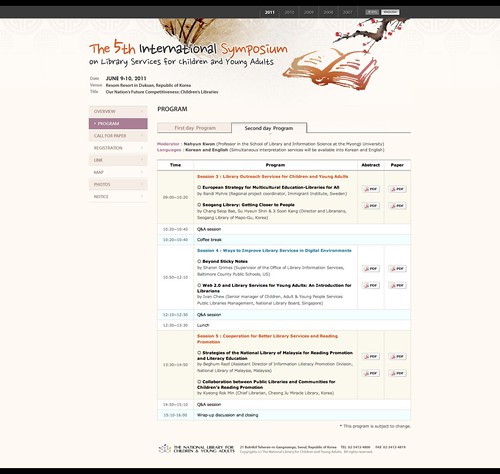
Yikes. This is a really late post. Back in June 2011, I gave a presentation at the 5th National Library for Children & Young Adults Symposium, 2011, South Korea. The symposium was held at Duksan Resom Resort, South Korea.

OK, so this is a "blast from the past" post then.

Here's my presentation, which was an update and also an extension of this 2009 IFLA document of the same title. The organisers found that document and wanted me to present a condensed version.


It might have sounded easy. Just reduce the original 78-pages to 30mins and deliver what's in the paper, right?

Umm, that would bore the heck out of me if I were the audience. So while in the plane to Seoul, I was still thinking about how to deliver the 30min talk. I wanted to be able to "tell a story" in a practical way. So I delivered what one of the delegate described later as a "workshop-style" talk.

The essence of my talk was how a Web 2.0. approach and mindset could be applied to librarians serving teens. But the presentations I enjoy are those that "told a story". And in the end, after brainstorming with a colleague, I did just that. I shared what I thought was a possible "day in the life of" a Teens Services librarian, straddling between online and offline engagement efforts.

My ego received a little boost when I was told it was like a TED talk. Heh.

It was also the first time I presented using an iPad. It was a calculated risk, as I've not delivered a talk using the iPad. I'd seen it used as a presentation tool but never actually used it. I rehearsed in the iPad, mentally went through backup plans. Arranged to test the iPad connection with their presentation equipment the day before my speaking slot. Phew, it worked beautifully.

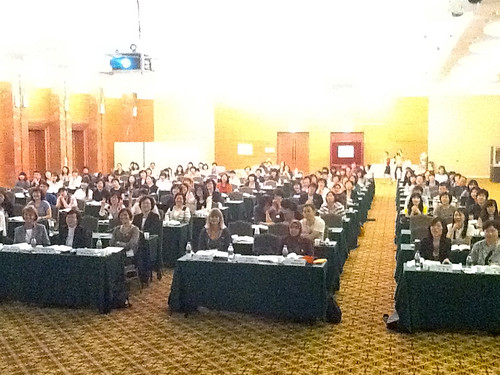
So much so that I was confident enough, by then, to even take a "live" picture of the attendees. I directed my iPad camera towards them as the iPad was hooked up to the projector. The audience saw their "live" video capture on screen. Neat (it worked to start the 'show', as I could see the attendees smiling and being amazed -- and South Koreans were pretty IT-savvy folks!)

5th National Library for Children & Young Adults Symposium, 2011, South Korea

What was new for me as a presenter was having a simultaneous translation (in Korean) of my talk. Luckily, I chatted with the translators the day before. They advised me that I should just deliver my talk normally, as in I should not try to wait for them to catch up between words. It was easier for them if my pace of speaking was consistent (not too fast nor too slow). I did what they advised and it worked well. Trust the experts, I say!

In preparing for my talk, I had excellent help from Daryl Tay, who pointed to this excellent source of information on Digital Media stats in South Korea (I understand it was initiated by Prof Netzley).

I also got in touch with Creative Commons contacts in South Korea, who gave me a concise background on the social media and IP scene in South Korea. Not directly applicable in my talk in the end, but gave me that additional layer of verification and background information.

My Facebook post also drew several good suggestions from friends (rats, I can't seem to find that Facebook thread).

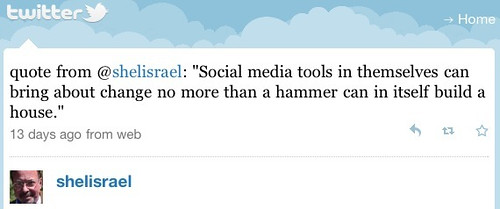
Here's a very nice quote from Shel, that I didn't get to use at the presentation:
Social media is like a hammer is a tool...

I had a fantastic time. The South Korean organisers were (famously) excellent hosts and the programme was also one of the better ones I've attended.

The 5th International Symposium-192158

Related post:
Your ideas on "Using social media as part of library services for Children or Teens", 1 June 2011.

Tuesday, February 28, 2012

Behind the scenes: Towards the launch of the Singapore Memory Project's flagship portal, SingaporeMemory.sg

[Views expressed here are strictly my own. I am straddling between writing in my personal capacity, as well as my official role as the head for Digital Engagement for the project. Just so you know :)]

By tomorrow, all the intense efforts for the past six months (in developing the website) will come to fruition The flagship website for the Singapore Memory Project will finally be unveiled.
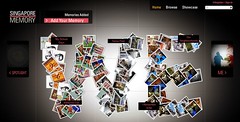
SingaporeMemory.sg Sneak Peeks

Before its official launch, there will be a pre-launch party. It's called a "party" for good reason. If you didn't sign up for the party, you'll probably have to read about it later :)

The publicity efforts for the party was two-prong: social media channels and the "traditional" way.

The traditional way was to write formal invites to specific people, such as e representatives of partner agencies and VIPs. The social media way, which my team was responsible for, had a more organic approach.

SOCIAL MEDIA INVITES
Our overall "framework" started off with a target in mind, as well as specific aims for inviting people. We set a target of 40 guests invited through social media circles (a check around suggested the average turnout for 'blogger events' was about 20 people).

We didn't want to limit to just "bloggers". I've probably mentioned it before (haven't I?) that in today's context, if you are active on Facebook, you're practically a 'blogger' in a general sense. We referred to our social media guests as 'social media users'.

CONSIDERATIONS
The main criteria was that they were active in their respective social media circles. We had some guidelines, though not hard rules on what was 'active'. They certainly need not be Singaporeans only. The project was not limited to citizens.

We sought out active social media users, particularly those who were seen to be enthused about heritage and memory-like activities. We felt such guests would also be more likely to be comfortable with our portal. If all worked out well, we would like guests to be one of the first few people in Singapore (nay, the world!) to create a 'Memory Account' and publish a memory there.

There were a few key influencers and social media guests in mind. We had already been in touch with a few of them in the preceding months. Our team members intuitively understood that we had to cultivate relationships early on.

Invited guests included people like (what I call) the hardcore heritage bloggers. Then there were the active Hertiage groups on Facebook's, as well as enthusiasts on twitter. These specific people, we wrote personal emails/ messages to them.

They weren't a focus group as such. We'd already conducted a few runs for that purpose weeks earlier.

THE CALL
Then we issued an open call for registrants to the party.

This was also an experiment, where we tried both Evenbrite and Facebook event page.
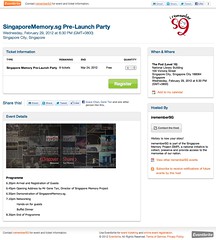
SingaporeMemory.sg Pre-Launch Party - Eventbrite

SingaporeMemory.sg Pre-Launch Party!


SNEAK PEAKS
Concurrently, a series of 'Sneak Peeks' were posted:

  • Sneak Peeks (Part 1)
  • Sneak Peeks (Part 2)
  • Sneak Peeks (Part 3)
Update: The posts have been consolidated into one post, with a refresh of the iRememberSG blog.
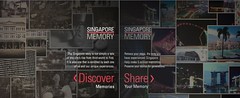
SingaporeMemory.sg Sneak Peeks

SingaporeMemory.sg Sneak Peeks

SingaporeMemory.sg Sneak Peeks

I would have liked to provide a set of "social media press kits", made available online. But details of the portal and the party was still pretty fluid at that time. Everyone was working on very, very tight deadlines. The Sneak Peeks was, I suppose, the next best thing we could offer.

The 'sneak peeks' was also our way of answering the question, "Why should I attend the pre-launch party?". I know I would ask that question if I were on the receiving end.

Rather than answer that question directly, I guess we presumed users could assess for themselves from the sneak peeks.

The posts also served to ease the regular iRemember.SG visitors into the upcoming portal. One obvious question to address was the difference between the SingaporeMemory.sg portal and the iRemember.SG site. As explained from Sneak Peek, Part 3:
As many of your will remember, the irememberSG blog began as our placeholder for stories submitted from the public. It was indeed an honour to be featured during the National Day Rally speech on 14 Aug 2011, and PM Lee Hsien Loong shared memories from James Seah and Muhammad Raydza as captured here. Six months on, we have taken some of our users' feedback for a more readable site and the ability to submit memories and view them instantaneously.

As already mentioned last week, we will port the memory submission and display functions to the new Singapore memory portal, while irememberSG will evolve into a staff blog. Here's how it will look like:
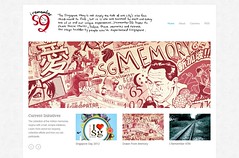

SingaporeMemory.sg Sneak Peeks


REACTIONS TO THE PARTY INVITES
From my own experience organising meetups for creative commons Singapore, theres always -- always -- a sense of trepidation and uncertainty when issuing open invites. The very human fear was that no one would give a hoot about your event.

But we were quickly assured that there was some positive response.

Within two hours of posting the open invite in twitter and Facebook, about ten people signed up on their own accord. About half were NLB staff, but they were not involved in the project. They signed up as guests, not as staff. It's nice when co-workers -- outside of the project -- show interest in it.

We didn't stop at that just posting the online invites. There was more work to be done.

My colleagues and I started issuing individual messages in ernest. I posted to several groups, and had help from a very active memory corp volunteer and a Hertiage influencer to get one foot into the group.

I can't really track when was the exact tipping point, if any. My colleague might have a day to day statistical report of the signups. We might analyse that a little more closely when we have time. I think we had very gradual steay daily build ups. The twitter community was fast and sort of peaked within two or three hours. Im not sure if there was a long tail. Seeing my RTs, I think it might have gotten three days worth of publicity before the tweets we overwhelmed.

The last count I was told was 150 219 unique individuals signed up. Just under 10 days after announcing the event via online channels. I must say part of the positive response is for the project itself. There's a certain draw to something like a national memory initiative.

Nonetheless, pretty good results for a fledging social media unit of the project.

Even if half don't show up, we would still have a very good crowd. I thought at least we reached our to those who had sign up, and they might have passed the message onwards indirectly.

This is just the start of a an ongoing relationship, for sure.
Facebook timline cover - Ivan Chew

HAIRY & AUDACIOUS
The scale of the project is huge. For one, there's a hairy and audacious goal of five million memories to be collected by 2015.

Given its scale, the team behind the project is also a large one, where project teams go in the NLB. Just to give you a peek (and also my way of acknowledging the unsung heroes and heroines):

There's another team working on marketing, publicity, and partnerships.

My team of four are responsible for the web development for the portal as well as a mobile app. Even so, we're really cogs in the larger machine. We're not web developers or coders.

There's another inter-divisional team comprising of a Information Solutions Architect, a web project manager, a mobile app project manager, an IT project manager who in turns manages a team of about ten coders.

Then there are colleagues working on legal documentation, liaison with our funding ministry, interfacing with NLB senior management.

The Singapore Memory project is the most ambitious project I've been involved. Certainly a most meaningful one. Or else I wouldn't have volunteered for it.
Sunday, February 12, 2012

Dealing with negative comments in social media

Ever since joining the Singapore Memory Project full-time in Nov 2011, I've been taking a closer look at social media strategies.

Being a social media practitioner, as I had for the past seven years, does not necessarily make me a good "social media strategist". It definitely helped that I was "part of the scene" but that did not automatically mean I could instantly formalise plans and approaches to fit a broader perspective.

It took me a few weeks of thinking, reading, and bouncing ideas with the team. I've paid closer attention to articles and posts relating to social media plans, strategies and so on. I intend to share more about my thoughts of the social media plan for the Singapore Memory Project. But that'll be for later posts.

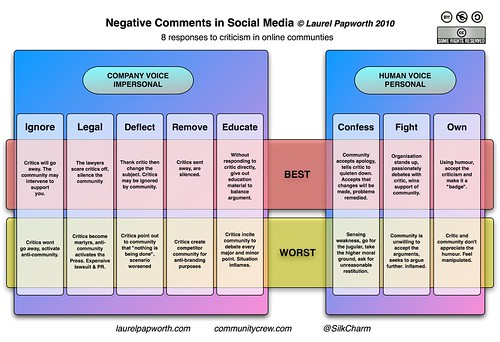
Today, I came across this post today (hat-tip to @criagthomler), which led me to this diagram on the "8 responses to criticisms in online communities", by Laurel Papworth.

NegativeComments in Social Media
NegativeComments in Social Media. CC-CY-NC-ND. Originally uploaded by Laurel Papworth.

I thought the diagram summed up the various scenarios beautifully. A fuller explanation is at her post.

Here's the eight approaches to negative online comments, according to Laurel's (I've paraphrased them somewhat):
  1. Ignoring the negative commenter
  2. Taking legal measures
  3. Attempt to deflect the negative comment to a positive one
  4. Remove and/ or ban the commenter
  5. Attempt to educate the commenter
  6. Adopt a confessionary/ apologetic tone
  7. Defend the organisation's position
  8. Use humour; adopt a self-depreciative stand

FORMAL VS INFORMAL
Approach one through five involves more of the formal organisational tone, while six to eight shifts the tone towards a more personable one. That's according to the diagram. Which made sense, though I think in practice, the "Formal Organisational Tone" and "Personal Tone" could be flexibly used, depending on the situation.

But come to think of it, I think "Personal Tone" probably starts at three and would not be effective if attempting to convince the other party that you're serious about taking legal measures. In the same regards, it would be very difficult -- and weird -- if one employes a formal organisational tone while attempting at humour. Well, unless you want to brand your organisation that way.

The diagram makes a lot of sense. It acknowledges that sometimes, perhaps on rare occasions, a formal tone has to be adopted. The crux is in how the organisation recognises and decides when would be appropriate to switch between formality and informality.

Most would agree a credible social media plan should have a "Response Strategy". Critically, an organisation need to be able to ascertain whether it should choose to respond or not, in addition to knowing how to formulate appropriate responses. Especially for 'crisis communications' or negative sentiments. Plenty of case studies out there, detailing how organisations were seen to be caught with their pants down, with regards to "social media crisis management".

OWNERSHIP
I've realised even more that an orgainsation's social media department should have a full-time staff heading it. This may sound like a self-reinforcing statement, given that I'm tasked to head the Singapore Memory Project's social media functions. Heh. It's just that taking on this role has convinced me of this.

An organisation's social media team could have a large part of its function outsourced. But decisions on communications should flow back to a staff with the appropriate level of accountability and discretionary authority.

I suppose it's possible that certain level of authority could be conferred to the outsourced staff. But if communications is key, is it then a good call to outsource a key function? Probably not.

It's not so much that one has to be a "full time staff". The closer truth is that the staffers in charge -- whether the one fronting the Twitter feed, or the department head -- have to take ownership of being the social media voice for the project/ organisation. With it comes the risk and responsibilities too.

Staffers need to have the confidence and gumption (i.e. guts and balls) in communicating with the online public.

LICENSE TO SOCIALISE
Staff competencies come with training and staff development, in addition to the innate abilities of the staffers. Then there has to be empowerment, either through the appropriate staff appointments. Or the organisation's policy on social media engagement (which is often related to its corporate communications policy).

You can't be an effective social media staffer if you feel the need to check with your supervisor on how to respond. It's equally true that you can't do your job effectively if your supervisor requires you to clear every response before it is posted.

One of the competencies would be the ability to read correctly the sentiments expressed by the online community. And then being able to decide on the appropriate response. Or perhaps a conscious decision not to respond at all.

Simply put, the social media team has to be empowered to speak for the organisation, to varying degrees.

The speed of the organisation's response has proved to be critical factor in how the online community perceives its "social media street creds". The perceived lack of response, often just a lag of a day or two, may do equal damage to the organisation compared to saying something that the community does not agree with.

Sunday, February 05, 2012

Remixes, Attribution, Creative Alchemies: The Long Tail in Acts of Kindness (part 2)

Continued from Part 1:

THE 'WHY' QUESTION
I get a kick out of the creative process.

I've come to realise that's the basis of why I create. Of having seemingly created something out of nothing; moulding ideas into something that can be seen/ heard/ experienced.

But beyond the initial post-creative euphoria, I will wonder if all my time and effort was worth it. The inevitable “What’s the point” rhetoric.

Luckily, once in a while, something like this comes along. Reminding me that it's worth it.


It's not new to have a video using my CC-licensed music as the soundtrack.

But what's new to me was the user being a company rather than an individual hobbyist.

Red Maps seem like a start-up firm. At least, not a huge conglomerate with a global household brand name (I do hope they become one though).

Still, to have a for-profit company using my work meant that my work had to be of a certain quality. No company worth their salt would want to be associated with low-quality music in their video. For a for-profit outfit to use my work, I consider that as affirmation of something.


REDEFINING WHAT IS 'BEING PAID'
When I started posting my work online, I haboured hopes that my talents might be discovered. And that I'd earn big bucks.

But the idea of "being paid" has become, to me, less about money. It is more about affirmation from others, which serves as a yardstick for my journey of self-expression.

The skeptic in me would say that all that is merely an exercise in self-massaging the ego. Nonetheless, we all have our own reasons for sharing and giving. And expectations as well.

I can't speak for everyone else who share their works under Creative Commons licenses. My primary motivation, if you can call it that, can be summed up as follows:
  • I create, as part of my journey towards self-actualisation.
  • Since the work already here, I might as well let others benefit.

Creative Commons provided that framework for sharing. A framework that I understood and was comfortable with.


LONG TAIL TO ACTS OF KINDNESS
I believe there might be a Long Tail to acts of kindness.

File:Long tail.svg - Wikipedia, the free encyclopedia
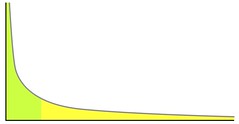
"An example of a power law graph showing popularity ranking. To the right is the long tail; to the left are the few that dominate. Notice that the areas of both regions match."

Can we really apply the true statistical definition of the Long Tail to "an act of kindness"?

What if the X-axis was Time and the Y-axis (vertical) was "the number of people who benefited from that one single act of kindness"? That "act of kindness" could be that one piece of work, which you and I release online (this might be interesting conversational fodder with David).

Whimsical, perhaps.

But I've come to believe that sharing my work online -- and allowing others to use -- is one of the simplest act of kindness I can do.

There's opportunity costs but it's of a very low probability. Sure, I could have been paid for my work. But I'm not likely nor willing to invest that sort of time and energy, to perfect my craft to the level of being able to make serious money on a regular basis. Such opportunity costs are low.


GENEROSITY ON A SPECTRUM
The extreme end of generosity would be to share the work as 'Public Domain'. You need not seek permission at all, nor are credits needed; absolutely no strings attached.

At the other end would be for people to pay money if they want to use my creations.

In-between, I think, are differing levels of generosity:
  • Creative Commons, where the owner has already given the world permission to use the work. One need not seek explicit permission, though attribution is required. Receiving monetary payment is often not the main intent of the owner.
  • 'All Rights Reserved' Copyright, where explicit permission is needed from the creator. The creator may agree to your request without any form of payment (if payment is required, it's not really sharing).

HELPING MYSELF
I've also come to realise that when I share, I hope to be entertained and learn from other people's self-expressions. I'm definitely a beneficiary, when people use my work and transform it into something that I cannot do for myself.

Sometimes, what is transformed fits exactly the vision I had.

I discovered two videos (here, and here) that seem to be part of a class assignment.

The second one is my absolute favorite, to date (thanks, LukeD):


KIB 105 Animation and Motion Graphics Assessment 3 - Luke Daly from Luke D on Vimeo.

LukeD's creative interpretation matched the sort of mental imagery I had, when I posted those words. Honestly, I would not have spent time making such a video. Nor would I have been able to produce an illustration-based work.

The best part is that my spoken poetry, that LukeD used, weren't even mine. The creator was kind enough to let me post them as a spoken piece.

The Long Tail of kindness indeed.

creativecommons.org.au/content/attributingccmaterials.pdf
Source: creativecommons.org.au/content/attributingccmaterials.pdf. CC-BY. Australian Research Council Centre of Excellence for Creative Industries and Innovation (www.cci.edu.au) in partnership with Creative Commons Australia(creativecommons.org.au).

Thursday, February 02, 2012

Singapore Memory Project: Focus group session with Memory Corp volunteers

My Digital Engagement team mates and I conducted a series of focus group sessions today. For the upcoming Singapore Memory website.

Here's one with volunteers from the Memory Corp: Tuck Chong (third from the left), James (first from the right), and Philip (not in the picture).

Singapore Memory Project - Website Focus Group

We'll be posting more behind-the-scenes updates regularly. At the official blog, that is (which is also scheduled for a facelift in a few weeks).

Busy busy busy.

Sunday, January 29, 2012

Remixes, Attribution, Creative Alchemies: The Long Tail in Acts of Kindness (part 1)

Here's a few recent videos that used my songs from my ccMixter.org uploads.


Remixed with: Beyond Jupiter III


Remixed with: Dreaming of the Ocean


Remixed with: Island Journey Reprise

Typically, my songs are used in "hobbyist videos". Not surprising, as the need and demand for royalty-free works generally come from hobbyists. I think it's also the increasingly popularity of ccMixter.org as the source for CC-licensed music.

ATTRIBUTION
I love how people are crediting my music, in full, in their video descriptions. By "full", I mean describing the title, indicating my name, and including the relevant URL to link back to the source.

This wasn't necessarily the case a few years back, at least for those remixes that use my music. My impression, at least. I don't have hard evidence to prove that the level of attribution has improved. Unless I trace back all the remixes and compile the way they have been cited (... hmm).

Anyway, about two years ago, most remixes tend to unwittingly omitted the credits entirely. People email me to thank me for sharing the music, and to let me know how they have used my music. For those cases where I find that credits were not made, I ask nicely that they include my name and the relevant URL. If they have already uploaded a video, I ask that the credit is included in the description, which was easily done rather than asking them to include in the video and re-upload again.

I would add that the attribution requirement was the stated condition for using the work:
"For any reuse or distribution, you must make clear to others the licence terms of this work"

I didn't want them to think I was asking for something extra. In all cases, they happily made the change. Some went the extra step of amending their video and re-uploading it. Which was very gracious on their part.

How do I properly attribute a work offered under a Creative Commons license?
All CC licenses require users to attribute the original creator(s) of a work, unless the creator has waived that requirement or asked that her name be removed from an adaptation or collection.

CC licenses have a sophisticated and flexible attribution requirement, so there is not necessarily one correct way to provide attribution. The proper method for giving credit will depend on the medium and means you are using, and may be implemented in any reasonable manner, although in the case of an adaptation or collection the credit needs to be as prominent as credits for other contributors.

The CC website offers some best practices to help you attribute works, and the CC Australia team has developed a helpful guide to attributing works in different formats.

Source: Creative Commons FAQ

Rather than say that Creative Commons "does not provide clarity on the proper way to cite", it's more accurate to say that Creative Commons allows flexibility in how attribution can be presented. The manner of attribution depends on the medium. For instance, a "live" hyperlink is only possible for an online media, whereas for a print media the URL is obviously not "live".

It's more important that people -- users and creators -- understand the spirit and philosophy of Creative Commons. But that's not to say there cannot be clarity in how to attribute properly when making use of Creative Commons licensed materials.


HOW TO CITE EQUITABLY
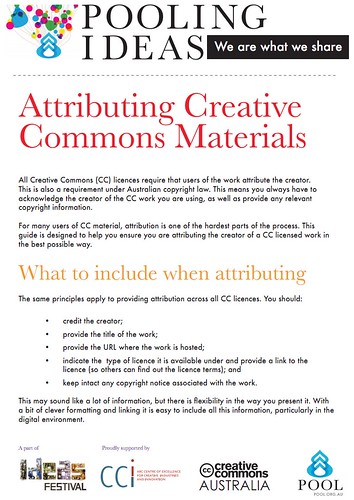
I highly recommend this PDF guide to attributing works by CC Australia. It's both comprehensive and concise:
What to include when attributingAll Creative Commons (CC) licences require that users of the work attribute the creator... ...The same principles apply to providing attribution across all CC licences. You should:
  • credit the creator;
  • provide the title of the work;
  • provide the URL where the work is hosted;
  • indicate the type of licence it is available under and provide a link to the licence (so others can find out the licence terms); and
  • keep intact any copyright notice associated with the work

creativecommons.org.au/content/attributingccmaterials.pdf

It's not so much about "proper citation" but more of crediting the source adequately and equitably. If I'm using a CC-licensed work, I try to put myself in the other person's shoes and ask how I would want to be credited. Also, I believe that "payment" can be the form of reciprocity. Any one who uses my work, and provides equitable attribution, is my publicist.

In the digital economy, a "live" hyperlink is currency.

Admittedly, I don't always follow the last two points, i.e. indicating the CC license type and copyright notice. But I always state the creator's name and provide a "live" link back to the CC-licensed works. I try to adhere to this when listing the credits in my videos, but if it's not possible to do so fully, the "live" links are definitely in the description section.

That said, if the creator indicates very clearly how they would like to be attributed, I will always adhere to it. It helps if creators state their preferences upfront and/ or in an obvious location next to the work.

My own practice, in licensing my own work, is to state how I would like to be credited. I state this near or just below the download link. Basically in a way that others won't miss it.
2011 Simpler Times : urmymuse & Ivan Chew : Free Download & Streaming : Internet Archive

I didn't always do that in the beginning. I used to assume others knew how to properly cite my work.

As creators, we can help others help us, by providing clear, simple/ hassle-free instructions and requirements. Most people will respect and adhere to that.


To be continued: Part 2.

Wednesday, January 18, 2012

My 2011 read list

The start of 2012 seems, for me, just as busy as 2011. Might as well just start with the annual read list.

Total items read since 2004:

Will do a more detailed breakdown, if I get the chance (ha!)

What's obvious is that my 2011 reading volume has decreased, reversing the increasing trend for the last two years.

2011 was a particularly busy and hectic year for me. I'm still having flashbacks of bringing work home, after office hours -- on a regular basis from January 2011 all the way to maybe July. *shudder*

But I believe I read far more graphic novels in 2010 compared to 2011. So in terms of reading depth, 2011 might be better. Maybe (I might be wrong).

The purchase of an iPad, and seriously using the NLB's Overdrive collection on a regular basis, has given me more reading options. I think my reading volume might have hit 40 or 50 items only, if not for the iPad. And those 40 to 50 items might comprise of mostly graphic novels.

A snapshot of my reading genre tag-cloud so far (wished I'd done a snapshot each year... ah well)

Annual Read List « Rough Notes :: By the Rambling Librarian (Singapore)

My overall perception was that I was reading more non-fiction (not graphic novels) compared with previous years. In anycase, I'm rather intrigued to discover any particular shifts in reading patterns, beyond volume read. We shall see.

Will leave you with a re-post of my 2011 list (first posted at RoughNotes)
  1. Aftermath: Prepare for and survive apocalypse 2012/ Lawrence E. Joseph
  2. Aliens: Female war/ Mark Verheiden
  3. Asimov’s Science Fiction/ March 2011 
  4. Battlestar Galactica: Complete Omnibus V1 
  5. Battlestar Galactica: Ghosts 
  6. Between water and song: New poets for the twenty-first century/ edited by Norman Minnick
  7. Bicycles: Love poems 
  8. Bloomberg Businessweek/ June 27 – July 3, 2011
  9. Blue Beetle: Black and blue/ Matthew Sturges & Mike Norton
  10. Brevity 2: Another collection of comics by Guy & Rodd/ Guy Endore-Kaiser & Rodd Perry
  11. Buy me: new ways to get customers to choose your products and ignore the rest/ Marshall Cohen
  12. Buying time: trading your retirement income for income and lifestyle in your retirement years/ Daryl Diamond
  13. Coach Wooden: The seven principles that changed his life and will change yours/ Pat Williams
  14. Core strength for dummies, pocketbook edition/ LaReine Chabut
  15. Digital animation 
  16. Dog fancy/ natural dog (2 issues in 1)/ Aug 2011
  17. Freakonomics 
  18. Fundsupermart/ 4Q 2009
  19. Futurama: The time bender trilogy/ created by Matt Groening; story by Ian Boothby
  20. Gone case/ Dave Chua
  21. Happiness at the end of the world/ Happy smiley and friends
  22. Heroes vol 1 
  23. How an economy works and why it crashes/ Peter D. Schiff
  24. Jack Doe: Anonymous/ Shawn Yap, Gabriel Chua, Xander Lee
  25. James Robinson’s complete WildCATS 
  26. Jia: a story of North Korea/ Hyejin Kim
  27. Kato vol 1: Not my father’s daughter/ Ande Parks
  28. Liquid thinking: Inspirational thinking from the world’s greatest achievers/ Damian Hughes
  29. Lost Squad/ written by Chris Kirby; art by Alan Robinson; lettered by Kel Nuttall
  30. Love is the best medicine: what two dogs taught a veterinarian about hope, humility, and everyday miracles/ Dr. Nick Trout
  31. Mac Life/ May 2010
  32. Macworld/ April 2011
  33. Macworld/ May 2011
  34. Mental floss: genius instruction manual 
  35. Myspace Darkhorse Presents (MDHP) vol 4.
  36. Northlanders. Book one: Sven the returned/ Brian Wood
  37. Northlanders. Book two: The cross and the hammer/ Brain Wood
  38. Relational intelligence: how leaders can expand their influence through a new way of being smart/ Steve Saccone
  39. Return on engagement: content, strategy, and design techniques for digital marketing/ Tim Frick – Standard
  40. Six degrees of expatriation/ Maida Pineda
  41. Small message, big impact: how to put the power of the elevator speech effect to work for you/ Terri L. Sjodin
  42. Social media metrics/ Jim Sterne
  43. StarCraft: Frontline. Volume 1.
  44. Story structure architect: A writer’s guide to building dramatic situations & compelling characters/ Victoria Lynn Schmidt
  45. Stranded vol 1/ Mike Carey & Siddharth Kotian
  46. Strategic thinking: a nine step approach to tragedy for marketeers and managers/ Simon Wootten & Terry Horne
  47. Strength for life: the fitness plan for the rest of your life/ Shawn Philips
  48. Teenage as a second language 
  49. Terminator: revolution 
  50. The agile enterprise 
  51. The appeal/ John Grisham
  52. The brain fitness workout: brain training puzzles to improve your memory, concentration, decision-making skills, and mental flexibility/ Philip Carter
  53. The collected stories of Arthur C. Clarke. Short stories/ Arthur C. Clarke
  54. The crown and other stories/ Rabindranath Tagore; translated by Ranjita Basu
  55. The digital handshake: seven proven strategies to grow your business using social media/ Paul Chaney
  56. The genius machine: the eleven steps that turns raw ideas into brilliance/ Gary Sindell
  57. The home and the world 
  58. The immortal iron fist 
  59. The past and the punishments 
  60. The Question: The five books of blood/ Greg Rucka et al.
  61. The right decision 
  62. The tarnished angel 
  63. The unwritten: Inside man/ Mike Carey & Peter Gross
  64. The war that time forgot: Vol 1 
  65. Twitterville: how businesses can thrive in the new global neighborhoods/ shel israel
  66. What should I do with the rest of my life? True stories of finding success, passion and new meaning in the second half of life/ Bruce Frankel – Standard
  67. What the dog saw, and other adventures/ Malcolm Gladwell
  68. Why we run: a natural history/ Bernd Heinrich
  69. Work’s intimacy/ Melissa Greg
  70. Yes! 50 secrets from the science of persuasion/ Noah Goldstein, Steve J. Martin, Robert B. Caildini