Monday, September 26, 2011

Remembering Project Gutenberg's Michael Hart (1947-2011)

Earlier this September, the world focused on the 10-year anniversary of the 9-11 attacks. Not surprising, for the events on 11th September of 2001 was a world-changing event.

I thought what seems to have slipped the world's attention was the passing of Michael Hart, founder of Project Gutenberg.

Hart's project might not be world-changing on the scale of 9-11, but it certainly spanned the World Wide Web.

Project Gutenberg is, without a doubt for me, the precursor of ebooks.

Hart was best known for his 1971 invention of electronic books, or eBooks. He founded Project Gutenberg, which is recognized as one of the earliest and longest-lasting online literary projects. He often told this story of how he had the idea for eBooks. He had been granted access to significant computing power at the University of Illinois at Urbana-Champaign. On July 4 1971, after being inspired by a free printed copy of the U.S. Declaration of Independence, he decided to type the text into a computer, and to transmit it to other users on the computer network. From this beginning, the digitization and distribution of literature was to be Hart's life's work, spanning over 40 years.
~ Dr. Gregory B. Newby, Obituary for Michael Stern Hart.

I only learned about Project Gutenberg after I entered the library profession in 1996. That was also the year I had any real practical experience with the World Wide Web and the Internet. I also did not realise -- until much, much later -- that Project Gutenberg was started in 1971 (I'm almost as old as it was).

Project Gutenberg, at that time, it was a no-frills website. It still is, by today's standards.

Then, and like now, you basically searched for titles and downloaded digital texts for free. Almost all 'books' in Project Gutenberg were texts from public domain.

However, it was not an online bookstore the way Amazon was. In terms of popular appeal, the public domain texts could never compare.

Still, I found Project Gutenberg impressive. I still do. It may seem a simple idea: converting texts from printed book form to digital files, then making the digital works available to the world. For free.

But for a 'simple idea' to be sustained since 1971, that alone has to impress.

The reading experience
Michael Hart's project didn't revolutionise the reading experience, not in the way Amazon's Kindle and Apple's iPad did.

Of course, I don't think he sought to do that.

I thought Project Gutenberg had two issues that prevented it from becoming truly world-changing. One, the reading experience wasn't 'wow'. Reading large volume of texts on desktop or laptop computer screens was impractical for most. It was more of 'reading off a computer' rather 'reading an ebook', not to mention the print resolution and several well-discussed issues.

Two, the content wasn't 'wow' either. Not when the rage was Tom Clancy and John Grisham etc.

I have an impression that when the world's reading experience was transformed with the appearance of Kindle and iPad (along with their respective supply of eBooks with modern and popular appeal), Project Gutenberg fell even more out of the public eye. Relatively speaking.

In the 90s, when the World Wide Web was a nebulous thing and librarians met it with calls of doom and gloom, I think librarians saw Project Gutenberg as a positive thing, but not a remedy.

Project Gutenberg was not a search engine. It wasn't an online reference (come to think of it: if it were, it would be seen as yet another threat!)

Renewed relevance?
I think with eReading devices becoming more accessible and affordable, an initiative like Project Gutenberg's Mission Statement may be well poised to take on the future:
The mission of Project Gutenberg is simple: To encourage the creation and distribution of eBooks.

This mission is, as much as possible, to encourage all those who are interested in making eBooks and helping to give them away.

Project Gutenberg has moved with the times. They have backed up their intent (of encouraging eBook distribution) by providing formats like EPUB and for Kindle.

And who knows? Perhaps a successful contemporary author, whose works have current mass appeal, may bequeath his works to Project Gutenberg. Or a philanthropist who decides to acquire the rights of popular works and make them available through the Project.

Or some one may leverage on Project Gutenberg's collection, add a new twist to its eBooks content or reading experience, and make it available as an Apple or Android app. Which might transform the world's reading experience.

Well, all are just conjectures.

Most of us did not see 9-11 coming. On a more positive note, neither did we foresee the Kindle or iPad. For that matter, did we anticipate a relatively simple idea like Project Gutenberg?

So who knows?

Thank you, Michael Hart.

Wednesday, September 21, 2011

Teaching racial harmony

The train doors opened.

An old man stepped in. I could tell he was quite elderly: his wrinkled skin; his unsure footing as the train moved off.

A much younger man noticed him too. The young man got up from his seat. The younger person's body language and eye contact was enough to signal his intent to the elder.

The old man shuffled towards the vacated seat. "Thank you, thank you," he said.

A few seats away, a young girl took it all in, glancing between the two.


Singapore MRT Cabin
Originally uploaded by xcode

The old man and young person were of two different races.

~

[Note: The above happened just the way I saw it. I was inspired to recount the above after reading Lucian's post. No where as elegant as Lucian's though.]

Friday, August 19, 2011

Singapore Wins Bid to Host 2013 IFLA General Conference and Assembly

There's about two years to prepare. This should be interesting for librarians in Singapore :)

I hope to see some of my IFLA friends and colleagues again.

From NLB's media release, dated 19 Aug 2011:

Singapore Wins Bid to Host Prestigious International Library Congress in 2013

Release Date : 19 Aug 2011

Singapore, 19 August 2011 – Singapore has won the bid to host the International Federation of Library Associations and Institutions (IFLA) World Library and Information Congress to be held in August 2013. This announcement was made officially at the closing session of the IFLA World Library and Information Congress 2011 on 18 August 2011 in San Juan, Puerto Rico.
 
This marks the first time that Singapore is hosting the Congress, which is the flagship professional and trade event for the international library and information sector. The Congress takes place in August each year in a city selected through a competitive three-stage bidding process that is overseen by the IFLA Governing Board. The hosting of the Congress rotates among the IFLA regions of Asia and Oceania, Europe, Africa, North America and Latin America and Caribbean. Previous host cities included Gothenburg, Sweden in 2010 and Milan, Italy in 2009. The last Asian host city was Seoul, South Korea in 2006.
 
Singapore's bid to host the 2013 edition of the Congress was jointly submitted by National Library Board (NLB) and the Library Association of Singapore and supported by the Singapore Tourism Board (STB), Ministry of Information, Communications and the Arts and the Ministry of Foreign Affairs. The international convention in August 2013 is expected to attract over 3,000 participants from over 100 countries who will converge in Singapore to discuss the developments and new trends in the library arena. The programme will run over eight days, including three days of business meetings, a five-day conference programme, and three and half days of exhibition.
 
“Our successful bid to host the IFLA World Library and Information Congress will place us firmly on the world map of the library and information sector as the Congress offers a unique platform to promote knowledge sharing and exchange best practices within the international community. This will also pave the way for us to deepen relations and facilitate future collaborations with our global counterparts,” said Mrs Elaine Ng, Chief Executive Officer (CEO), NLB.
 
“We are very pleased to be the city of choice for the 2013 IFLA World Library and Information Congress. Singapore's vibrant and pro-business environment, bolstered by quality infrastructure, and a strong global network of strategic partnerships, will provide an ideal platform for the exchange of ideas and collaboration among delegates,” commented Ms Melissa Ow, Assistant Chief Executive, Industry Development (II) Group, STB.
 
“Further, Singapore's rich multi-cultural heritage, diversity of business and leisure offerings, and upcoming developments such as Gardens by the Bay, and the world's first River Safari, look set to provide guests and delegates with a differentiated experience of our constantly evolving city.”
 
A national committee, chaired by CEO of NLB, comprising representatives from the local library and information sector will be set up to oversee the organising of the Congress.

Here's more, from the current Library Association of Singapore president.

Tuesday, August 09, 2011

Celebrating Singaporeana: Happy 46th

In my friend Lucian's post, he admitted having the sort of prejudice some Singaporeans might have towards things made or achieved by Singaporeans:
It is true that for some obscure reason, Singaporeans look down on other Singaporeans. “Made in America” comes with the notion that the product is heavy-duty; “made in Japan”, quality; “made in the UK”, quaint. But when you talk about something that is “made in Singapore”, it is always the Singaporeans who’ll be first in line to pull it down. You’ll often hear things like “trying too hard to be [insert name of western country]” or “cannot make it”. Best of all, these criticisms are uttered by the ones who’ve never had the guts to even try.

I know, because I’m guilty of it.
(Btw the context of his post was Inch Chua's Open Letter to Singapore; her facebook post has been removed but you can read a repost here).

Lucian's admission struck a chord with me. I, too, displayed a similar sort of prejudice a few weeks earlier.

I was reading a book containing stories written by Singaporeans. The title of the book isn't the point. The point was my unconscious judgement, comparing those stories with my favourite non-Singaporean authors. I felt the "made in Singapore" stories were not "good enough".

On one hand, I desperately wanted to like the stories. On the other, I wanted to admit the stories didn't appeal to me. I even tried to rationalise why those stories weren't appealing to my tastes. My reasoning came up short.
I was torn between wanting the stories to be great, and having to acknowledge they were not.
Then I realised something else.
Even though I would not consider those stories to be 'great', I had managed to read the entire book from cover to cover. I read every single story. That was already an achievement. There have been contemporary best-selling authors whose works I can never read past chapter one, or less.

Once I got past my mental literary-hang up, it was easy to see what else was good about those stories. They were technically competent. There were no glaring spelling or grammatical errors. The story ideas may not have made me go "wow" (actually, very few stories can) but they were not run-of-the-mill ones. It was clear the authors put in what they were worth, and not out to insult the intelligence of the reader.

I also realised I didn't have to like every single story in that "made by Singaporeans" book.

Perhaps this sort of reader reaction is part of the literary territory. We all have our personal yardsticks against what we consider as 'best'. And I think it's healthy to compare, so that there's some specific literary target to aim for.

However, I think we Singaporean readers have to be mindful not to confuse "setting a goal" with "expecting every Singaporean author to write like [insert name of your favorite author]".

Another friend of mine is fond of saying, "Don't celebrate mediocrity".

I agree.

I'm not suggesting we endorse or embrace, by default, everything "made in Singapore" or "by Singaporeans". If the works are shoddy, we should say so. But I believe we should not impose undue expectations or comparisons. Enjoy the work -- a play, music, a piece of creative fiction -- for what they are worth.

We should not confuse "not being unique" with "not good".

If we have a flower that smells like a rose, it's OK to compare with another blossom in the next yard. But let's not forget: that very flower, grown in our garden, still smells sweet.

Happy 46th, Singapore.

Sunday, June 26, 2011

App How-To: EBSCOhost iPhone/ iPod Touch app

If you access EBSCOhost resources regularly, you might want to give this EBSCOhost app a try (even if you don't it's still worth giving this a spin if you own an Apple mobile device).

It's compatible with iPhone, iPod Touch and iPad (though, the design/ app display size is more for the iPhone and iPod Touch than the iPad).


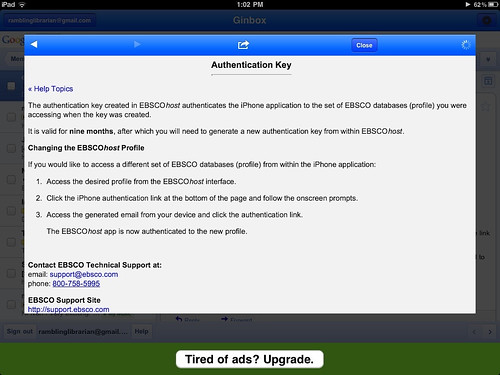
NOTE: After you've installed the app on your iPhone or iPad, you can't use it right away. You have to obtain and activate an Authentication Key from the EBSCOhost database page, which has to be done via logging into the library's eresources website. It seems you do this step once and it's valid for 9 months. It's also valid only for the individual database, which means you have to do the same authentication process for each of the EBSCOhost that you want to access via the App

Ebscohost iPhone app

Here's a step-by-step guide (btw, the steps were done via my iPad):

SETTING UP
Download the app from the App Store (keyword search "ebscohost").

After installing the app, there's a few more preparatory steps. You need to obtain and activate the authentication key (if not, you won't see any menu options on the app).

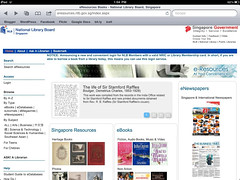
To get the key, you first login to eResources.nlb.gov.sg in order to get to an EBSOhost database (I'm assuming you've already signed up for a digital library account, or you're registered as a NLB library member. The site's How To section has details of how to sign up/ access the resources).


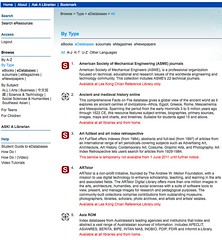
After logging in, browse through the database listings and click on the EBSCOhost database you prefer. The list is in alphabetical order, so you've to scroll the page to entries starting with "E".
eResources - National Library Board, Singapore

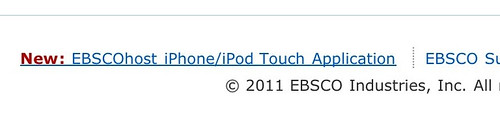
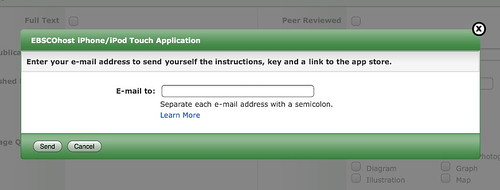
In this example, I clicked on an EBSCOhost database called "MAS Ultra - Public Library Editition". On the database page, scroll all the way to the bottom of the page and click on the link "EBSCOhost iPhone/ iPod Touch Application":


You will be prompted to enter your email address, where the authentication link will be sent.
IMG_0229

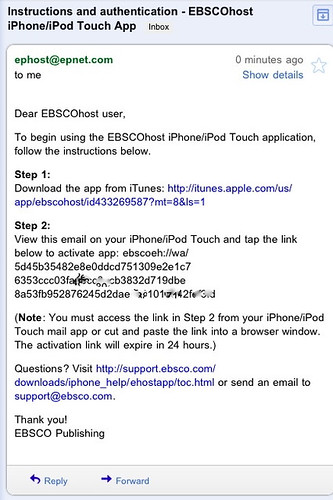
The authentication mail looks like this. Follow the instructions (the link has to be accessed via your iPhone/ iPod Touch/ iPad).
IMG_0230

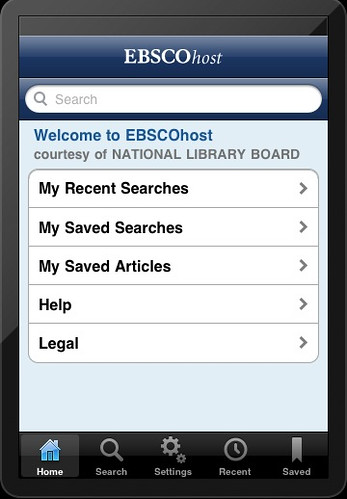
After that, you're done. When you open the EBSCOhost app, the menu appears.
IMG_0231


EXPLORING THE APP
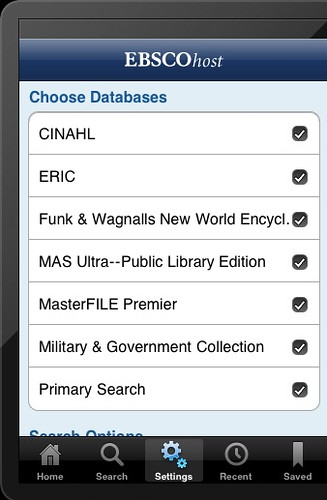
Under the Settings option, I can specify the databases I'd like to access (note: you have to repeat the authentication process for every individual database. But
IMG_0232

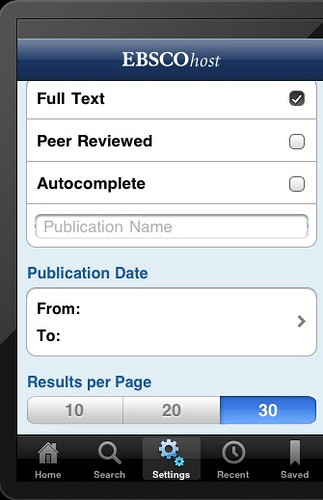
You can specify what results to display (e.g. show you full-text articles only, or filter by date ranges):
IMG_0233

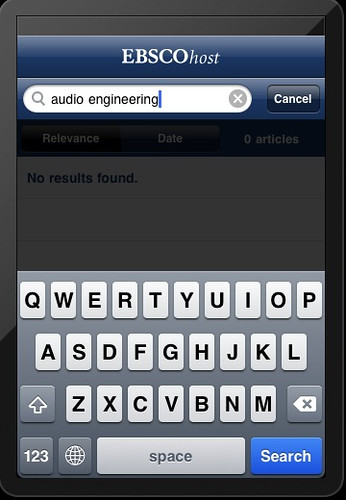
To search for articles, you type your keywords (there's no Advanced Search option in this app, but you can filter the results under the Settings option, as explained above)
IMG_0243

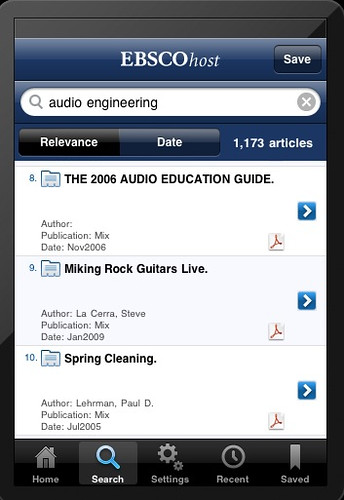
Results are displayed like this.
IMG_0234

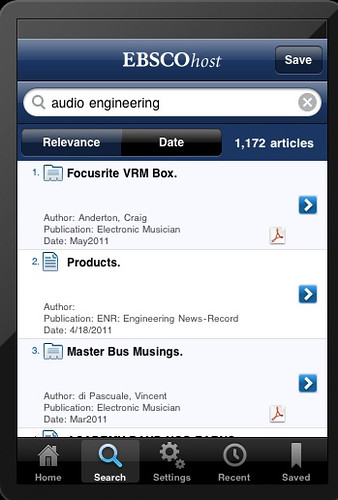
The default display is by articles that the system deems as most relevant based on the keywords. In the above screenshot, the first article was published in 2006. is You can display the most recent articles by tapping on the Date tab (the following screen now shows the first listed article published in 2011).
IMG_0237


READING (on and offline)
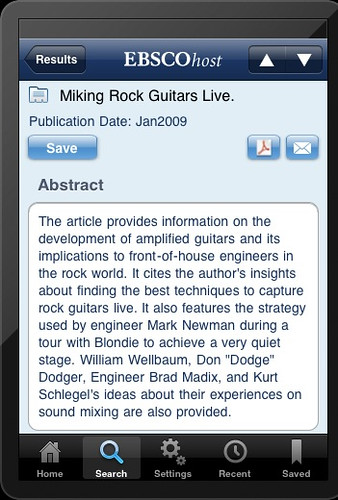
Tapping on the displayed article title brings you to a screen like this. It gives you the abstract, the link to save the article to your mobile device, or download the PDF or email.
IMG_0235

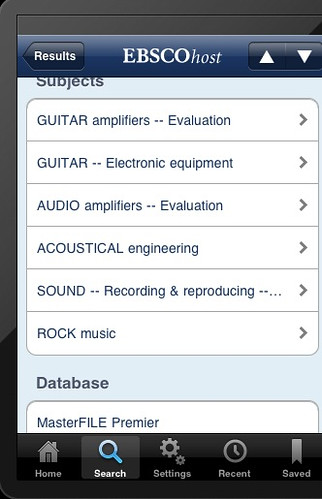
Scrolling down the page shows information like the author, article source, subject headings, database name (tapping on them does an automatic search and display, based on those links):
IMG_0236

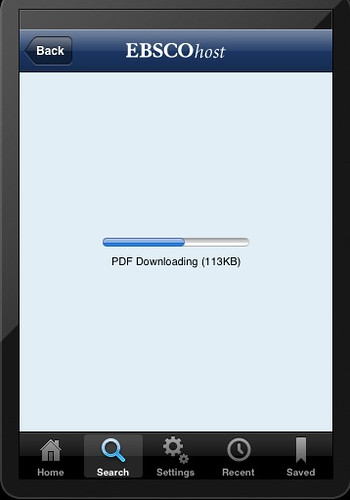
When I tapped on the PDF icon, the app starts to download the PDF document:
IMG_0238

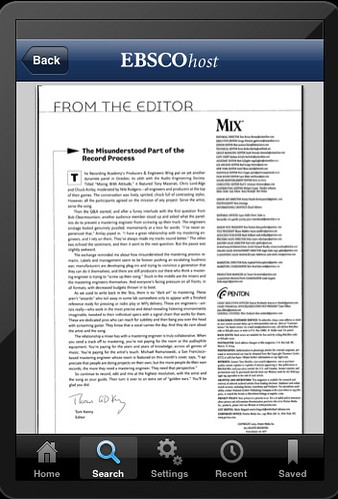
The PDF document shows the scanned article, with all other contextual information (e.g. sidebar, ads) preserved on the page.
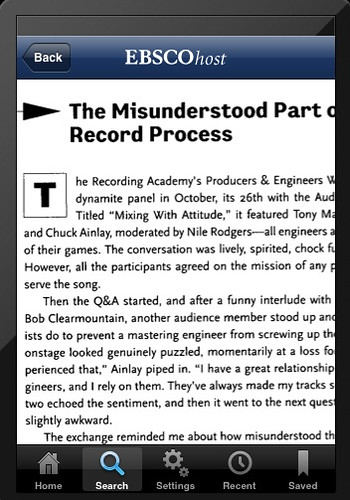
IMG_0239

The display can be expanded by dragging. But the display window is definitely not as large as the iPad, so reading the PDF was a bit tedious (the app works on an iPad but resolution tends to become grainy when enlarged).
IMG_0240

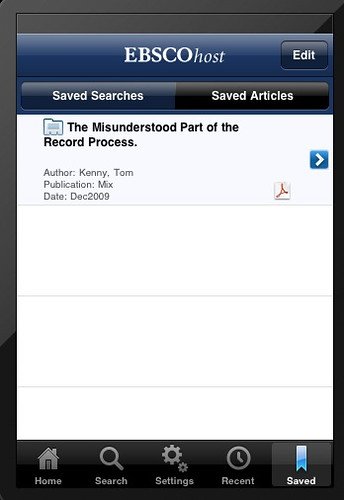
I was able to access my saved articles from the "Saved" tab.
IMG_0241

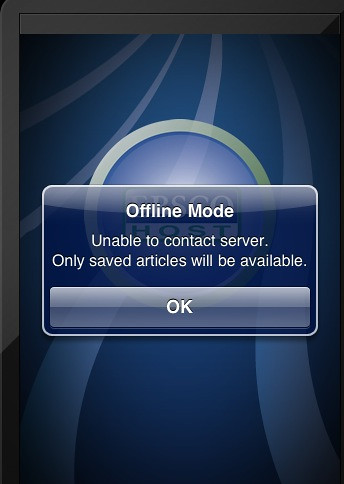
The saved articles can be read off-line, which was great. When I disconnected from my WIFI, the app says as much.
IMG_0242


The NLB libraries subscribes to the EBSCOhost databases, which you can access at eresources.nlb.gov.sg.

There are 14 EBSCOhost databases, out of which 11 are accessible from home (and hence via the app). The 11 are:
  1. EBSCOHost CINAHL
  2. EBSCOHost ERIC
  3. EBSCOHost Funk & Wagnall's new world encyclopedia
  4. EBSCOHost kids search
  5. EBSCOHost MAS ultra : public library edition
  6. EBSCOHost MasterFILE premier
  7. EBSCOHost military and government collection
  8. EBSCOHost novelist
  9. EBSCOHost primary search
  10. EBSCOHost regional business news
  11. EBSCOHost searchasaurus

Of the 11, the ones in bold are accessible via the EBSCOhost app (at least, it's listed in the app).

Sunday, June 05, 2011

What others shared: Their ideas on ideas on using social media as part of library services for Children or Teens

[From this earlier post]

Thanks for the responses, people!

"We are having our teen advisory groups make videos that we post on blogs, facebook and Twitter. I am sure thus isn't anything new though." ~ Jessica, who works for Seattle Public Library.

[I quickly commented that it wasn't necessary to be new or earth shaking. Being consistent and being genuine in engaging customers were more important]

"you can make them post impressions of what they read on facebook. It helps to introduce others to particular books and rate them. When I go to the library, I see shelves of books that might not be good to read rather than shelves of books that may be good to read. Maybe if there is a rating system using social media, it might help." ~ This was from my band-buddy, Adrian (a teacher and a biologist). I think his comment about "seeing shelves of books that I might not like to read" was something worth looking into.

"Maybe this is already done. Set up target group specific twitter alerts. For example for pre-school kids, encourage parents to follow "twitter tots" for updates on bks suitable for their kids" ~ From Mui Lin, an ex-colleague of mine and now a stay-at-home mommy. She also adds:

"I'm a SAHM, am planning to set up a book club in the online forum that I'm a member. What prompted me to do this is I'm stressed out looking after my 3 young kids and want to reach out to other parents who love to read. We do not need to meet and can share anytime of the day :). Not sure how it will work out or if anyone will join" [I think she should just give it a go! :)]

"Make catalogue.nlb.gov.sg facebook friendly. You have almost the entire population of kids on facebook (short of a couple of non-facebookers). Tag a discussion board to the end of the listing and allow posting by people. Policing the discussion boards would be a challenge but I don't see how technology can't overcome it." ~ from Say Hong. [Hmm... nice idea; the online catalogue is probably the most visited page/ site of the library so it makes a lot of sense to make it more social]

how would you use social media to service children and/ or teens, in the context of library services?

What's interesting for me was that in all their ideas, there's a strong social element and about people-to-people-to-content connections. There's also implied or explicit roles for the librarians.

It's also about simplicity.

It's definitely less about the tech.

Thanks again, people!

Saturday, June 04, 2011

Tools don't make change. People do.

I wouldn't be surprised if this was re-quoted some years down the line:
Social media is like a hammer is a tool...

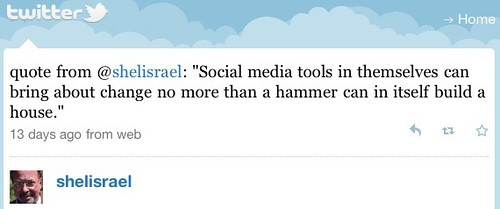
"Social media tools in themselves can bring about change no more than a hammer can in itself build a house." ~ @ShelIsrael

It was from Shel, as part of an email conversation we had some weeks back. Just briefly about social media and social/ political change.

I liked Shel's quote so much I just had to tweet it.

Wednesday, June 01, 2011

Your ideas on "Using social media as part of library services for Children or Teens"

Question to librarians (or people who use library services): how would you use social media to serve children and/ or teens?

I've been invited to speak at the 5th International Symposium on library services for children and young adults, in South Korea. Several weeks back, I was pleasantly surprised to hear from the organiser (the National Library For Children and Young Adults) that they wanted me to present a condensed version of the "Web 2.0 and Library Services for Young Adults: An Introduction for librarians".

I'll share more of what I intend to talk/ present, in subsequent posts.

For now, I thought I'd ask the above question. I'm interested in examples or just ideas (they don't have to be earthshaking ones), to be featured in my presentation.

Thanks!
P.s. Let me know how you would like to be quoted in my presentation (if I do cite your idea/ comment).

Saturday, May 28, 2011

Think aloud (research idea): Digital Media Literacy, information Consumption and Use by Singaporeans

I've not looked at this seriously. Just womdering if there's any research relating to the “Digital Media Literacy", "Information Consumption" and "Use" (meaning, more than just reading but application, repurposing or remixing) by Singaporeans.

The thought came about when, at work, a question was asked if there were any high-level strategic projects that could be initiatied. This was several months back (just finding time to blog the thoughts now).

I thought it would be interesting obtain a representative profile (ages, gender, occupations etc.) of the extent of Singaporeans' "digital media and know-how".

It is about the everyday use of information by Singaporeans (an example of "everyday use" could be weather or traffic information)How do Singaporeans make informed choices? Or perceptions on whether they think they are getting informed.

How do Singaporeans approach their information search? What digital information sources do they use, and do those sources differ by the information need? (for instance, might video-sharing sites be the preferred source for certain situations?)

Maybe part of the study could show how information -- or what types -- proliferates through Social Media (compared to traditional media?)

Who are their key influencers -- teachers, friends, colleagues, friends via social platforms, or strangers in familiar social networks?

How much of their information search involves different modes like informal grapevine (i.e. Unsubstantiated) and how much involves independent fact-checking? For instance, how much of the information -- by different ages, profiles -- are they able to differentiate as rumours, outright inaccuracies, or facts? e.g. Radiation threat, from the nuclear reactor incident, on food imports. Or health and legal matters.

Who are their key influencers (e.g. teachers, friends, colleagues, friends via social platforms, or strangers in familiar social networks?)

What is their level of awareness/ knowledge regarding existing online information sources? For instance, are they aware of online sources for local weather information? Government policies and procedures? Consumer rights and avenues for legal recourse?

The study may have implications on the roles of libraries and other potential "community information centres" like schools, community clubs, cultural organisations etc. May also give insights on the role such institutions have to play in shaping information and media consumption.

As I mentioned, I was just thinking aloud. The research idea is still rough on the edges.

Do you know of similar research that has been done? Thought, ideas, critiques and comments are welcome.

Monday, April 25, 2011

Clementi Public Library: Officially opens 23 April, 2011

Clementi residents have waited for about five-plus years for a public library near their homes.

With the official opening of Clementi Public Library (CMPL) on Saturday, 23 April 2011, it has brought the total number of public libraries in Singapore to 24.

The ChannelNewsAsia, 23 Apr 2011 quoted the Trade and Industry Minister, Mr. Lim Hng Kiang, who officiated the opening:
Speaking at the opening of the library, Mr Lim highlighted the importance of public libraries in Singapore's development.

"We must pay tribute to the library. It has been a very progressive organisation. Over the years, it has done so many brand new things and has been innovating in many ways to reach out to Singaporeans and improve their reading habits," he said.

Visitorship for Singapore's 24-strong network of public libraries is estimated at 13 million per year, while books loaned numbered 31 million, according to Mr Lim.

My colleagues should record his remarks as official compliments!

The NLB CE, Mrs Elaine Ng, adds:
"Libraries are social learning spaces that draw and unite people across all ages and cultures...the new services at the Clementi Public Library are part of our efforts to promote reading and make books and other information resources accessible to all our users."
LINK

I discovered this blogger, quite likely a Singaporean, who was even more succinct:
The library opens today. Very popular, quite crowded but well managed.

Brief comment, but no less important. Ultimately, it's the residents who will be using the public library. Or not.

Over at the HardwareZone forum, there are even more succinct comments (Singaporean trademark? heh).

Here are pictures I took on the opening day (some shots show the obvious Before/ After scenes, as you'll see):

8.30am: The public were already asking if they could go into the library.
Clementi Public Library

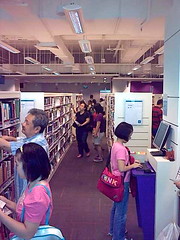
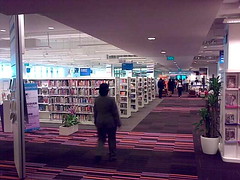
A view into the library, from the entrance:
Clementi Public Library

The self-check machines are to the right (off picture):
Clementi Public Library

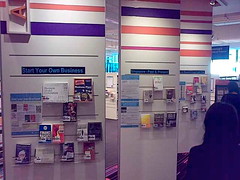
Very cool looking book/ item displays:
Clementi Public Library

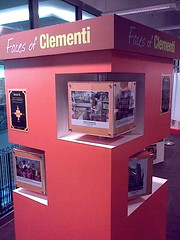
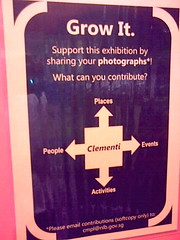
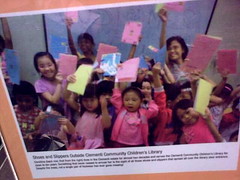
One of the highlights of CMPL -- the Faces of Clementi showcase:
Clementi Public Library

Clementi Public Library

Clementi Public Library

Clementi Public Library

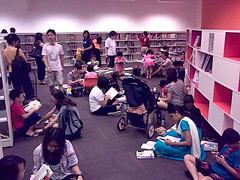
The Children's section:
Clementi Public Library

Clementi Public Library

Clementi Public Library

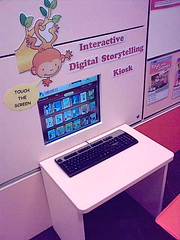
Another highlight of CMPL -- the Digital Storytelling Kiosk. Selected eBooks and games (from Tumblebooks) are featured on this console.
Clementi Public Library

All quiet on the library front... until the library-enthusiasts enter!
Clementi Public Library

Clementi Public Library

The Programme Zone (which is unusual for a mall library to have one; the space doubles up as a reading area when there are no programmes):
Clementi Public Library

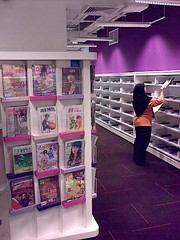
The magazine section:
Clementi Public Library

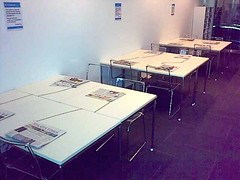
The newspapers reading area:
Clementi Public Library

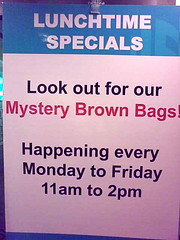
Another highlight of CMPL -- Mystery Brown Bags. You pick a bag (you're not supposed to peek in to the bag), check out the item, then discover what's the book in the bag. When done reading, return the item with the bag via the bookdrop.
Clementi Public Library
The picks are from library staff and volunteers. There are different themes each time. It's a way to target the lunch-time crowd who wish to read but can't stay in the library to browse and choose. Or those who wish to be surprised and expand their reading tastes.

Clementi Public Library
In my view, what's cool is that it's a social experiment of sorts. For instance, how would readers take to the service? Would people return the bag (or just the book?) Will this encourage the busy lunch-time crowd to pick a book? What sort of problems will materialise, if any? What opportunities would be created from this?

Here's a shot of Friends of the Library being briefed and assigned duties for the opening:
Clementi Public Library

And then, the Guest of Honour arrives...
Clementi Public Library

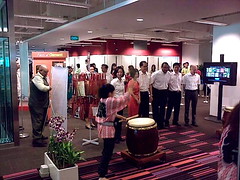
... greeted with a thunderous welcome by students from Singapore Polytechnic, Japanese Taiko Drums club:
Clementi Public Library

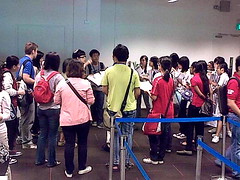
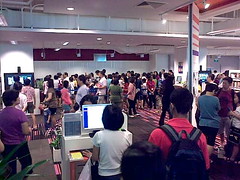
9.30am, thereabouts. The library opens to public. The place got busy and crowded in a matter of minutes.
Clementi Public Library

Orderly crowd, as far as I could tell. Btw, the "aunties" will always be there but they were better-behaved this time. I couldn't resist mentioning that episode because I wanted to put the entire matter in context: those ungracious few probably numbered 10 or so, compared to the 31 million of civic-minded users who pass by the public library gates in FY2010. From that perspective, I'd say the vast majority of library users in Singapore are gracious people. I'm sure I speak for my colleagues when I say we thank them for it.

Clementi Public Library

Clementi Public Library

Clementi Public Library

Clementi Public Library

Clementi Public Library

Not least, the Read and Reap initiative, offline (Web 2.0 in action, without the Tech!):
Clementi Public Library

Clementi Public Library