Monday, April 25, 2011

Clementi Public Library: Officially opens 23 April, 2011

Clementi residents have waited for about five-plus years for a public library near their homes.

With the official opening of Clementi Public Library (CMPL) on Saturday, 23 April 2011, it has brought the total number of public libraries in Singapore to 24.

The ChannelNewsAsia, 23 Apr 2011 quoted the Trade and Industry Minister, Mr. Lim Hng Kiang, who officiated the opening:
Speaking at the opening of the library, Mr Lim highlighted the importance of public libraries in Singapore's development.

"We must pay tribute to the library. It has been a very progressive organisation. Over the years, it has done so many brand new things and has been innovating in many ways to reach out to Singaporeans and improve their reading habits," he said.

Visitorship for Singapore's 24-strong network of public libraries is estimated at 13 million per year, while books loaned numbered 31 million, according to Mr Lim.

My colleagues should record his remarks as official compliments!

The NLB CE, Mrs Elaine Ng, adds:
"Libraries are social learning spaces that draw and unite people across all ages and cultures...the new services at the Clementi Public Library are part of our efforts to promote reading and make books and other information resources accessible to all our users."
LINK

I discovered this blogger, quite likely a Singaporean, who was even more succinct:
The library opens today. Very popular, quite crowded but well managed.

Brief comment, but no less important. Ultimately, it's the residents who will be using the public library. Or not.

Over at the HardwareZone forum, there are even more succinct comments (Singaporean trademark? heh).

Here are pictures I took on the opening day (some shots show the obvious Before/ After scenes, as you'll see):

8.30am: The public were already asking if they could go into the library.
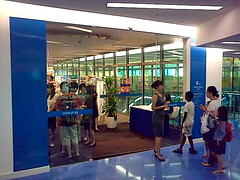
Clementi Public Library

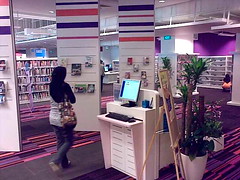
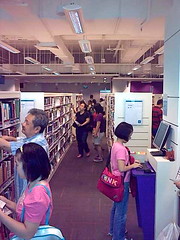
A view into the library, from the entrance:
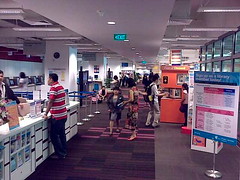
Clementi Public Library

The self-check machines are to the right (off picture):
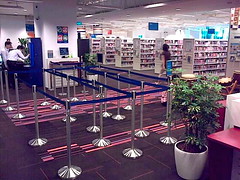
Clementi Public Library

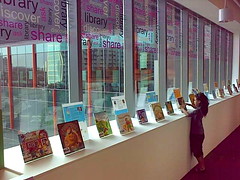
Very cool looking book/ item displays:
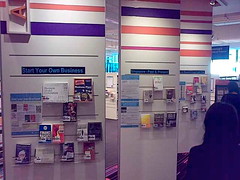
Clementi Public Library

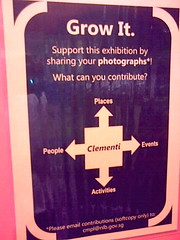
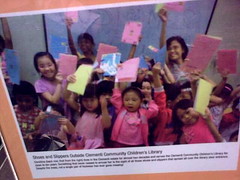
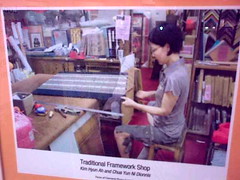
One of the highlights of CMPL -- the Faces of Clementi showcase:
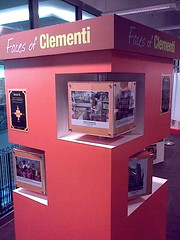
Clementi Public Library

Clementi Public Library

Clementi Public Library

Clementi Public Library

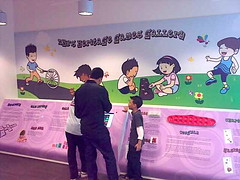
The Children's section:
Clementi Public Library

Clementi Public Library

Clementi Public Library

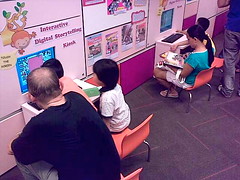
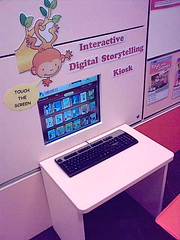
Another highlight of CMPL -- the Digital Storytelling Kiosk. Selected eBooks and games (from Tumblebooks) are featured on this console.
Clementi Public Library

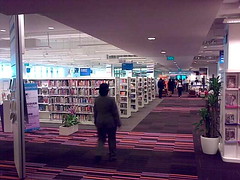
All quiet on the library front... until the library-enthusiasts enter!
Clementi Public Library

Clementi Public Library

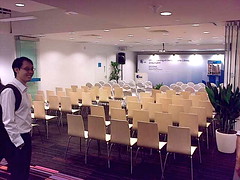
The Programme Zone (which is unusual for a mall library to have one; the space doubles up as a reading area when there are no programmes):
Clementi Public Library

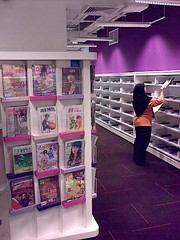
The magazine section:
Clementi Public Library

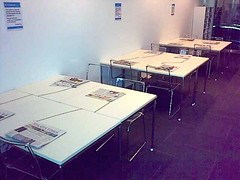
The newspapers reading area:
Clementi Public Library

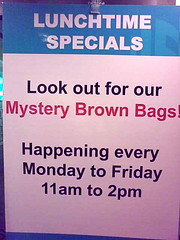
Another highlight of CMPL -- Mystery Brown Bags. You pick a bag (you're not supposed to peek in to the bag), check out the item, then discover what's the book in the bag. When done reading, return the item with the bag via the bookdrop.
Clementi Public Library
The picks are from library staff and volunteers. There are different themes each time. It's a way to target the lunch-time crowd who wish to read but can't stay in the library to browse and choose. Or those who wish to be surprised and expand their reading tastes.
Clementi Public Library
In my view, what's cool is that it's a social experiment of sorts. For instance, how would readers take to the service? Would people return the bag (or just the book?) Will this encourage the busy lunch-time crowd to pick a book? What sort of problems will materialise, if any? What opportunities would be created from this?

Here's a shot of Friends of the Library being briefed and assigned duties for the opening:
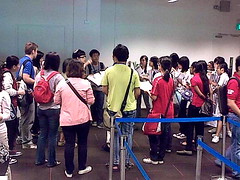
Clementi Public Library

And then, the Guest of Honour arrives...
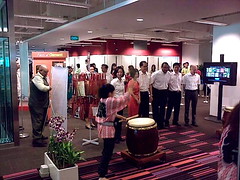
Clementi Public Library

... greeted with a thunderous welcome by students from Singapore Polytechnic, Japanese Taiko Drums club:
Clementi Public Library

9.30am, thereabouts. The library opens to public. The place got busy and crowded in a matter of minutes.
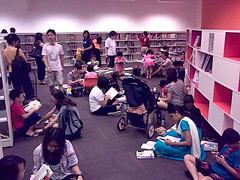
Clementi Public Library

Orderly crowd, as far as I could tell. Btw, the "aunties" will always be there but they were better-behaved this time. I couldn't resist mentioning that episode because I wanted to put the entire matter in context: those ungracious few probably numbered 10 or so, compared to the 31 million of civic-minded users who pass by the public library gates in FY2010. From that perspective, I'd say the vast majority of library users in Singapore are gracious people. I'm sure I speak for my colleagues when I say we thank them for it.
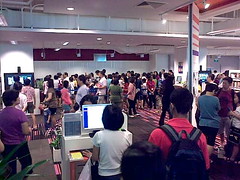
Clementi Public Library

Clementi Public Library

Clementi Public Library

Clementi Public Library

Clementi Public Library

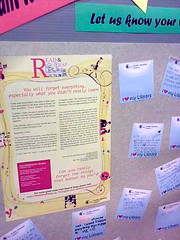
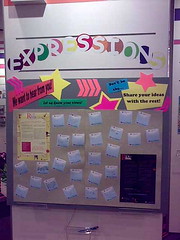
Not least, the Read and Reap initiative, offline (Web 2.0 in action, without the Tech!):
Clementi Public Library

Clementi Public Library

Monday, April 18, 2011

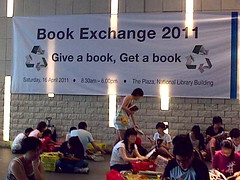
Book Exchange 2011

I was roped in to help at this year's event, which was on Saturday, 16 Apr.

Book Exchange 2011

ChannelNewsAsia reports: Over 77,000 books exchanged in a day
SINGAPORE: A project for book lovers to refresh their collection and help save the environment at the public libraries is drawing huge support.

The Book Exchange on Saturday attracted more than 7,000 people, with over 77,000 books exchanged.

Chief Executive of the National Library Board, Mrs Elaine Ng, said this shows that people still love books and reading.

To participate, members of the public had to drop their used books at any public library from April 2 to 15.

A coupon was given for every book accepted.

On April 16, the coupons were presented at the National Library Building for a one-for-one exchange of books collected from other participants.
LINK

They weren't kidding when they said "huge support". My colleagues said the morning queue, before the event started, snaked round the big National Library building twice.

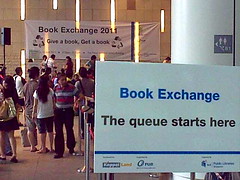
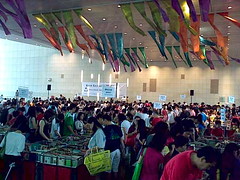
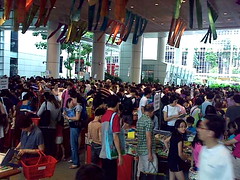
This was the scene when I arrived at 12.30pm.
Book Exchange 2011

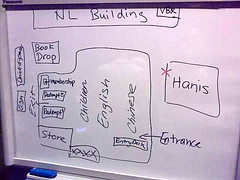
Volunteers, comprising of staff and Friends of the Library, were briefed on our respective duties. We were told of the layout and various logistics and measures put in place.
Book Exchange 2011

My duty area was "The Store":
Book Exchange 2011

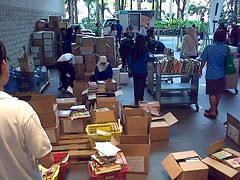
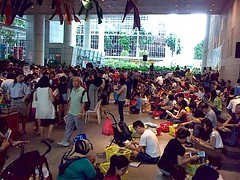
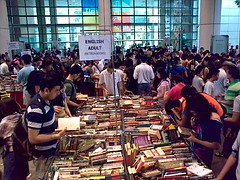
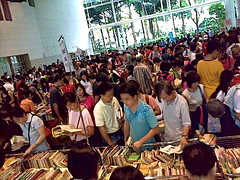
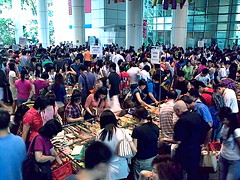
In between my duties, I went round to take some pictures. The place was utterly packed.
Book Exchange 2011

Book Exchange 2011

Sadly, there were some ungracious people who grabbed all they can -- but not what they needed. Then they sat down in their own space sorting out their "treasures". Which would still have been OK, except that they left their unwanted pile on the ground. Tsk.

Still, it was heartening to see the majority who were well-behaved and orderly.
Book Exchange 2011

Book Exchange 2011

Book Exchange 2011

At one point, one person came up to me. Asked what the event was about. He said he wasn't from Singapore. So I explained. He was impressed that the Public Libraries were doing this. During my rounds, I saw at least one other foreigner asking similar questions.
Book Exchange 2011

Book Exchange 2011

Book Exchange 2011

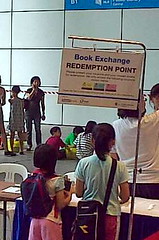
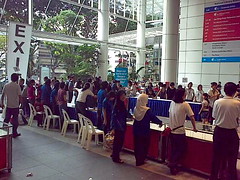
Library staff (from various other groups and divisions) were also helping out. Here's a shot of the exit point, where books and accompanying tickets were counted and exchanged.
Book Exchange 2011

At around 6pm, only these carts were left.
Book Exchange 2011

End of event. Staff all chipped in to pack up.
Book Exchange 2011

I think about an hour later, the Event Plaza was cleared.
Book Exchange 2011

Until next year!

Saturday, April 16, 2011

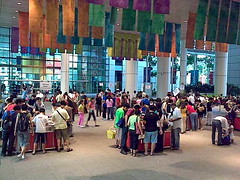
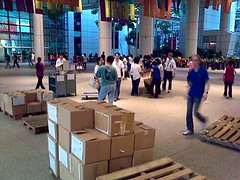
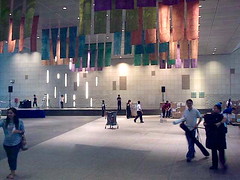
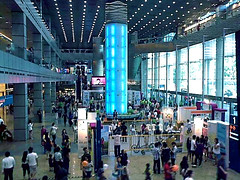
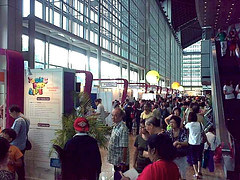
Two Public Libraries outreach events: MOE ExCEL Fest and Active Ageing Carnival

Should've posted this on 2 Apr...

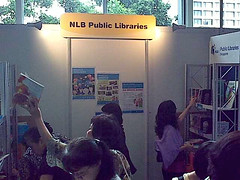
My colleagues from the Public Libraries were at the Suntec Convention Centre early this month, for two outreach events that happened in the same week. I went down on Sat, 2 Apr, to say Hi to my colleagues.

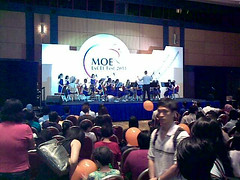
MOE ExCEL Fest 2011 (1-2 Apr)
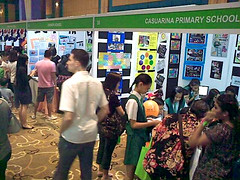
The MOE ExCEL Fest is organised yearly by the Ministry of Education (MOE). It's a showcase of innovative practices in schools. The event aims to let parents and the general public learn more about the latest developments in schools.
MOE ExCEL Fest 2011 MOE ExCEL Fest 2011

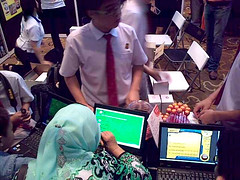
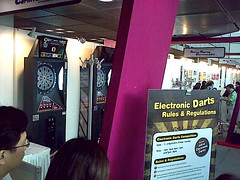
I saw Primary and Secondary schools, as well as Junior Colleges and Polytechnics at the event. Didn't hang around long enough to properly check out the booths. But I saw reading programmes, lesson plans, student projects etc.
MOE ExCEL Fest 2011 MOE ExCEL Fest 2011

The ExCEL Fest's first day was for teachers and MOE staff only. The second day, Saturday, was open to the public.

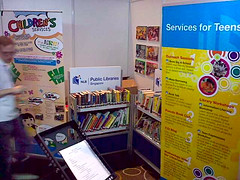
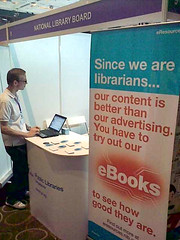
The library booth was there for both days.
MOE ExCEL Fest 2011

My colleague, Robin, observed that more teachers and parents were asking more indepth questions about the library digital resources (databases and eBooks). A year ago, they probably asked general questions (e.g. "How do I access?"). Now, the questions were more specific (e.g. "Why aren't certain titles available?") that suggested they had actively used the resources and had specific suggestions/ feedback.
MOE ExCEL Fest 2011

Two of my colleagues spoke, at different presentations, on the second day. Unfortunately their event were just over when I arrived. I was delighted to see one of the event ("Raise-A-Reader") fully subscribed.


Active Ageing Carnival (1-3 Apr)
This annual event was organised by the Council for Third Age.
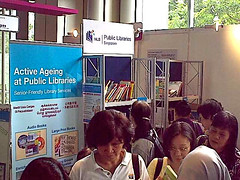
Active Ageing Carnival 2011

The event blurb says:
The Active Ageing Carnival 2011 will help seniors discover their inner Fun-atic! This annual event is back this April with three full days of fun and exciting programmes. There is clay craft, glass art, Kangoo Jumps—the world’s lowest impact exercise shoes— and an obstacle course designed to build confidence. There is always something for every active ager at the Carnival.

From what I saw, I thought they certainly achieved the "discover the inner fun" part.

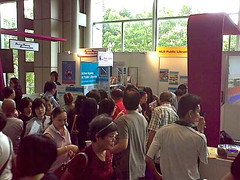
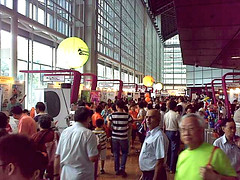
The place was packed.
Active Ageing Carnival 2011

The library booth was particularly so, which was an excellent sign. Books were being issued at such a brisk pace that I could only barely manage to exchange a few words with my colleagues on duty.
Active Ageing Carnival 2011 Active Ageing Carnival 2011 Active Ageing Carnival 2011

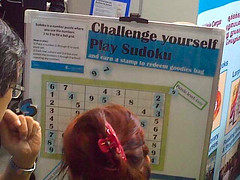
Senior citizens visiting the carnival were issued a little book. If they collected the required stamps (by visiting and "playing" at the various booths), they stood to win prizes. Or, I think they were instantly given some gifts.
Active Ageing Carnival 2011 Active Ageing Carnival 2011 Active Ageing Carnival 2011

I think this was the first time there were two major outreach events happening at the same venue.

From the public library's perspective, they were just two of the hundreds (in total) of outreach events conducted each year. Part of the job of public library staff and librarians.

Sunday, April 03, 2011

Think aloud: Japan quake, tusnami & nuclear reactor crisis (Part 2 - Friends and personal perspectives)

[From Part 1]

SOCIAL CRISIS PLATFORMS
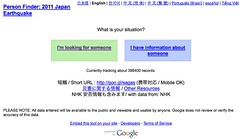
Whoever thought this up deserves a prize or something: Google Person Finder. This one is specific to the 2011 Japan Quake.
Google Person Finder: 2011 Japan Earthquake

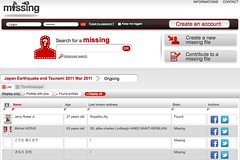
There's now sites like Missing.net, a" global missing persons search engine".
missing.net

More about Social Crisis Platforms at the readwriteweb.com.

[ASIDE: I wonder if some people will make use of those sites to deliberately make themselves "disappear"...]


LIBRARY CRISIS PLATFORMS?
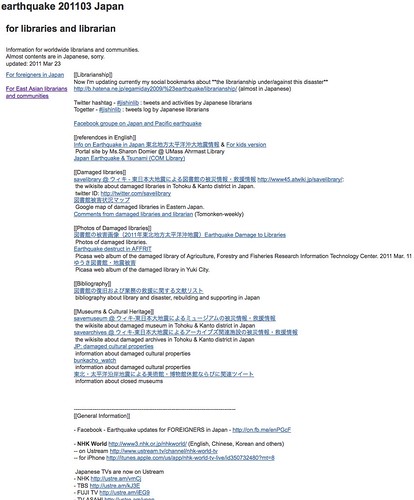
Over at the IFLA mailing list, I learned of this page for "Libraries and Librarians", and reports on "damaged libraries information, photos, and librarianship in Japan".
for libraries and librarian - earthquake 201103 Japan


Perhaps more typical was the dissemination of information via mailing lists. Like the previous Egypt and NZ crisis, library-specific was also being discussed at IFLA-L.

On 13 March, two days after the quake struck, Ryuichiro Takahash, Chief of Library-user Support Section, Tokyo Gakugei University Library, shared insights on the situation faced by Japanese libraries affected by the quake (edited for brevity):
  • Fallen and scattering of library material
  • Damage to library facilities (windows, walls...)
  • Lack of response of Internet servers; unable to access the World Wide Web and e-mail
  • Staff members could not return home because of traffic stoppages
  • Libraries forced to close, or cut-back of servics
  • Power outages (unforseen and scheduled ones as well, to conserve power)
Good news--no injured persons.


The effort of researching about present damaging situation and recovery operation will continue from this time.

The Japanese Library Association, individual library institutions and many voluntary library-related persons will have this role.
For example, Mr. Makoto Okamoto open following website, for researching and collecting present information about damage... "savelibrary @ wiki",
http://www45.atwiki.jp/savelibrary/ (written in Japanese)
[5 April, update: Ryuichiro shares with the IFLA-L list that members of the Japanese library community are still unable to communicate with many libraries in the Tohoku area, which was seriously damaged by earthquakes and tsunamis.]


REDUCING ANXIETIES
It's a very human need to want to know if our friends and family are OK. Some news is better than no news.

When disaster strikes, I think the very first thought for most people would be, "Are my friends and family safe?" Or if they were the ones involved in the crisis, they would want to let their family know they are alright.

I found myself searching my Japanese friends' Facebook pages. And was relieved when they posted that they were safe.

My Japanese friend's Facebook updates has provided some very interesting insights for me. Hours after the quake, one of my Japanese friend posted that she was safe but was initially stuck in her office and couldn't get home.

She even thought she was going to die when the quake struck while she was on the 11th office floor. I could only imagine the terror.

A week later, one of her subsequent updates said she finally had hot water (she lives in Tokyo).


CONVERSATIONS
On 22 Mar (about two weeks back), I chatted online with another Japanese friend, Kanako. She was in Singapore when the quake struck. I was interested in her viewpoint. She gave me permission to share the following:
Kanako: Now, the biggest problem in Tokyo is lack of electricity rather than aftershocks. Some of my friends are a kind of aftershocks-phobia though. Imagine your ground shakes once a day... But they are not so terrible, my fine friends and news says

Kanako: ... we can't get any energy from the nuclear plants, electricity lacking is happening in Tokyo area... some thermal power station are also broken, so blackouts are unavoidable.

Me: How do you feel when people are praising Japanese society's civility in handling the crisis, e.g. no riots or looting.

Kanako: I agree with some parts of praising, but not all... ... I saw some bad fake info online. like attempt to trick people who wish to donate money

Me: but it's also true that vast majority of japanese people are not looting and damaging property.

Kanako: One thing I'm sure is Japanese are trained for earthquake better than other nation citizens. Turn off fire, Keep the exit open, Hide under the desk, Don't push people around you, don't run, and don't chat when you evacuate. We do many earthquake drills when we are in elementary school. And we know there is no 'safe place' when it's happened.

Kanako: We need to cooperate with others.

Good advice.

And I couldn't help but ask whether Singaporeans would display the sort of discipline and tenacity, if disaster does strike here.


EMPATHY & REMEMBERANCE
My friend Kanako has also published this translation of someone else's blog post, originally written in Japanese. The author experienced the 1995 major quake that struck Kobe and the tedious road to rebuilding.

The author makes an interesting point of "sustaining our emotions". Which I understand to mean "sustained empathy".

Lest we forget.

The pertinent point was that it takes only an instance for a disaster to strike, but a much longer time for the recovery process. And that the aftermath of the disaster doesn't end just because the mainstream media has stopped reporting it.

As of this post, the world's media has largely shifted its attention elsewhere. My impression is that most reports are of the ongoing nuclear reactor crisis. And mostly articulated as statistics and monetary terms.

Still, there are individuals -- regardless of nationalities -- who are helping with fundraisers. My Singaporean friend, O., emailed:
As you know there was an earthquake on 11 March that led to tsunami and a nuclear plant leakage in Japan. Life has been very unsettling and tough for many Japanese, especially those in the affected areas in this cold season. There is a shortage of basic essentials such as drinkable water, blankets, gasoline and medication.

I hope you'll consider donating to the Japan Disaster 2011 efforts.

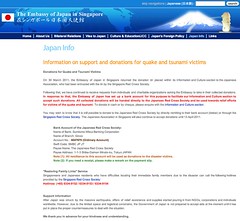
You may refer to the Embassy of Japan's website for ways of donating:
http://www.sg.emb-japan.go.jp/ryoji_THEQ_redcross.htm

... Every bit counts.

Thank you.

http://www.sg.emb-japan.go.jp/ryoji_THEQ_redcross.htm

Facts and statistics are just information. It's the personal appeals and insights that will bring the world closer.