Monday, June 21, 2010

On cities and urban living

Came across this interview of Bruce Sterling, "science fiction author, cultural observer, and futures provocateur", where he shared his thoughts about cities.

When asked about what thought were the dangerous aspects of urbanisation, he had this to say:
But I'd also like to point out that large financial centers in certain cities around the planet are certainly going to kill millions of us by destroying our social safety networks in the name of their imaginary financial efficiency. You're a thousand times more likely to die because of what some urban banker did in 2008 than from what some Afghan-based terrorist did in 2001.

Do read his interview in full, at boingboing.net.

Incidentally, I came across a 2007 work, by Zygmunt Bauman (Emeritus Professor of Sociology, University of Leeds and the University of Warsaw), titled "Liquid times: Living in an age of uncertainty":
Liquid Times: Living in an Age of Uncertainty
RoughNotes | NLBsearchplus
ISBN: 0745639879

It's a relatively short book (115 pages, including references). For a work by an academic, it's quite readable (yes, I realise there are several biased views in the remark I just made... heh).

The book is a collection of five essays, containing intellectual views and ideas about society and modern living.

I can't say this book compelled me to read it cover to cover (I lack that sort of academic inclination). But it contains several intellectually provocative statements, perspectives and interesting framing of issues.

Like page 71 to 72, that "Cities have become places with more danger than safety".

The original intent of cities (walled towns and the like) was for people to band together for safety. But now, individual homes have become places to protect and hide inhabitants away from the community, rather than integration. Or so that particular essay suggests.

And on page 92: "Cities as dumping grounds for globally produced troubles, but can also be seen as laboratories to invent ways and means to live on an overcrowded planet."

There's no question that urbanisation will continue.

But what isn't inevitable is that urbanisation will be at the expense of community integration, as well as co-existance with nature.

At least I hope it isn't inevitable.

Sunday, June 06, 2010

Highest Number Of Singapore Literary Works Selected For READ! Singapore 2010

Still going strong since 2005.

The 2010 theme is "Roads Less Travelled". Selected titles are posted at readsingapore.nlb.gov.sg.

Release Date : 26 May 2010

Poetry is included for the first time in this nation-wide reading initiative

SINGAPORE, 26 May 2010 – The National Library Board (NLB) officially launched READ! Singapore 2010 today. Into its sixth year, the nation-wide reading initiative promotes a culture of reading fiction among Singaporeans. The theme of this year's campaign is “Roads Less Travelled” which aims to encourage Singaporeans from different walks of life to share their perspectives in making unconventional life choices.


Selected works feature Singapore literary talents
In line with the theme, eight novels, eight short stories and five poems in the four official languages, written by well-known local and international authors, were selected by the READ! Singapore Steering Committee, with one title voted by the public. This is the first time that poetry is included to provide a greater variety of literary works. The selected works explore the different scenarios in which the characters took the roads less travelled in their lives. Each of the short stories is translated into the other three official languages and compiled into four anthologies, together with the poems, to encourage Singaporeans to read across cultures and communities. This year's selection also features the most number of literary works written by Singaporean and Singapore-based authors.


New initiatives to engage youths and the community-at-large
Apart from meet-the-author sessions, book discussions and reading carnivals, READ! Singapore 2010 will feature the first-ever infocomm-enabled nation-wide reading event, Read! IT.

Organised by NLB and the Infocomm Development Authority of Singapore, Read! IT will feature teams of readers simultaneously reading over a two-hour period at six different venues on 18 July 2010. They will be streamed online via a collaborative platform, www.readit.sg (operational from 1 July 2010 onwards). The public can view the six reading groups creatively read or present their selected books in the form of a live dance, mime performance or skit. They can also tweet about Read! IT, vote for their favourite team and participate in online teasers to win attractive prizes.

Another highlight of this year's campaign is Game2Read, a joint initiative with the Singapore Cybersports and Online Gaming Association to encourage the gaming community and youths to re-discover the joy of reading. This will be done through book discussions on gaming-related titles, gaming competitions, a cyber-wellness exhibition and other activities related to gaming and reading. These activities will be held over a two-day period from 26 to 27 June at The Plaza, National Library Building.

“In this digital age, it is common for youths to spend many hours online on social networks and playing their favourite computer games. Through Read! IT, Game2Read, and various other exciting programmes organised as part of READ! Singapore 2010, we want to engage more youths and the wider community to pick up the selected literary works, read and discuss with one another, and in the process, cultivate a passion for reading and lifelong learning. We hope that the programmes would spark their imagination and encourage them to discover new possibilities in their lives,” said Dr N Varaprasad, Chief Executive, NLB.

READ! Singapore 2010 will run from 26 May to 30 August. During this 14-week period, Singaporeans can look forward to a wide range of reading-related events happening at various locations around Singapore.
LINK

Wednesday, May 26, 2010

The late Dr. Goh Keng Swee and I (part 2) - National Service

This post, as with the previous one, may seem unabashedly about me and not the late Dr. Goh Keng Swee. Quite unintended, really.

I don't know Dr. Goh Keng Swee personally. Yet much of what he was directly involved had a direct influence in my development as a Singaporean.

This post is about one other great foundation that Dr. Goh laid down for generations of Singaporeans -- National Service (NS).


A GREAT SACRIFICE
I do not entertain any romantic notions about military service.

No way would I want to repeat my two-and-a-half years full-time stint and the subsequent 13-year 'reservist' cycle of NS, in the Army.

And yet I truly and deeply believe I would be a lesser person if not for NS.

"National service imposes not only a great sacrifice of time and money on the young men called up. It is also unpleasant as military training aims to push the soldier to the limits of human endurance. Yet in every election since national service was introduced, its abolition has never been an election issue.

...The average Singapore citizen knows the dangers that he faces are real and not hypothetical. A kind of folk wisdom has grown on the need to defend ourselves.

... Having said this, while we must prepare for war to keep the peace, we must not get paranoid about this. The worst policy is to arm ourselves to the point where our neighbours misread our intentions. We are not Israel and South-east Asia is not the Middle East."
- Dr. Goh Keng Swee. Sept 25, 1984 (as cited in The Straits Times, May 18, 2010).

I feel war is a great economic and social waste. But I also accept that defence spending, for deterrence, is a human necessity.

At a personal level, there's a confidence that comes from knowing how to handle a basic infantry assault rifle. At the societal level, NS is a modern-day rite of passage.

But what NS really gave me was an education that formal schooling could never impart.


A DIFFERENT SORT OF EDUCATION
In the army, I experienced first hand that street savvy-ness, human decency and intellect has no direct correlation to education and economic backgrounds.

In the confines of army rules and regulations, between the whims of sargents and officers, I got to know -- and learned how to live with -- people whom I would never have been exposed to in my civilian life.


FROM ALL WALKS OF LIFE
In civilian life, you can choose your friends or acquaintances. Or, you could avoid them. In the army, you have a lot less say in who you're assigned to work with.

Some of the people I met were real rough in language and behaviour. Now, I'm no prude and I've heard swearing and have been known to swear as well. The difference was that when those other people swore and cursed, they sounded like they meant it. Very intimidating for a person like me, who grew up relatively sheltered from these rough and tumble manners.

And yet once I got to know them, I enjoyed their company. There isn't any secret to it. Treat other people decently, they are likely to show the same to you.

Of course, the rule that "anyone can be an a**" holds true. I don't have misplaced notions that all 'rough and tumble folks' are nice people. Some are just plain mean on their inside as well as outside. As I said, there's no correlation between education and economic background and whether one acts decently or not.


UPGRADING MYSELF
Beyond the basic necessities the army provided, anything else was what I made do with it. The lesson was that I should not leave my own future to "other people".

Before I went into NS, I naively thought that obtaining a diploma was good enough. I didn't think taking up a degree course was necessary.

It was NS that made me realise I had to better myself.

Nearer the end of my full-time stint, I heard some of my peers boast of how they were going overseas to study. They spoke of grand career plans after getting a job with their degree.

I didn't think I was any less capable than them. Yet the stark reality was without equal qualifications, they would likely to be my bosses (also, I'd like to restate that some people would just be a**holes no matter what, heh).

That realisation strengthened my resolve to upgrade myself. I found my way to a degree programme. That degree eventually landed me in librarianship. Would never have become a librarian if I had not started down that path, I guess.


A CORPORAL WHO LED SINGAPORE'S ARMED FORCES
From The Straits Times, Saturday Special Report, May 15, 2010. "Corporal who built an army" by Goh Chin Lian:
What he knew of military affairs then was learnt only as a corporal in the British-led Singapore Volunteer Corps, but he rose to the challenge of building up Singapore's defence, one which people at that time did not think was possible.

He took a decade to accomplish his mission. From August 1965 to August 1967, he headed the Ministry of Interior and Defence which also handled Home Affairs.

His initial plan was to build up a regular army of 12 battalions between 1966 and 1969. Minister Mentor Lee Kuan Yew said in his memoirs that as the Prime Minister, he disagreed and proposed a small, standing army with the capacity to mobilise the whole civilian population, who should be trained and put in the reserves.

The revised plan gave the blueprint for today's national service and SAF - mobilising a large part of the population, while keeping regular forces at 12 battalions.


UNDERSTANDING LOSS, CHERISHING FREEDOM
During my Basic Military Training, one of my platoon mate remarked that the army stint was no different from his jail time. He should know what he's talking about. He had been in and out of Juvenile reformatory several times.

What he said was true in many ways, when I think about it. As a conscripted soldier, you could not quit from the Army. Your personal freedoms wasn't exactly curtailed, but there were restrictions whenever you put on that uniform.

Here's where I'll allow a romantic indulgence about NS: one does not really know what is freedom, until one experiences its absence.

It may not have been the primary intent, of the late Dr. Goh, for NS to be a social leveler or to serve as a "school beyond school".

But the way I experienced it, NS was more about defence. It was an education in itself.

Thank you, Sir.


More references:

Sunday, May 23, 2010

Weapon of Mass Instruction

Brilliant.

"Literature gets a ride in the streets of Buenos Aires"

LINK

The AFP YouTube channel says:
"In Argentina, a local artist has transformed an old ford Falcon into a roving library. He weaves through the streets of Buenos Aires and the rest of the country, offering books to passers-by in the hopes of sparking the country's appetite for literature."
American Libraries tweeted it as a "Weapon of Mass Instruction", which is an apt description since the artist made the car look like a tank.

Monday, May 17, 2010

The late Dr. Goh Keng Swee and I (part 1)

No, I do not know the late Dr. Goh Keng Swee personally.

But after the past few day's stories and commentaries in the The Straits Times, I now have a deeper appreciation of just how much his vision and work has influence my life. Dare I say, a stronger connection to him than before.

Goh Keng Swee
NLB Call No. 959.5704092 TAN (SINGAPORE Collection)
LINK

NO PERSONAL CONNECTION, UNTIL NOW
Initially, what I did know of Dr. Goh was from The Singapore Story: Memoirs of Lee Kuan Yew. From the book, it was clear that Dr. Goh was one of the Old Guards, who were the architects of post-Independence Singapore.

The connection went as far as that, however. He was of an earlier generation of leaders, from a time before I was born. And when I was mature enough to know who he was, he was someone far beyond my ken. I could not really relate to Dr. Goh, the man, and did not think I ever will.

But maybe time, and biological age, has a way of making one see links that were previously beneath one's consciousness.

Of the many ministerial portfolios undertaken by the late Dr. Goh, two things stood out for me now: Education and Defence.

Here's part 1, about Education. Specifically, I'll talk about the now defunct Religious Knowledge curriculum that Dr. Goh introduced in the early '80s.

RELIGIOUS STUDIES IN SECONDARY SCHOOLS
From The Straits Times, Saturday Special Report, May 15, 2010. "Shaking up the Education Ministry" by Susan Long & Ho Ai Li:
(Dr. Goh Keng Swee) long believed that religion was a systematic way to inculcate values, temper Singaporeans' individualism and build social cohesion. In 1982, he introduced religious knowledge to the secondary school curriculum, in spite of widespread reservations that this would lead to overzealous proselytising.

But barely seven years after Christianity, Buddhism, Hinduism, Islam and Confucian ethics classes were offered, they were phased out because of a 'heightened consciousness of religious differences and a new fervour in the propagation of religious beliefs'.

...'The rationale to develop the student's character was good, but implementation was difficult. Since then, the MOE has never brought up religious education again.'

They still had Religious Studies when I was in Secondary school, which was about two decades ago. It was only now that I'm making the connection that what I went through in school arose from the late Dr. Goh's policy.

I remembered having to choose a 'religion', so to speak. I did not have a religion then (I still don't have one now).

Students could opt for "Buddhist Studies", "Bible Studies", "Confucian Ethics", "Islamic Religious Knowledge", and "Sikh Studies". I chose Buddhist Studies because it was the closest religion I had been exposed to as a child (my grandmother was Buddhist).

BUDDHIST STUDIES
From my classes, I learned of the origins of Buddhism. I remember being struck by the very profound and simple observation that "Life is Suffering", meaning: life and suffering is very much intertwined.

My young and impressionable mind was also introduced to concepts like "cause and effect", "mindfulness", "compassion" and how desire was often the root cause of greed, anger, and suffering.

When I learned of something called the Five Precepts, I remember thinking they sounded rather similar to what I vaguely knew of Christianity's Ten Commandments (e.g. "thou shall not kill", "thou shall not commit adultery").

FAILURE?
MOE decided to terminate the Religious Knowledge curriculum. The failure was in the implementation, as reported.
The programme proved divisive because students studied only one of the religions. Some quarters felt the teachers were not adequately trained, while others used the classes to promote their faiths.
Source: Fri, Sep 18, 2009. "Best not to bring back religious classes in schools" by Tan Hui Yee". The Straits Times.

There were problems, for sure. Even back then, when I wasn't too aware of what was happening or the intent of the classes, it was clear to me that religious lines became more apparent.

My peers who were Christian/ Muslims/ Taoists/ Hindus took up classes that were closest to their religion of their upbringing. Come Religious Studies period, the 40 plus students in each class would break out to different classes, to attend their respective religious studies class.

Now that I have two decades of hindsight, what do I think of this the late Dr. Goh's "Religious Knowledge in Secondary Schools" policy?

I think he was right.

Let me put in more specific terms: Dr. Goh's vision IS still a right one. Its implementation might not have been perfect, but I can attest to positive outcomes for myself.


TIME TO RE-VISIT?
Till today, I remain a Free-thinker. Admittedly, I'm partial to some Buddhist philosophies. But that does not make me a Buddhist any more than believing in the "Thou shall not kill" commandment would make me a Christian.

My Religious Studies class teacher wasn't a Buddhist either, as I remembered. It might seem that the non-partisan educator is the key to making Religious Studies work.

I did not have less friends or make enemies because they were of different religions and chose different Religious Studies classes. We accepted that we had different paths to take -- and come to think of it, all positive religions preached the same positive values anyway.

While I hated the need to regurgitate and exhorts by my teacher to memorise the Five Precepts, thanks to my Buddhist Studies classes I dare say I am who I am because of those foundation years. I was made more aware of positive values of being a good person.

Perhaps MOE should re-consider and revisit the late Dr. Goh's vision of religious knowledge in schools. I'm not the first to make a similar call either (see section on "Religious Knowledge"; MOE's parliamentary replies, 9 Mar 2005).

Mind you, it's "knowledge" and not "indoctrination".

Rather than let students choose their particular religious topic, there should only be one common curriculum, comprising of the major religions in Singapore. An "Inter-Religious Knowledge Studies" curriculum. Again, emphasis on "knowledge" and not "indoctrination".

We already have the Inter-Religious Organisation, Singapore (IRO). A "Inter-Religious Knowledge Studies" curriculum would aim to promote mutual respect, understanding and exposure of ideas to the different faiths. All students would learn of what the major religions in Singapore represent, perhaps clarifying certain misconceptions in the process.

Yes, it will be a ultra-sensitive topic to introduce in schools. Carry it out badly and we will scar entire generations. Still, the same could be said about education as a whole, right?

Now if done well (and we Singaporeans have a track record for doing things well too), it will mean a generation who goes beyond "religious tolerance" to "religious understanding and acceptance.


THANK YOU, DR. GOH
To the late Dr. Goh, I thank you.

Particularly for introducing Religious Knowledge when I was in Secondary School.

I may not be the best person that I can be now (it's my excuse for being human). But I am certainly mindful about a lot of things -- particularly about being human.


[Next: Part 2 - Dr. Goh and National Service]

Sunday, May 09, 2010

Creative Sushi: Fresh & "Live" remixing of Creative Commons content

These past months, I've been working closely with the good folks at Creative Crew Singapore (namely Linus, Stefano and Carlsson). Not only are they a talented and passionate bunch, they are also open and enthusiastic about trying new creative ways of doing things.

Like incorporating a "CREATIVE SUSHI SESSION" for the 11th May meeting, at Bedok Public Library (starts 6.45pm). See the Facebook events page or the Creative Crew SG website.


We're not preparing real sushi, of course.

It's all about creating, remixing or mashing up creative works -- "live" and "fresh", like how real sushi should be :)

CREATIVE SUSHI - "LIVE" & "FRESH"
  1. The creative work could be anything, from retouching a photo, composing a music track, editing a video, or coding an application -- even written works or performances.
  2. Each work is created within the allotted time and then passed on for remixing or mash-up.
  3. Creative Commons is the obvious enabler (copyright permission already given, so creators can focus on the creative process).
  4. The final outcome is an on-the-spot original creation, built upon earlier ones. And that itself would be released under the appropriate Creative Commons license.

For this session, Stefano and I will be the "sushi chefs". I'll take 30mins to create an audio track on GarageBand (similar to this attempt). Then, I'll pass the track to Stefano (he's a Photoshop expert with a capital 'E'). He'll take 30mins to demonstrate "live" on incorporating the track into a video. The final result, we hope, is a music video.

We will not be rehearsing or discussing prior to the meeting. The only thing we've agreed is to use this  set of audio stems: "Man in love stems". Credits: ManoloCamp. 2010 - Licensed under Creative Commons Attribution Noncommercial (3.0)

Audience participation is certainly welcome. We hope people will bring their Macs, laptops, video editors of their choice. To attempt their own "sushi remix".


The famous dragon roll
Originally uploaded by Lorenia

Just in case you're not aware, the Creative Crew Singapore and the Public Libraries has been collaborating for the past year. The library sponsors the venue for the Creative Crew meetings. The Creative Crew team would organise their meetings, which are essentially mini-learning seminars on using creative apps and stuff.

My librarian colleague would prepare the appropriate book displays, after checking with the Creative Crew team on the topics for the month. At the meeting, at least one of the demonstrators would also recommend a relevant library item, usually related to the demo.

Supporting communities like Creative Crew is one way for the public library to fulfill our stated mission and vision (specifically in this case, it's about creating and enabling social learning spaces).

Sunday, May 02, 2010

"I've Got Google, Why Do I Need You?" (or, "Thoughts about the Future of Public Libraries" Part 2)

[From Part 1]

A manage-your-expectation Disclaimer: These posts are just my way of articulating thoughts and refining ideas. Definitely work-in-progress. And if you're expecting earth-shattering ground-shaking life-changing concepts and revelations, you can stop reading now :)

I've been told that the first step towards effective treatment is to acknowledge and accept that there is a problem (be it drug addiction, learning disabilities etc.).

So I suggest we librarians have to accept that the old "rules of the game" have changed. There's no turning back (except maybe if the Internet goes kaput and it's back to printed references).

WHAT IS THE PROBLEM?
To put it simply, I see the problem boils down to one issue: disintermediation.

This issue isn't unique to librarians. The banking industry have faced it in the '90s. So have brokerage and fund houses. We see that happening with 'traditional' music publishers and distributors.

It's a problem faced by organisations and institutions whose main business is/ was being the middle-man. Technology and market maturity (among other factors) will reach a stage where suppliers and customers can, and prefer to deal with, each other direct. The middle-man gets cut out.

Public libraries are middle-men.

We source for information materials and make them available to our members/ customers. Our members indirectly pay us through taxation. The gnawing issue is that in the future, more customers may prefer to get their materials direct from suppliers (especially digital content).

The writing on the wall may be just a scribble right now. But it's there.


INVENTORY VULNERABILITY
Public libraries, to me, are also particularly vulnerable. Because our business is largely invested in print-based information inventory.

We may say we're in the business of promoting learning and reading but in essence, what public libraries are really doing is to promote the use of print books. Printed materials are still the mainstay of the public library's inventory. This affects how our stakeholders measure our performance.

What about eBooks? I've explained why the current eBook business model for libraries may not be sustainable.

What about public library services that are independent of printed materials? Like our advisory/ reference services?


GETTING OUR HEADS OUT OF THE SAND
I'm uncomfortable when I read/ hear proclamations that librarians are still the best source of information. Or that only libraries offer credible and authoritative information (implying that anything else is junk).

Statements of that sort only serve to push our proverbial heads deeper into the sand.

Take for instance, back in 2008 this Google employee blogged that Google results are often good enough.

Self-serving Google propaganda? I don't think so. If what he blogged didn't have elements of the truth, would the liblogsphere would let him get away with it? He would have been blasted off the face of the Internet. Right? :)

The reality is that library customers value convenience over anything else. The debate of Satisficing (in the context of information search) is over, in my opinion.

If anyone -- librarian or otherwise -- takes issue with the above position (and some of my colleagues frequently do), just answer this: What's the first thing you refer to/ use when searching for information (whether for your individual need or to help others with their information need)?
  1. Google/ Yahoo!/ Wikipedia/ Bing [name your preferred internet search engine]
  2. Ask a friend/ colleague
  3. Search the library's online catalogue
  4. Search the library's databases online
  5. Email a librarian

Come on, be honest.

It's Google/ Yahoo! etc., isn't it?

Hey, I am NOT suggesting it's about professional laziness or incompetence.

The truth is that few public library customers need to embark on anything that requires the level of academic rigour, that requires them to refer to in depth information from electronic databases.


CHANGES
I entered the public library world at about the same time the Internet was introduced in public libraries (i.e. mid '90s). My early impression of the general library-world mood was one of 'seige-mentality' and possibly denial -- one that centred on the threat of widespread proliferation and adoption of the Internet. The reaction was usually "Librarians know better" or "Libraries have credible information compared to the junk out there".

Today, that sort of thinking still lingers.

But for the most part, I sense the mood has shifted from away from a 'them-Vs-us' to a more proactive 'let's try/ do this'.

For instance, changing the way libraries are valued and measured (British Library's Contingent Valuation is one often cited approach). Some are experimenting and reconceptualising library spaces, for specific audiences (e.g. Mindspot www.mindspot.dk)

In Singapore, the changes introduced include the provision of eBooks/ electronic databases, an improved Search feature, SMS services, a social experiment in allowing unmoderated publishing and community monitoring of images, bringing the library to social spaces...

I believe the solution isn't necessarily about competing with Google (nay, Google is my friend). It's also not about making library customers need us in the way they need Google.

It's about creating value, in the context of public service. And making attempts to change the rules of the game.

It's also about learning from how other non-library industry players have changed, or are attempting to implement change.


LOOKING OUTWARDS: IDEAS TO EXPLORE
I'll explore a few ideas and thoughts in the next few posts. Recently I came across some interesting sources that may give insights and ideas:


NLB Call No. 338.762138456094897 LAT -[BIZ]


NLB Call No. 658.4012 GRA -[BIZ] | EBook version.


NLB Call No. 658.4012 RAS -[BIZ]


IT'S ALSO IN THE MIND
Above all, I believe it's for librarians to adopt a positive mindset. Acknowledging that we have a problem is the first step. Keeping an open, realistic and positive mindset is also part of the recovery.

Success, even.


[Next: Exploring ideas].

Thursday, April 29, 2010

"I've Got Google, Why Do I Need You?" (or, "Thoughts about the Future of Public Libraries" Part 1)

A provocative, well-argued and self-explantory presentation. By Ida Aalens (who's the student in question, I believe).

The provocation, to me, was akin to the little boy telling the crowd that the emperor isn't wearing any clothes (some of us librarians anyway).

This is the current reality for libraries and librarians:
LINK

HOW DOES THIS RELATE TO PUBLIC LIBRARIES?
The presentation is from the perspective of a mature student, enrolled in a higher-education course, in an academic library setting. But it's something that's equally applicable to the situation faced by public libraries.

Public libraries have a growing tech-savvy customer base. And every year more students, like the one in the presentation, graduate and join the workforce and become the public library customers (or choose not to).

The idea behind Ida's presentation isn't new. It's the way she presented her arguments that I found refreshing.

Viewing her slides was also timely for me. I've been meaning to post some thoughts about how public libraries should react to such a current reality.

Might as well start with the next few posts.


[Next: Part 2].

Sunday, April 25, 2010

Public Libraries: "Spot A Reader" for World Book Day 2010

Friend of the Library (FOL), Mr James Seah, blogged about his experience helping out at the first-ever "Spot A Reader for World Book Day 2010", held last Friday on World Book Day and Copyright Day 2010 (23 Apr).

He and his fellow FOLs were at the Circle Line, Bishan MRT Interchange Station, to "spot the readers" in the trains.


[Image linked from source: Blog To Express]

The library obtained permission from the train operator, and had to adhere to the 11am and 1pm time slots within specific train routes.

As James wrote in his post:
"The SMRT Guides chaperoned the participants and to comply with instructions. The MRT train is a security and safety public areas not allowed for loitering or hawking business purposes...

We were ensured not to speak too loudly to the commuters, seek their permission and with courtesy, considerate and public decorum. We were required not to disturb the commuters on their train ride, while commuters taking a nap on long journey (as seen some babies in arms). Not to cause unnecessary annoyance when commuters are left alone."

Thanks for the post, James. From what he shared, some commuters were delighted to be spotted.

The event organised by the public libraries was a deliberately low-key.

Should the "Spot a Reader" be a regular event in Singapore? What do you think?

Thursday, April 22, 2010

This librarian shall be conducting a "DIY Music remixing and publishing workshop"

In this earlier post, I mentioned that the conjunction with World Book Day and Copyright Day (Apr 23), the Public Libraries has organised a series of events.

Here's another one this coming Saturday, 24 Apr 2010 (I'm conducting this one, btw):
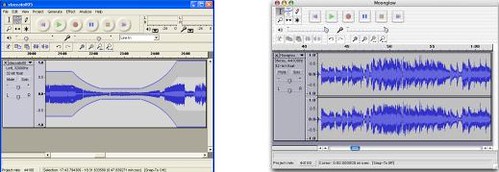
Audacity: Screenshots
DIY music remixing and publishing workshop
This is a free hands-on workshop, for and run by, DIY music enthusiasts. It is an introductory session for those interested in self-recording, producing and publishing their audio, music and podcasts online -- with simple and inexpensive recording and computer equipment.

Participants are encouraged to bring their own laptops and thumbdrives for the session.

The session will cover GarageBand (for Mac users) and Audacity (a free and open source application for PC and Macs). Music samples will be from ccMixter.org and FreeSound.org.

The session is led by Ivan Chew. In his day job, he is the Senior Manager/ Librarian from NLB. Off work, he dabbles in music and arrangement and volunteers at Creative Commons Singapore. Samples of his work, all created and mixed using GarageBand and Audacity, can be found at myrightbrain.wordpress.com/my-discography

This event is organised in conjunction with World Book Day and Copyright Day.

24 April 2010 (Saturday), 2.00pm – 5.00pm, Bukit Merah Public Library, Radin Mas room, Level 3.

In truth, I had apprehensions about organising this session.

Not from lack of confidence or uncertainty about the content itself. I've done podcasting workshops before, where participants -- with zero knowledge and experience -- were able to create usable audio tracks after 3 hours.

I was concerned about the turn out. Will people turn up? Will there be interest in such a workshop?

We shall see.

More details of how I intend to run the workshop:
Objective:
By end of the 3 hours, participants will be able to use an audio editing/ sequencer software and piece together a music track, using free and legal sound samples from the Internet (e.g. ccMixter.org, Freesound.org).

Pre-requisites:
Ideally the participants need to bring their own laptop computers and earphones. Also their computer microphones (optional). Those with Macs should check if they have their preloaded GarageBand software on their computer. For PCs, they may wish to download the Audacity open source software.

Sequence of the session:
1) Welcome of participants.

2) Installation of software (open source freeware) if desired.

3) Introduction to basics of Audacity and GarageBand.

4) First hour: demo of GarageBand (30mins) and Audacity (30mins). Demo covers:
- Importing tracks
- Basics of editing, sequencing, recording.
- Fade-in/ outs
- Sound effects
- Saving/ exporting tracks

5) Next hour - participants will try on their own.

6) Finally, we will showcase some samples produced by participants (if any).

7) Sharing of how one can publish a music album online (free file hosting; copyright considerations; Creative Commons).

8) End of programme.


I've created a Facebook event page. You may wish to sign up at the Facebook event page.

Currently it's still 1 person attending (me!)

Which is rather scary and maybe even embarrassing... but heck, nothing to be embarrassed about. Even if one person turns up, and is an old lady who knows nuts about computers and wish to learn more, I'd be happy to share :)

[Post-event update: Total of eight people showed up. Sweet! Thanks to Arul, Wan, Raman, Ms Tan, Edmund, Lee, Judy, and Linus. You rock!]