Wednesday, May 30, 2007

Post-workshop reflections: Cybersafety/ Writing workshop for 10-year olds

"The title is 'Smarter Blogging' and I thought I was going to learn to blog. But I was wrong. The name should be stated clearly."

That's what a 10-year old boy wrote on the feedback form, for the workshop my colleagues and I conducted today, titled "Smarter Bloggers’ Workshop: Internet adventures of Little Red Riding Hood, her Grandma and the Wolf".

He wasn't wrong. The workshop title could have left the blogging part out, as we didn't really touch on how to blog.

We named it "Smarter bloggers" as it's about how they can be smart and protect themselves should they choose to go online to start blogs and stuff. That being said, I think we'll have to review the workshop title.

MOE Language Arts Festival 2007
A total of 56 students, all 10-year olds, attended -- 30 kids in the morning session; 26 for the afternoon one. Our workshop was just one of the many language and arts related sessions conducted by various parties for the Language Arts Festival 2007, organised by MOE aimed at Primary Three level students from various schools.


How did I get involved in this?
A MOE staff who'd attended the talk I did for the Civil Service College. At first, the proposal was for me to conduct a 90 minutes blogging workshop for 10-year olds. After further discussion, we agreed it was more feasible and more critical to focus on Cyber-safety.

To make the session more interesting, I thought we'd use the Little Red Riding Hood fairy tale to convey Cyber-safety tips. For instance, Red Riding Hood gave away details to the wolf (a stranger) on where she was going, and where her grandma lived... you get the idea.

And to be consistent with the Language and Arts theme, the students would be required to work in groups to write and present their version of a fairy tale that incorporated Cyber-safety concepts.

Although Children Services isn't my forte, I ended up conducting the session since the overall workshop outline was from me, and other Children's Librarians weren't sure how to deliver it. Luckily I had help from two of my librarian colleagues from Children's Services. They helped flesh out the workshop content. One of them volunteered to help assist in the morning session, and I had help from another NLBA colleague to help manage the kids.

Session outline
  1. First we told the Red Riding Hood fairy tale (the "traditional" Grimm Brothers version). Where possible, we had the kids tell parts of the story. This was a suggestion from a Children Services colleague, and it worked wonderfully. My colleague also suggested that we check if the kids knew the "traditional version", as nowadays the fairy tales they read might be modern or heavily modified versions.
  2. Then we introduced four to five Cyber-safety concepts (e.g. "Don't reveal personal information to strangers online", "Do not meet strangers face-to-face alone").
  3. To reinforce the concepts, we told an updated version of Little Red Riding Hood, where she chatted with the Wolf online. Kudos to my colleague, Yasmin M. A., for coming up with the cyber-version. The kids found the story funny and engaging. We ended the story by quoting real-world criminal cases of how some children were victimised by deceitful adults after engaging in online activities.
  4. For the next 20 to 30 minutes, we made the kids work in groups. Their assignment was to write a story that included at least two Cybersafety concepts AND at least two cartoon/ fairy tale characters.
  5. Finally, each group had to present their story, not exceeding five minutes. They could use powerpoint, or draw on paper.

What the kids came up with
  • All of them were able to cite cyber-safety concepts in their presentation. I thought that was clearly demonstrated in their presentations.
  • Shrek and Spongebob Squarepants seemed to be the more popular characters. The generation gap couldn't have been wider! I identified more with "Snow White" and "Three Little Pigs".
  • Then there were the Three Blogging Billy Goats Gruff, who knew karate.
  • One group presented a powerpoint on "How Mr Krabs got cheated"
  • One had Jerry (from Tom and Jerry) and Donald Duck, who were kidnapped by Wicked Mickey Mouse (see the two pictures that follows)
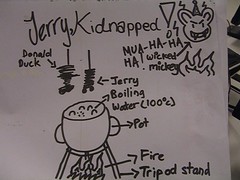
Cyber-safety workshop - Art work
Cyber-safety workshop

Overall effectiveness of the workshop
It would have been better if there was more time. Inevitably, there were kids who were clearly not as participative as we'd like them to be. I don't see it as their fault. The manner in which we tried to engage these few just didn't work out.

What was pleasantly surprising to me was how majority of them threw themselves into the task given. All groups managed to present a story.

Even after my Children's Librarian colleague reviewed the workshop outline and said the kids would be able to grasp what was required of them, I still had some doubts. I mean, these were 10-year olds who had to develop an original story, with a time constraint, and work with some people whom they didn't know. I would have considered the workshop a failure if there was one group that didn't manage to produce any story.

What some kids wrote about the workshop
  • "Workshop was interesting and I liked it"
  • "I will like to a attend more of these courses in future"
  • "Give longer time"
  • "Let us explore freely and extend the time"
  • "Make it more interesting"
  • "It can be more more interesting if we can use all the rules of the cyber safety and do not show powerpoint slide show"
  • "This workshop teaches me many new things that I would like to share with my family and friends"
  • "This workshop is cool"
  • "Very interesting"
  • "The groupwork was pleasant and I enjoyed the activity very much."
  • "This workshop is fun and stimulating. It teaches us online safety"
  • "I hope to go to more workshops like this in the future. It is very interesting and I have learnt about cybersafety"
This is the first time I've ever received written evaluations and comments from 10-year olds. In truth, I was more worried about how they'd feel at the end of the course, than if I were doing a course for adults.

Adult participants might give you a low rating, or they might not. I'd get disappointed but that's part of training. But for kids, I'd always remember what I heard Edwin Thumboo mention in his speech one time: "Teachers don't make mistakes; they leave scars".

Whether it's a 30-minute storytelling session, or 90-minute workshop, or 12 months of school -- the librarian, teacher, adult has a heavy responsibility.

I think most 10-year olds tend to tell it like it is. I hope their opinions about the course was honest. Most indicated in the forms that the workshop was useful.

And at least one 10-year old gave his honest opinion about the workshop -- the one who wrote that he expected a workshop on blogging. He actually indicated, for other questions in the form, that the workshop was useful and enjoyable. I remember him as an active participant during the session.

I also noted how he wrote "I was wrong" (about the workshop) rather than blame the trainer for misrepresenting the workshop title. I guess he's at an age where respect for authority is still high on his list. Good for you, kid.

Hey kid (I think his name was Paul), for what it's worth, if you ever come across this post when you're older, I'd like you to know you have my gratitude for your honest comments. I would have loved to conduct a blogging workshop for 10-year olds like yourself. After today's session, I'm pretty sure how we can offer such a workshop.

So who knows? :)

p.s. Thanks to colleagues Raneetha, Yasmin, Hong Li; Zee May the student helper; and all the 56 kids who turned up today.

Double up your loans (again)

Yes, it's back again. Double-up your loan quota when you borrow items from the NLB libraries from 26 May to 8 July 2007.


More details posted at High Browse Online.

The timing for D.E.A.R. is quite apt, to coincide with the Great Singapore Sale.

Sunday, May 27, 2007

InternetArchive.org is now officially a library

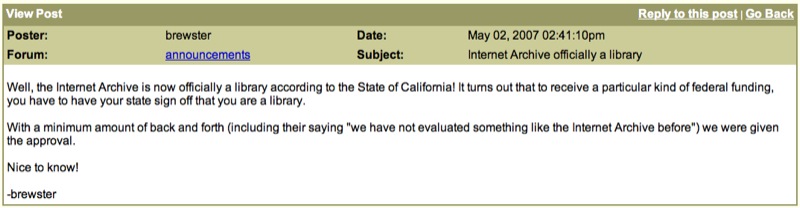
From a post in the Internet Archive (www.archive.org) forum (2 May 2007):
screenshot - Internet Archive is officially a Library
Well, the Internet Archive is now officially a library according to the State of California! It turns out that to receive a particular kind of federal funding, you have to have your state sign off that you are a library.

With a minimum amount of back and forth (including their saying "we have not evaluated something like the Internet Archive before") we were given the approval.

Nice to know!

-brewster

I first heard about Internet Archive back in late '90s. The name "Wayback Machine" was also used interchangeably (I think that later got consolidated as "Internet Archive" when they archived more than just web sites).

More about the Internet Archive here.

BTW, I looked up "library" in my Mac's Oxford American dictionary (Version 1.0.1) and the entry says:
Noun ~ a building or room containing collections of books, periodicals, and sometimes films and recorded music for people to read, borrow, or refer to : a school library | [as adj. ] a library book.

• a collection of books and periodicals held in such a building or room : the Institute houses an outstanding library of 35,000 volumes on the fine arts.

• a collection of films, recorded music, genetic material, etc., organized systematically and kept for research or borrowing : a record library.

• a series of books, recordings, etc., issued by the same company and similar in appearance. • a room in a private house where books are kept.

• (also software library) Computing a collection of programs and software packages made generally available, often loaded and stored on disk for immediate use.

ORIGIN late Middle English : via Old French from Latin libraria ‘bookshop,’ feminine (used as a noun) of librarius ‘relating to books,’ from liber, libr- ‘book.’

I think it's time to update the opening paragraph and add another bullet point, so that the definition includes something like the Internet Archive (where the library and its collections isn't physical in the traditional sense).

Podcast: Home Again (2007)

My brother and I did this. Our first ever music mash-up. It was all unplanned. He'd just come back from a nine-month stint in Hong Kong. He dropped my place to have dinner with my wife and I a few weeks ago. We had time to spare. I showed him how GarageBand works. He did an impromptu recording of a simple "C#m/ A/ E" rhythm. We played back and jammed along (one player at a time). Entirely unrehearsed. Very raw stuff.

Over the last few weeks, I took what we'd recorded earlier (no additional recordings) and did a little GarageBand magic -- edited out the unwanted/ misplayed notes; exercised my amateur-level musical arrangement and sound engineering skills.

This is for you, brother. Welcome home.


powered by ODEO
[Alternate download from Archive.org]

I've uploaded the basic rhythm and drum track, without the melody, here (3.1MB). Will post a tutorial on how the song went from the basic track to the finished one, later. [UPDATE 9 June 1007: Posted the "How it was done" at MyRightBrain]


RamblingLibrarian's Podcasts:
My Odeo Podcast

Technorati Tags: , , ,

Wednesday, May 23, 2007

READ! Singapore is back!

It's here again!
READ! Singapore banner

Oh, there'll be another round of "live" book discussions (see this one from last year). If online book discussions aren't your cup of tea, feel free to join in the face-to-face discussions that will be held at the public libraries (in addition to the regular sessions by the various reading groups/ book clubs).

More details would be posted at readSingapore.nlb.gov.sg

READ! Singapore is one of the key annual events organised by the NLB since 2005. I'll be blogging more about it later (my left and right brains are totally beat right now...)

Sunday, May 20, 2007

Singapore celebrates International Museum Day 2007: May 18th to 27th

International Museum Day 2007 (IMD'07) was launched on Friday, 18 May 2007. The IMD has been celebrated all over the world since 1977.

The National Heritage Board IMD'07 website has more details on the various events across 24 museums, from 18th to 27th May. Basically, through IMD'07, NHB hopes to make heritage and culture more accessible to everybody:
screenshot - International Museum Day 2007.jpg
[www.museums.com.sg/imd07]

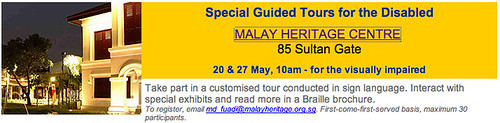
Nice to see at least one museum has organised its events to cater to people with disabilities:
screenshot - Special Guided Tours for the Disabled MALAY HERITAGE CENTRE.jpg

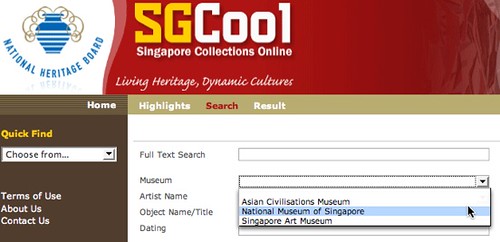
Something new I learned from the IMD'07 website -- Singapore Collections Online:
screenshot - Singapore Collections Online
[www.sgcool.sg]

The search feature only covers objects from the Asian Civilisation Museum, the National Museum of Singapore, and the Singapore Art Musem -- though the homepage of SGcool.sg says, "From time to time, you can view and appreciate the digital collections of other non-NHB museums in SGCOOL. Over time, we will also be releasing more artefact and artwork images from our own collections periodically."
SGcool Search

Walter (aka Cool Insider), who works for NHB, shares more on the various activities for IMD'07.

They even have a twitter page for IMD'07! I believe most Singaporeans aren't aware of Twitter.com, so efforts to publicise events via Twitter would be limited. At least I'm speaking for myself -- I have a Twitter account but am an infrequent reader/ user.

Btw, I used to think there were only four or five museums in Singapore. Did you know there are at 43 museums right now? See the Museum Roundtable website.

Tuesday, May 15, 2007

"RSS in Plain English" from The Common Craft Show

Thanks to Library Stuff Steven Cohen who pointed me to this video titled "RSS in Plain English" by the folks at The Common Craft Show:
There are two types of Internet users, those that use RSS and those that don't. This video is for the people who could save time using RSS, but don't know where to start.

Monday, May 14, 2007

My Library of the Future (for LINT)

[Prelude: Thanks to CW for telling me about this post from LINT, and Peta for inviting me to "get creative for May". I've slightly revised this earlier post, i.e. rewrote the introduction, added section headings, and a part on "Would there be librarians..."]

15 May 2007 update: LINT post here.


My vision of future library spaces was inspired by a video by my non-librarian friend (Kevin). who produced this video of a newly opened "cafe + lounge + bar + business centre + broadcast centre + technogear playhouse" in Singapore called Geek Terminal (GT).

Here's what you'll see in my Library of the Future (the future may be closer than we think):


1) Plug, Power & Play
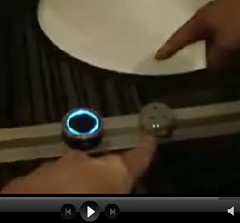
01:20 mins - "You get to have free power," says GT CEO, Chris. But that's not what's cool. Check out the power-track sockets (Brand name 'Eubiq') that gives new meaning to "plug and play". Produced by a Singapore-based company. More reviews about the power-track socket: here, here, here and here.
screenshot: Geek Terminal - Eubiq power socket


2) Coffee, Wine, and Information
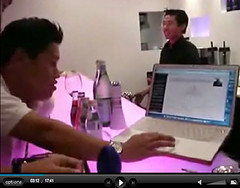
03:10 mins - A bar that serves wine and coffee. While it's not surprising to find coffee joints in libraries nowadays, I've not heard of wine bars... yet. "Books and wine". And the librarian could double-up as the bartender serving up coffee, tea, wine and information! Wine-not? *ouch*
screenshot: Geek Terminal - Bar


3) Furniture that lasts!
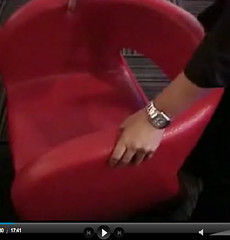
03:35 mins - Custom-made stain-proof chairs. According to the GT CEO, "wine, coffee... nothing can stain this chair". If the chairs offer permanent protection against ink (pen, markers etc) from bored teens, then library will get a few thousands of those, thank you.
screenshot: Geek Terminal - custom stain-proof chairs


4) Multi-function furniture
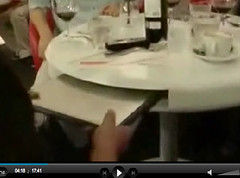
03:45 mins - Well thought-out design for the table. When the food arrives, there's a slot in the table for you to put your laptop away.
screenshot: Geek Terminal - laptop tuck-away


5) Discussion spaces & Noise Dampeners
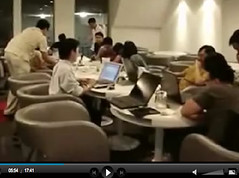
05:50 mins - I took this shot to show that such a scene (of people crowding around computers for discussions) is already happening in some public libraries, especially those with free WIFI. Perhaps to handle the increase in noise levels, the Library of the Future could have Noise Dampeners -- devices installed just above the individual discussion area that cancels out the noise made from a specific location.
screenshot: Geek Terminal - Food & discussion space


6) Real Meet-ups in Virtual Worlds
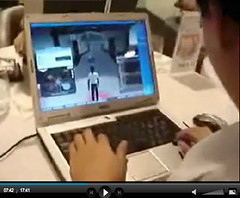
07:40 mins - Here's a shot of a Ping.sg meetup participant moving his avatar in Second Life. In the Library of the Future, interactions in virtual worlds might become part of the library's regular activities, in addition to the "traditional" face-to-face interactions. E.g. book discussions in virtual worlds, with international participants.
screenshot: Geek Terminal - Second Life users


7) Configurable Walls and Spaces
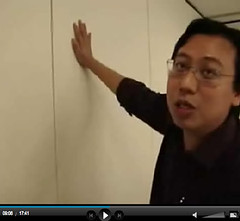
09:00 mins - Chris points out the collapsible wall panels. The Library of the Future would have spaces that are configurable and customisable -- without requiring specialist skills to set them up.
screenshot: Geek Terminal - Collapsable Wall Panels


8) Geek-speak Galore (we hope not!)
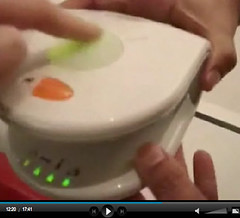
10:00 & 11:35, 12:20 mins - This part's Geek-talk Galore, on servers, load balancers, bandwidth, Industrial routers... "N-series, which is cool," says Chris. Kevin responds, "You mean A-O2-11-N?" Heh.

In the Library of the Future, library professionals won't be expected to go gah-gah over Geek-speak, but I think at the basic level we must be able to hold our own where end-user level of computer is concerned (maybe by then, we'd understand what they are talking about).
screenshot: Geek Terminal - Gadget talk


9) User-sensitive Information Bar
13:00 mins - The bar pulsates with LED lights installed underneath. OK, a little SciFi indulgence here -- maybe the Library of the Future's "Information Bar" has some built in intelligence.
screenshot: Geek Terminal - LED light bar1
As the librarian conducts the reference interview with the customer, the bar would glow according to the customer's satisfaction level. The warmer colours, the closer the search is to the customer's expectations. The cooler the colours, the more the librarian has to try alternative search strategies.
screenshot: Geek Terminal - LED light bar2
Instead of computer screens and keyboards, the bar counter top acts as the display and input device. I'm sure this aspect is already feasible with today's technology.
screenshot: Geek Terminal - LED light bar3


10) Would books have a place in the Library of the Future?
Yes they will have a place, in my version of the future library.

11) Automated retrieval of physical items
Customers would search the library catalogue via WIFI, and place their "order" for the physical book they'd like to read. The books would be automatically retrieved from compact storage areas (hidden away but still within the library premise) and delivered to the customer at their table.

If it's not delivered directly to the table, at the very least the customer would receive an alert (via SMS or IM) that their items have been delivered to the collection point (e.g. the cafe/ book bar).

12) Space, Aesthetics & Use
The Library of the Future would be a place where there's a harmony between space, aesthetics, and use. If libraries can excite all its users, like what Geek Terminal elicits from those folks, then the library's future is assured. : )

13) Would there be librarians in this Library of the Future?
But of course! It's implied in all the required activities and services mentioned above. I've treated it as a given (plus the need to adapt and change the profession in accordance to customer needs).

[Original post here. Kevin's video here.]

Sunday, May 13, 2007

Tips on developing Web 2.0 applications

Preetam shares his insights on Web 2.0 development in Asia, in this interview at Singapore Entrepreneurs.

Here are extracts of the post, which I found quite insightful (it's of interest to me 'cos it's not that far-fetched for libraries to develop their own Web 2.0 applications):
SGE: ... what are the common features that you see in most successful companies in this industry?
Preetam Rai: Ease of use (e.g. YouTube or Flickr can be used by someone with very little technical expertise); ease of sharing (allowing people to plug the video and images on their blogs etc.)

*

Preetam Rai: ... there is no way South East Asia based sites will get the valuation that the US or Chinese services get as we don’t have the user base. And this is particularly true of Singapore. Given that constraint, I think we can develop smaller fun applications - I see some food recommendation sites. I think there is nothing wrong in being a small service as long as you are useful to the community here.

The other thing is to develop services for global/regional audience. I think Singapore has some advantages in building education and travel related services. I like the idea of travel community site Travelfish, a site run by Australians. Singaporeans with so much travel experience should be able to do such content+community site.

*

SGE:
If a young entrepreneur wants to venture into this space, what are the three important lessons that you need him to know?
Preetam Rai:
  • Be close to the end-user community - try to hang out as much as possible with your target audience.
  • Attend low key tech events in India/ China/ Philippines - the best place to network with individual developers or small companies who might be able to take on your development/user experience work.
  • Don’t give up if you see someone else developing a product in the same space as you. More competition means there is someone else who thinks that the idea is worth doing.
Preetam also points out a few social networking sites that he likes. Full interview here.

Saturday, May 12, 2007

Podcast: Sea Biscuit Redux - Tears Came To My Eye (2007)

For some reason, Kevin and Siva decided to revisit my earlier "Sea Biscuit" radio interview. Kevin and cut an excerpt from the original MP3 recording, where I’d said “tears came to my eye”. He emailed me that 2-second clip and wrote in his email, "Download this as a ring-tone!"

Well, that gave me an idedea. I wanted to see if I could make a piece of music out of it. So I downloaded the original radio interview, spliced and diced the track, and here it is:

powered by ODEO
[MP3 file can be downloaded at Archive.org]

Maybe I'll call it this a "Librarian's Book Recommendation with Bells and Whistles". Anyway this sounds much better than the original interview, after editing out my irritating "ums" and "errs".

Also blogged at MyRightBrain.


UPDATED 14 Feb 08: Thanks to Kenneth for reminding me of the RSI interview.